
UK Horse Racing Bet Types: 2026 Betting Markets
 Available in US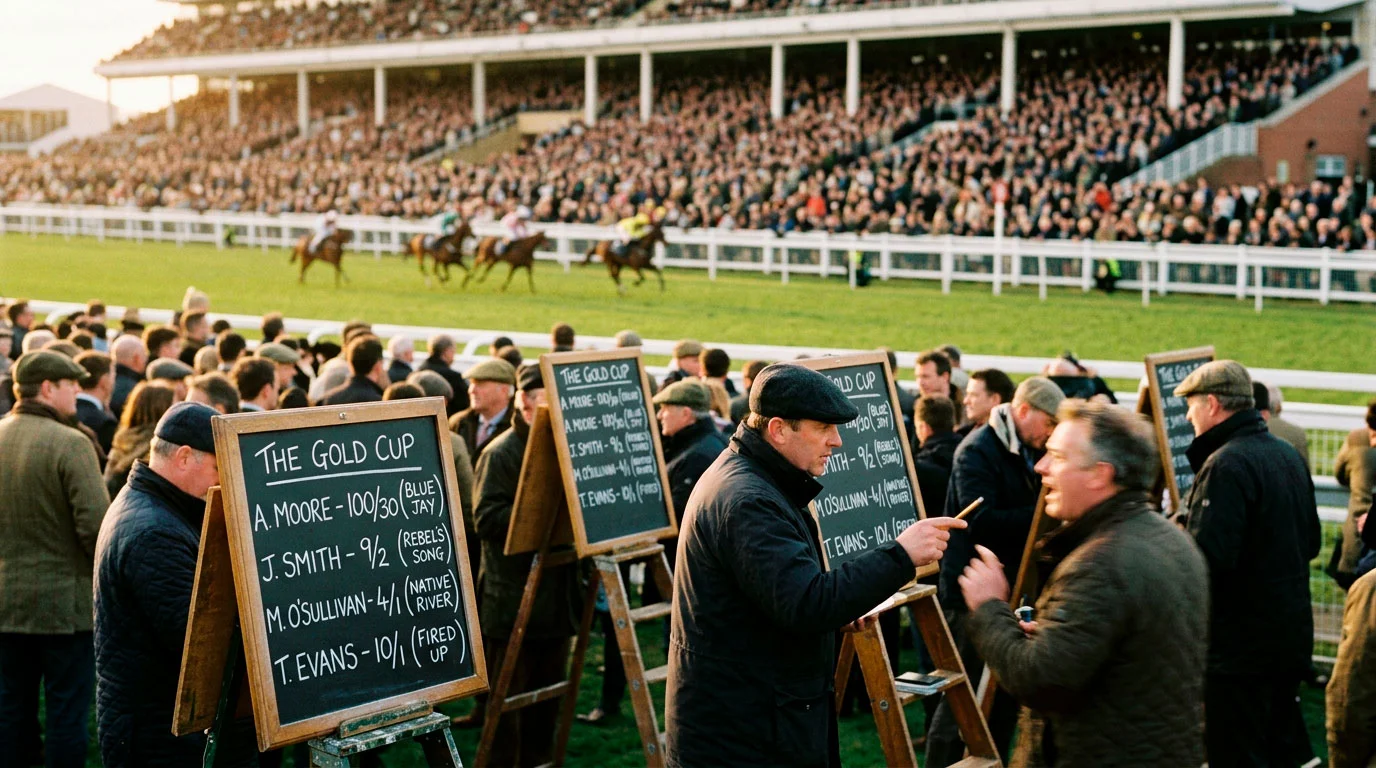
UK Horse Racing Bets: Market Selection and ROI Strategy
The first time I tried to explain a Lucky 15 to an American friend at Royal Ascot, he stared at me like I had just recited a tax form in Welsh. Four singles, six doubles, four trebles, one four-fold, fifteen bets across four horses, with bonus consolations if only one of them obliged. He had been betting on horses in Kentucky for twenty years and had never heard of it. The catalogue of bets you can place on a UK racecard is genuinely peculiar, and most punters fall into using only two or three without ever knowing what they have skipped past.
Types of bets in horse racing means something specific in a British context. The Lucky 15, the Yankee, the Goliath, the Tote Placepot, the each-way fraction at 1/5 of the win odds — these are home-grown formats with no clean American equivalent. Forecast and tricast cover the same finishing-order ground as exacta and trifecta on the other side of the Atlantic, but the maths and the takeout are different.
The market itself is the framing. Remote betting on horse racing produced a gross gambling yield of £766.7 million in the financial year to March 2025, and the wider sport injects around £4.1 billion into the British economy each year while supporting 85,000 jobs. Richard Wayman, the British Horseracing Authority's director of racing, put a damp note on the same period when he told the trade press that total betting turnover had fallen by nine per cent compared with the same period in 2024, a slide he described as concerning. The floor is moving under everyone's feet, including yours.
BHA — the British Horseracing Authority, the regulator and governing body for the sport in Britain. The BHA sets racing rules, handicaps horses, and publishes the quarterly racing reports I will quote from throughout this guide.
Tote — the original British pool betting operator, where every stake on a given pool is combined and the winning bets share the pot minus a takeout. The Tote does not lay you a price; it returns a dividend known only after the race.
I will walk you through every recognisable bet type a UK racecard punter is likely to meet, from the simplest win single up to the 247-bet Goliath, with the Tote pools and bookmaker features that sit alongside them.
What This Guide Tells You Before the Next Off
- Fixed odds bookmakers run roughly 95% of UK horse racing turnover; the Tote pari-mutuel pools run the remaining 5%, and the two formats price the same horse differently.
- Each-way is two equal stakes — one to win, one to place — paid at 1/4 or 1/5 of the win odds across the places the race offers. Place numbers depend on field size and on whether the contest is a handicap.
- Yankee, Lucky 15, Heinz, Super Heinz and Goliath are full-cover bets: every possible combination from doubles upward across your selections, with Lucky variants adding singles and bonuses.
- Placepot, Quadpot, Jackpot and Scoop6 are Tote-only pools with no fixed price; from 1 November 2025, britbet runs the pools on 14 racecourses while UK Tote continues on the rest.
- BOG, NRNB and Rule 4 are the three settlement mechanics that decide what your winning ticket actually pays — none of them are optional reading.
The UK Betting Market in Numbers
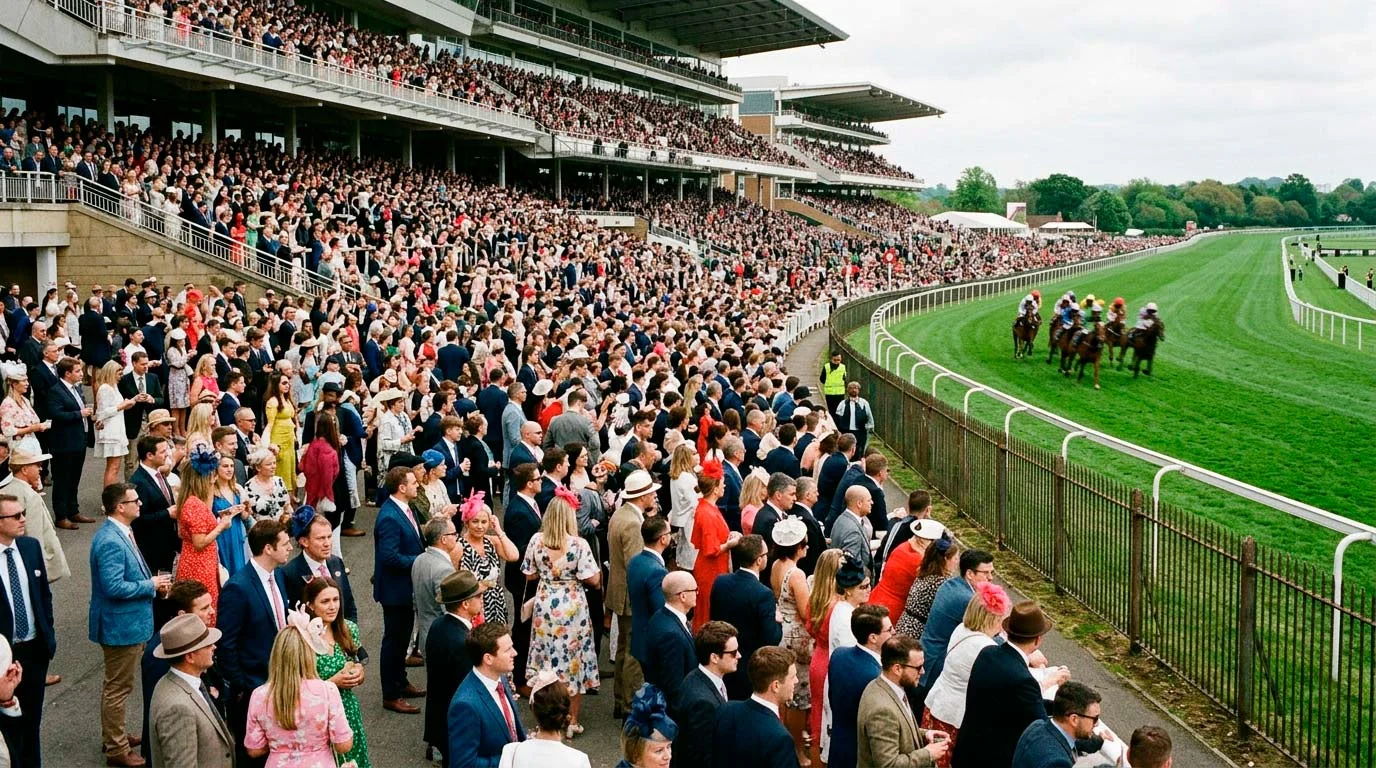
Five million people went racing in Britain in 2025. I had to read that figure twice the first time I saw the BHA Racing Report. Total racecourse attendance hit 5.031 million for the year, the first time since 2019 the headline cleared five million, with under-18 attendance up 17% year on year. On the betting side, the picture is more bruised. Average turnover per race in the third quarter of 2025 was 5.8% down on 2024 and 11.4% below 2023. Five million through the gates, less money through the till — those two facts tell you how British racing is changing, and they shape why some bet types are growing while others are quietly retreating.
£766.7m
Remote betting GGY on UK horse racing, April 2024 to March 2025.
5.031m
Total racecourse attendance in Britain in 2025, up 4.8% year on year.
65.6%
Share of horse racing turnover transacted online.
4-7%
Proportion of UK adults reporting a horse race bet across the Gambling Commission's 2025 GSGB waves.
Gross gambling yield is stakes minus winnings paid out, before operating costs and tax. Turnover is much larger and is what regulators generally quote. The two move together, but not always in step, and 2025 saw turnover sliding harder than yield because winning favourites tilted the maths in the bookmakers' direction at several festivals.
Online dominates, but mobile dominates online. More than 80% of bets placed on the Cheltenham Festival 2024 came from mobile devices, with Flutter Entertainment recording 34.9 million bets across Paddy Power, Betfair and Sky Bet over the four days. Each of the 2.5 million active users placed an average of 14 bets.
Participation rates told a story of seasonal lumpiness in 2025. Wave 1 showed 4% of UK adults having placed a horse race bet in the previous four weeks. Wave 2, capturing Aintree and the Guineas, lifted that to 7%. Wave 3 settled it back to 4%. The Grand National pulls in around 12 million one-off bettors a year — roughly 30% first-timers, and approximately 82% of their stakes are £5 or under.
Alan Delmonte, who runs the Horserace Betting Levy Board, told the trade earlier this year that the Board continued to express caution about sustainability even though levy income had risen for a fourth consecutive period, because of an ongoing fall in betting turnover on British horseracing. Translation: the bookmakers paid in more, but only because margins improved on a smaller pie.
Fixed Odds Versus Pool Betting
Imagine two queues at the racecourse. In one, a chap in a fluorescent jacket chalks 9/2 next to your horse's name and takes your tenner — that price is yours whatever happens. In the other, your tenner disappears into a communal bucket with every other stake on the race. After the race, the operator's cut is removed, what is left is divided by the number of winning tickets, and you find out what you have won. Two completely different transactions, both running at every UK meeting. One of them takes about 95% of the money.
Fixed odds is the dominant format because it sells certainty. You see a price, take it, know your maximum return before the off. The bookmaker — the layer — sets the price using trading judgement, market intelligence and overround. Overround is the bookmaker's mathematical edge: if you add up implied probabilities of every horse priced fairly, the total is 100%; on a typical UK racing market it is 110-130%, and the extra is the margin.
Parimutuel — the French term for pool betting where all stakes on a given market are combined, the operator deducts a takeout, and the remainder is divided among winning tickets. The dividend is unknown until the pool closes.
Pool betting works the other way round. Every Win stake on a race goes into the Tote Win pool. After the race, the Tote removes its takeout — typically 16% to 19% on Win pools, around 25% on bigger combination pools — counts winning units, and the dividend falls out of the arithmetic. If you backed a 33/1 outsider barely supported in the pool, the dividend can hit numbers that would make a fixed-odds trader wince. If you backed a heavily-supported 6/4 favourite, the pool dividend usually undercuts the bookmakers.
| Feature | Fixed odds | Pari-mutuel (Tote pool) |
|---|---|---|
| Price known before race | Yes — locked when bet placed | No — dividend declared after the off |
| Operator's cut | Overround, typically 10-30% | Takeout, around 16-25% |
| Counterparty | The bookmaker as layer | Other punters in the same pool |
| Best on favourites | Usually competitive | Usually undercuts SP |
| Best on longshots | Capped by bookmaker price | Can pay multiples of SP |
| UK market share | ~95% of turnover | ~5% of turnover |
The 95-to-5 ratio understates the Tote's importance on certain days. World Pool, the international liquidity arrangement run with the Hong Kong Jockey Club, pulled $605 million of turnover across 17 race days in the UK and Ireland in 2022, up 44% on the year before. Royal Ascot, the Derby and Champions Day sit inside that calendar, and on those days the Tote pools fill with money from Hong Kong, France, Australia and beyond.
The deeper mechanics of pool maths, takeout rates and the britbet split that has carved the UK Tote landscape in two as of November 2025 belong in tote pool betting in UK racing. The strategic framing: pools are the format you reach for when you want a dividend that reflects what the public did not back. Fixed odds is everything else.
Straight Bets: Win, Place and Each-Way
Eighty-two percent of bets on the Grand National are £5 or less. Around 12 million people place one. Roughly a third are first-timers. The overwhelming majority of those bets are a win single or an each-way. Not a Yankee, not a Scoop6. The straight bets are the foundation of UK racing not because they are the cleverest options on the menu, but because they are the only ones most people ever touch.
A Win bet does what it says. Your horse must finish first. A Place bet pays out if your horse finishes inside the official place positions for that race; UK bookmakers typically restrict standalone Place markets to races with eight or more declared runners, and the price is considerably shorter than Win. You are buying a wider safety net at a slimmer return.
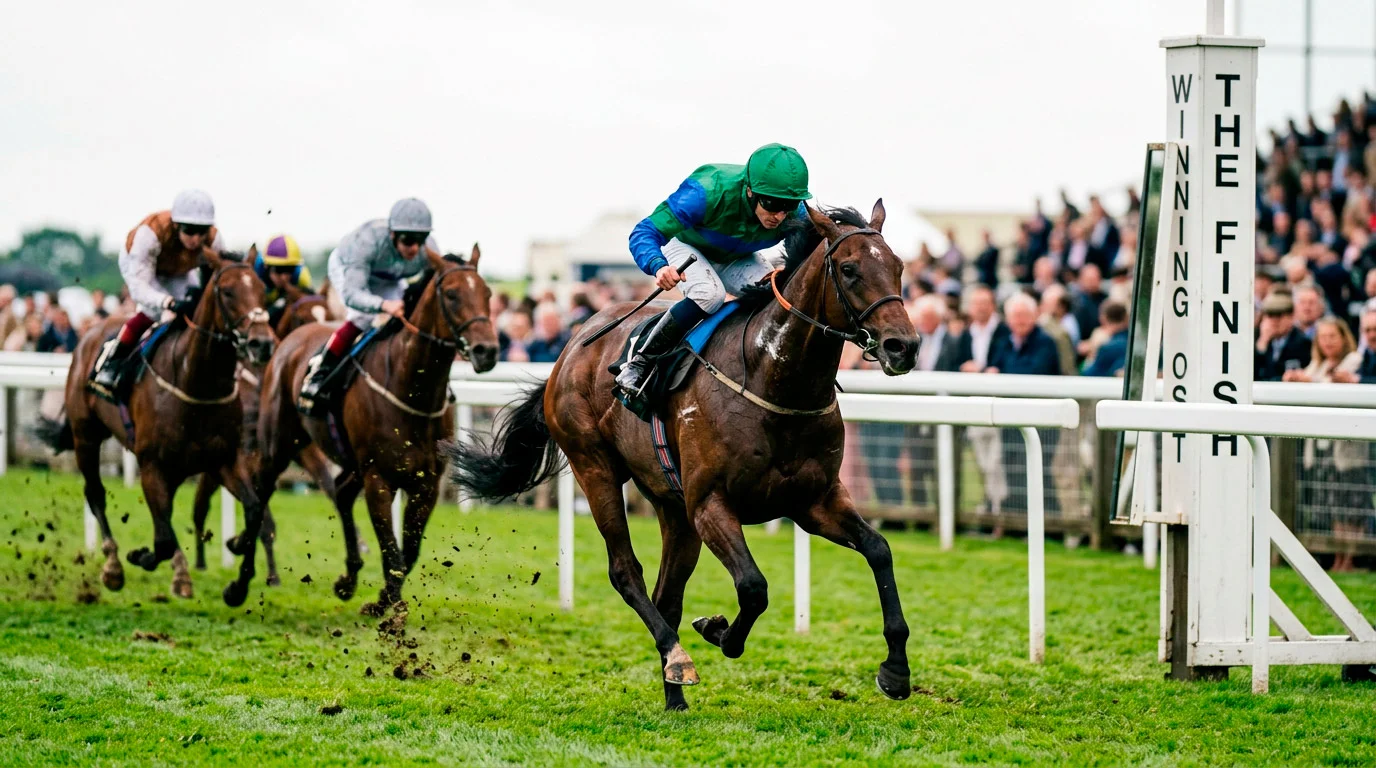
Each-way is two equal stakes bundled together. Half on the horse to win, half on it to place. A £10 each-way bet costs £20. The place portion pays at a fraction of the win odds — usually 1/4 in handicaps with 16 or more runners, 1/5 in most races of 8 to 15 runners — across however many places the race offers.
Each-way £5 at 8/1, 1/5 odds, 3 places
Total stake: £10. Horse wins. Win leg: £5 × 8 + £5 = £45. Place leg: £5 × (8/5) + £5 = £13. Total return: £58.
Horse finishes second or third. Win leg loses. Place leg pays £13. Net profit: £3.
Horse finishes fourth or worse. Total loss: £10.
| Number of runners | Race type | Places paid | Standard fraction |
|---|---|---|---|
| 1 to 4 | Any | Win only — no each-way | — |
| 5 to 7 | Any | 2 places | 1/4 of win odds |
| 8+ | Non-handicap | 3 places | 1/5 of win odds |
| 8 to 11 | Handicap | 3 places | 1/5 of win odds |
| 12 to 15 | Handicap | 3 places | 1/4 of win odds |
| 16+ | Handicap | 4 places | 1/4 of win odds |
Each-way betting on the Cheltenham Festival 2024 was up 25% on the year before. Not coincidence. Festival handicaps run to 20-plus runners, and at a 24-runner handicap paying four places at 1/4 odds, the maths get interesting in a way they never do at a five-horse Wolverhampton flat race. Extra-place offers stretch this further, with Grand National 2025 seeing several layers offering seven places — a generosity that turned the day costly for the bookmakers when I Am Maximus came home in front. One trading boss called the result one of his firm's worst possible scenarios.
Place terms are the single biggest lever a bookmaker uses to shape racing margin on big-field handicaps. Win prices are usually competitive across firms; place fractions and the number of places are not. On a 24-runner handicap, the difference between four places at 1/4 and five places at 1/4 on the same horse can be the difference between a winning bet and a losing one.
The full detail of place terms, dead heats and the small print some operators bury about graded company belongs in the each-way bet in UK horse racing. The rule that does the heavy lifting: more runners and handicap company mean more places, and more places mean the each-way bet is doing more work for you.
Multiples: Doubles, Trebles and Accumulators
Here is the question that decides almost every multiple I have ever placed. How many horses do I want to be right about, all on the same afternoon? Two? A double. Three? A treble. Seven? You are looking at the ITV 7 acca and you had better have a plan for the third leg, because that is where every accumulator I have known has come unstuck. Multiples are not really bets on horses. They are bets on a sequence of correct outcomes, and the maths of compounding makes them simultaneously alluring and brutal.
A double is two selections combined into one bet. Both must win. The returns from the first leg roll onto the second as stake. A treble is the same idea with three selections, a four-fold with four, and from there you are in the country of weekend accumulators.
| Bet | Selections | Number of bets | Required winners |
|---|---|---|---|
| Double | 2 | 1 | 2 of 2 |
| Treble | 3 | 1 | 3 of 3 |
| Four-fold accumulator | 4 | 1 | 4 of 4 |
| Five-fold accumulator | 5 | 1 | 5 of 5 |
| ITV 7-fold | 7 | 1 | 7 of 7 |
The compounding is what people misjudge. Three horses at evens combined into a treble do not return triple the money. They return eight times your stake. Three horses at 3/1 each return 64 times your stake. Three horses at 5/1 each return 216 times. The bet looks irresistible on paper. The problem is the probability. Three legs at 20% — a fair 4/1 shot — give you a 0.8% chance of landing the lot.
Treble £10 across 3/1, 5/2, 4/1
Stake: £10. Leg 1 settles: £10 × 3 + £10 = £40 onto leg 2.
Leg 2 settles: £40 × 2.5 + £40 = £140 onto leg 3.
Leg 3 settles: £140 × 4 + £140 = £700.
One losing leg and you collect nothing.
The accumulator culture in the UK is heavily tied to ITV Racing's Saturday coverage. The ITV 7, a seven-fold across the channel's televised races, runs every Saturday and gets thousands of small-stake punters lumping a pound or two in hope of a five-figure return. Most weeks the bet falls at the third or fourth race. Over 80% of bets at the Cheltenham Festival 2024 came from mobile devices, and a healthy slice are accumulators built in the bet-builder pre-loaded with that day's programme.
The temptation to add one more leg is the cardinal accumulator mistake. Each leg increases the headline payout impressively and reduces your probability disproportionately. If your four-fold has a 5% chance of landing, adding a fifth leg at 4/1 cuts that to roughly 1%. Expected value almost always falls because the bookmaker's overround compounds across every leg.
The straight multiple ends here. When you start asking what happens if only two of your four horses win, you have moved into full-cover territory. Full-cover bets pay out on partial winners by combining every possible multiple between your selections. That is a different bet family with very different economics, and it is the subject of the next section.
Full-Cover Bets: Yankee, Lucky 15 and the Family
The Goliath is 247 bets on eight horses for a £1 unit stake. That is £247 down before a single hoof has touched a furlong marker. I have seen experienced punters reach for the Goliath on a Saturday afternoon and not realise until the bet slip comes back exactly what they had committed to. Full-cover bets are the most quintessentially British category in this guide, and the one that does the most damage to the wallet of the punter who does not understand what he is doing.
A full-cover bet is a package of every possible multiple between your selections, from doubles upward. Pick four horses and a Yankee covers all six doubles, all four trebles and the four-fold — 11 bets. Pick eight and a Goliath covers 247. The Lucky variants — Lucky 15, Lucky 31, Lucky 63 — add singles, so a Lucky 15 on four horses is 4 singles + 6 doubles + 4 trebles + 1 four-fold. Patent does the same on three selections.
| Bet name | Selections | Bets per £1 unit | Total stake at £1 | Includes singles? | Min winners for return |
|---|---|---|---|---|---|
| Patent | 3 | 7 | £7 | Yes | 1 |
| Trixie | 3 | 4 | £4 | No | 2 |
| Yankee | 4 | 11 | £11 | No | 2 |
| Lucky 15 | 4 | 15 | £15 | Yes | 1 |
| Canadian / Super Yankee | 5 | 26 | £26 | No | 2 |
| Lucky 31 | 5 | 31 | £31 | Yes | 1 |
| Heinz | 6 | 57 | £57 | No | 2 |
| Lucky 63 | 6 | 63 | £63 | Yes | 1 |
| Super Heinz | 7 | 120 | £120 | No | 2 |
| Goliath | 8 | 247 | £247 | No | 2 |
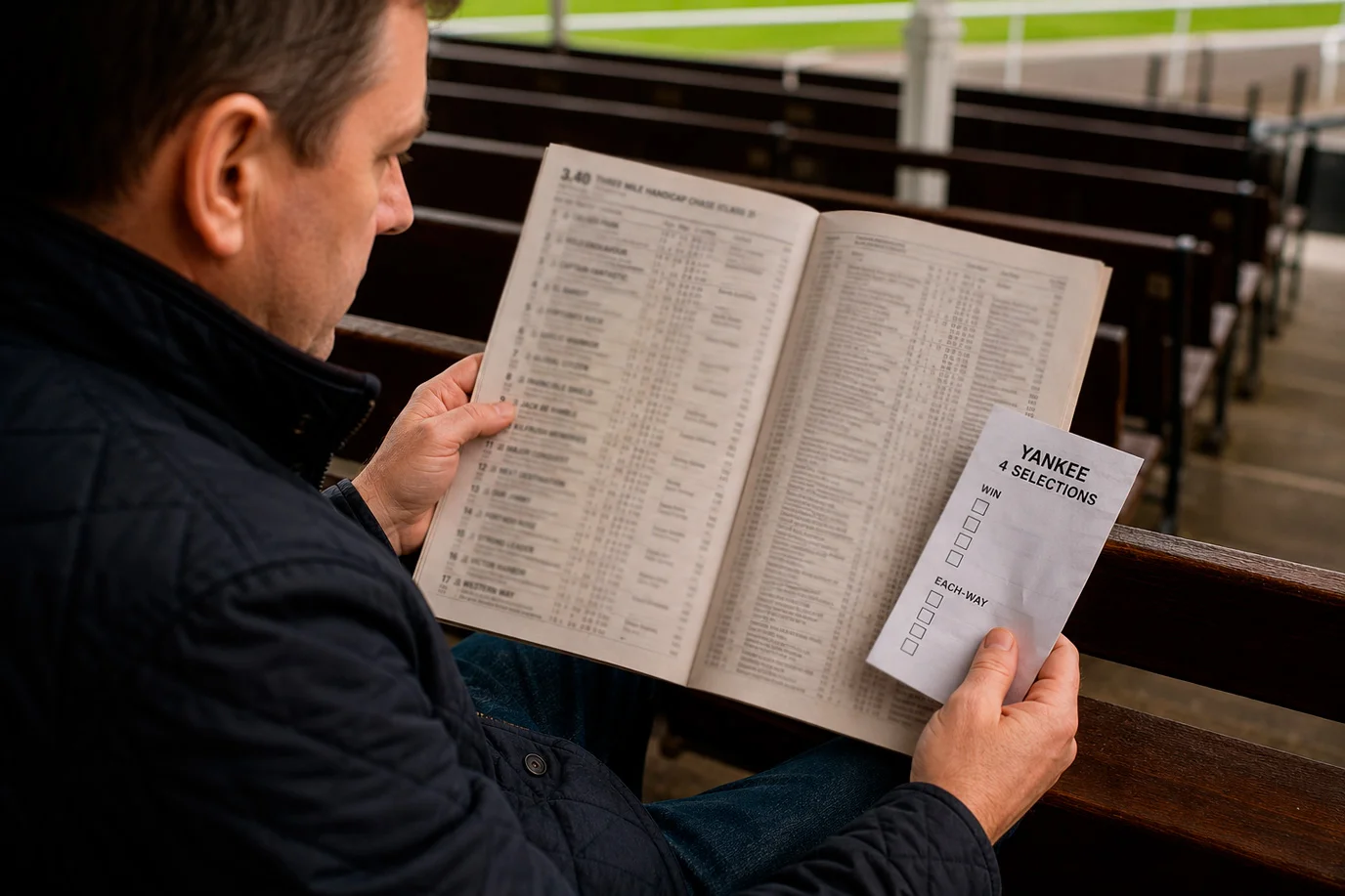
The point of a full-cover bet is that partial winners still return money. A Yankee on four horses where only two oblige still pays the double between them. You stake more upfront in exchange for the comfort that a couple of correct picks salvage something.
Flutter Entertainment registered 34.9 million individual bets through Paddy Power, Betfair and Sky Bet over the four days of the 2024 Cheltenham Festival. A meaningful chunk were Lucky 15s and Yankees, because festival meetings are where the full-cover format earns its keep.
The Lucky bonuses are the reason punters pick Lucky 15 over Yankee. Most UK bookmakers add a bonus on top of a winning Lucky 15: double the odds if only one of your four singles wins, and a treble-odds bonus if all four singles win. A few firms substitute a 10% bonus on the total return. Yankee has no such bonus. Those bonuses are the marketing hook that has made the Lucky 15 a fixture of UK Saturday afternoons since the 1980s.
Where the format goes wrong for the casual punter is at the Goliath end. Eight selections at average prices of 4/1 give you mathematically infinitesimal odds of landing the lot, and even partial returns require multiple winners. The Goliath is a bet for people who want their Saturday to be exciting until the third race, when most are out. A Yankee on four well-considered selections at fair prices is the most defensible bet in the family. A Lucky 15 with the bonus is its more marketable cousin.
The deep maths — bet-by-bet payouts at every combination of winning legs, bookmaker bonus structures, ROI analysis across festival weeks — sits in multiple bets in UK horse racing.
FurlongStake · Proprietary Tool
The Cover Test
A Yankee is eleven bets. The question nobody's bet slip answers is how many of your four horses have to oblige before that outlay comes back — and how often that actually happens at the price you took.
4 horses at 4/1, £1 unit. The Yankee turns a profit from 2 winners — an 18.1% shot on market-implied chances. The Lucky 15 asks £4.00 more for the same break-even point, and is the only structure here carrying a bookmaker bonus. The Four-fold needs all 4: 0.16%.
Singles × 4
4 bets- 1 winner£5.00
- 2 winners£10.00
- 3 winners£15.00
- 4 winners£20.00
Yankee
11 bets- 1 winner£0.00
- 2 winners£25.00
- 3 winners£200.00
- 4 winners£1,275.00
Lucky 15
15 bets- 1 winner£9.00
- 2 winners£35.00
- 3 winners£215.00
- 4 winners£1,424.50
Four-fold
1 bet- 1 winner£0.00
- 2 winners£0.00
- 3 winners£0.00
- 4 winners£625.00
Returns are gross of stake and assume every selection is taken at the same price — that is what makes the four structures comparable like for like. Break-even chance is binomial, using the market-implied probability of the price shown (1 ÷ decimal odds), so it already carries the bookmaker's overround and is, if anything, generous. Bonus rules vary by operator; some substitute a flat 10% on the total. Nothing here is a prediction of a race result. 18+, please bet responsibly.
Exotic Single-Race Bets: Forecast and Tricast
The first time a punter from New York asked me the difference between an exacta and a forecast, I had to think for longer than I should have. The bet is essentially the same; the names and the maths around them are not. Forecast and tricast are the British names for picking the first two and the first three home in correct order within a single race, and they are the only UK bet types where the bookmaker's pricing depends on a formula rather than a quoted market.
CSF — Computer Straight Forecast, the most common forecast format in UK racing. The dividend is calculated by a formula based on the SP of the first two horses home, the field size and favouritism, rather than priced individually.
Tricast — a UK exotic bet on the first three home in correct order within a single race. Tricasts are typically only offered on handicaps with eight or more declared runners.
A Straight Forecast is a stake on two named horses to finish first and second in correct order. A Reverse Forecast is two stakes — one each way round — so it pays whichever wins, as long as the other finishes second. A Combination Forecast lets you nominate three or more horses and covers every possible first-and-second pairing. The CSF dividend is calculated after the race using starting prices, runners and market rank, which means a 14/1 shot beating a 25/1 shot returns more than a short-priced favourite beating a 33/1 outsider.
CSF on a 5-runner field
Stake: £2 Straight Forecast on Horse A to beat Horse B.
Horse A wins at 7/2 SP. Horse B finishes second at 9/2 SP.
CSF dividend declared: £18.20 to a £1 stake. Return on £2 stake: £36.40.
Tricast applies the same formula principle to the first three home. Tricasts are restricted to handicaps with eight or more runners because tricasts on smaller fields would be too predictable. A Combination Tricast covers every order among a nominated set; six selections gives you 120 individual tricast bets.
Forecasts and tricasts are bets I reach for sparingly. The CSF formula is opaque, the bookmaker's edge on the average tricast is healthy, and the bet rewards punters who can identify a specific finishing shape rather than a single likely winner. The full mechanics of CSF maths and Reverse Forecast cost-versus-coverage sit in the forecast and tricast in UK racing companion piece.
Tote Pools: Placepot, Quadpot, Scoop6
Ask anyone who has been racing for thirty years what the most satisfying bet in the UK is, and a decent percentage will tell you the Placepot. You pick a horse to place in each of the first six races on a single afternoon, pay your pound, and get a dividend that depends on how few other people managed the same trick. I have collected Placepots in three figures off a £2 stake on quiet Wednesday cards. The Tote pools reward patience and punish complacency.
The Placepot runs at every UK meeting. You select one or more horses to place in each of the first six races. Place follows each-way rules. If at least one of your selections places in every race, your ticket lives. After the sixth race, the pool is divided among surviving units. If nobody survives, the pool rolls over.
The four Tote pool families at a glance.
Placepot: Place in each of the first 6 races. Stakes from 10p per line.
Quadpot: Place in races 3 through 6. Smaller pool, easier to land.
Jackpot: Win selection in each of 6 specified races. Single meeting. Massive carryovers when not won.
Scoop6: Win selection in 6 specified Saturday races across multiple meetings. Separate Win Fund and Place Fund.
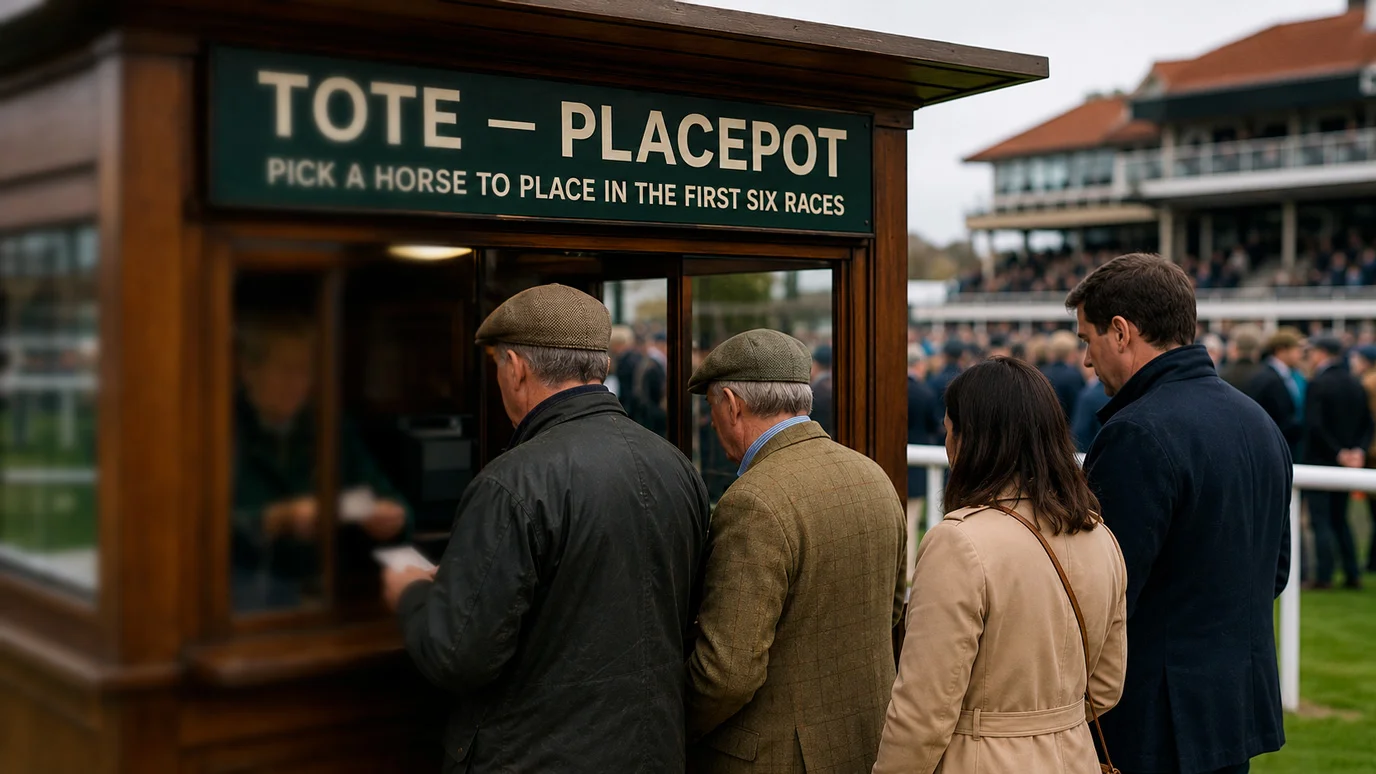
The Tote Jackpot is the Placepot's win-only sibling — six races at a single meeting, all of which your horse must win. Jackpot pools are smaller most days because the bet is much harder to land, but carryovers that build up over a week of empty pools can grow into life-changing sums. Scoop6 takes the same principle and stretches it across six Saturday races, usually drawn from different meetings.
The takeout on the bigger combination pools is around 25%, which sounds steep until you remember that on a longshot dividend you would never get from a bookmaker, that 25% is comfortably the smaller cost. A Placepot with three 7/1 shots, a 5/1 winner and two slightly fancied selections can pay £400 or more for a £2 stake when the public misses the same combination.
From 1 November 2025, britbet took over as licensed pool operator for the Arena Racing Company racecourses plus Hexham, Newton Abbot and Ripon — 14 tracks in total. The UK Tote continues at the other 45 British racecourses. The two run separate accounts and separate dividend pools, which means a Placepot taken on a britbet day is a different transaction from one on a UK Tote day, and the dividend reflects only the money in the pool you entered.
The britbet split matters more for regular Tote punters than for casual ones. If you only play Placepot at Cheltenham and Aintree, the change is invisible because both run on UK Tote courses. The deeper detail of pool maths, takeout rates, World Pool international liquidity and carryover history sits in tote pool betting in UK racing.
BOG, NRNB and Cash Out: Features That Move the Maths
You back a horse at 5/1 in the morning. By the time the race goes off, the same horse is 7/1 SP. Without Best Odds Guaranteed, your bet settles at 5/1. With BOG, the bookmaker pays at 7/1. A small mechanic, a meaningful difference. The settlement features bolted onto UK fixed-odds racing — BOG, NRNB, Rule 4, Cash Out, the SP variants — decide what your winning ticket actually pays, and they are the part of the game most casual punters never bother to learn.
Best Odds Guaranteed settles your winning bet at the bigger of your taken price or the official SP. It applies on UK and Irish horse racing at most major bookmakers, usually with a cut-off some hours before the race. Non-Runner No Bet kicks in on ante-post markets when a horse is withdrawn from the race. Without NRNB, an ante-post stake on a non-runner is lost. With NRNB, the stake is refunded.
Rule 4 is the other end of the same conversation. When a horse is withdrawn after the market has formed but the race goes ahead, bookmakers apply a Rule 4 deduction to remaining winning bets, scaled to the SP of the withdrawn horse. The Tattersalls scale starts at 5p in the pound for a withdrawn 9/2-or-longer shot and climbs as the horse gets shorter — a withdrawn 4/6 favourite triggers a deduction of around 55p in the pound. Rule 4 is not negotiable. It is built into the settlement maths.
Before you place a horse racing bet, run this check
- Place terms — how many places, what fraction, and is there an extra-place promotion?
- BOG window — does Best Odds Guaranteed apply, or is the cut-off already past?
- Non-Runner No Bet — if ante-post, has NRNB been triggered?
- Cash Out availability — is it offered, and at what minimum return?
Cash Out is the in-running feature that lets you settle a bet before the result is known, at a price the bookmaker calculates from the live market. The offered figure is almost always less than fair mathematical value because the bookmaker is taking a spread. Cash Out is useful when locking in a return clearly beats letting the bet run; it is terrible when used to soothe nerves on a winning bet that still has a fence to jump.
Yes
- Take BOG-eligible prices when they look fair, not just the earliest you see.
- Read the NRNB terms before an ante-post bet, because the trigger date matters.
- Use Cash Out when the offer comfortably beats fair value, not as a habit.
- Account for Rule 4 in your expected return on any race with a doubtful runner.
No
- Assume BOG applies everywhere — handicaps and certain operators carry exclusions.
- Confuse NRNB with Rule 4. NRNB refunds the stake; Rule 4 cuts the winnings.
- Cash out on every winning leg of an accumulator. The maths is not on your side.
- Ignore SP variants like SP+ or industry SP, because they can differ materially.
The full breakdown — operator-by-operator BOG cut-offs, NRNB trigger dates, the Tattersalls Rule 4 scale, and Cash Out's fair-value calculation — sits in UK bookmaker features for horse racing.
Tax, Levy and the 2025-26 Regulatory Backdrop
One question I get asked at almost every racing dinner, by someone who has never opened a betting account in their life: do I pay tax on my winnings? In the United Kingdom, no. The 15% remote betting duty is paid by the bookmaker on its gross gambling yield, not by you on collected returns. That is the foundational tax fact, and the regulatory backdrop of 2025-26 is reshaping around it in ways that affect which bets remain economically sensible.
The Horserace Betting Levy Board collected £108.9 million in the financial year to March 2025, the highest figure since 2017. Most of that money flows back into the sport. The Levy is calibrated to bookmaker gross profits on UK horse racing rather than to turnover, and it rose because trading margins were strong around the Cheltenham Festival, not because turnover grew. The two have been moving in opposite directions for three years.
The Autumn Budget of November 2025 was the defining regulatory event. The Treasury kept the remote betting duty on horse racing at 15%, raised the Remote Gaming Duty — covering online casino, not racing — from 21% to 40% from April 2026, and lifted general betting duty on non-racing sports from 15% to 25% from April 2027. Racing was, in narrow terms, the protected category.
Why the exemption matters for bet selection. If your habits include football, golf and tennis alongside racing, the April 2027 hike to 25% on general betting duty means non-racing margins will tighten. Bookmakers will pass the increase through in worse prices, narrower promotions, or both. Racing continues on 15%. Expect the gap between racing and non-racing pricing at the same operator to widen over the next two years.
Not everyone in the industry called the racing exemption a win. Grainne Hurst, who runs the Betting and Gaming Council, said racing had seemingly been protected from higher betting duties, that it sounded like a win, but that anyone who understood how the sector operated knew that was not true. She called the exemption cosmetic and said the Budget delivered a devastating blow to the ecosystem racing relied on, because gaming duty rises would push casino activity offshore. EY modelling suggested the Remote Gaming Duty rise alone could cost almost 15,000 jobs and shift more than £4 billion of stakes to unlicensed operators.
Affordability checks are the other regulatory thread pulling at every bet type. The Gambling Commission threshold for enhanced financial checks fell from £500 of monthly deposits to £150 in February 2025. Any punter approaching that figure can expect to be asked for evidence of disposable income. One in three respondents to the Racing Post's 2025 Big Punting Survey who staked £1,000 or more per transaction reported using an unregulated site in the previous twelve months.
The combined effect on bet selection is real even when it is not obvious. Affordability checks make the £200 Yankee a different transaction from what it was three years ago. The gaming duty rise will narrow promotional offers because bookmakers will be cross-subsidising less from their casino books. Racing has kept its existing duty rate, but the ecosystem the duty sits inside is shifting.
How to Choose the Right Bet for the Race
A 21-runner handicap at Aintree on Grand National day is not the same race, in betting terms, as a five-runner novice chase at Plumpton on a wet Tuesday. The size of the field, the race type, the depth of the place market — all of it changes. What does not change is the depressing regularity with which I see punters reach for the same bet type whatever is in front of them. Picking the right bet for the race is the highest-leverage decision in the entire transaction.
The framework I have used in nine years of this is field size first, race type second, confidence in the favourite third.
Yes
- On 4 to 7 runners, take a win single. Each-way pays only two places, and the fraction kills the value.
- On 8 to 15 runners, use each-way 1/5 where you fancy a price horse to be in the frame.
- On 16+ runners in a handicap, each-way 1/4 across four places is the strongest straight-bet option.
- Build a Yankee when you have four genuine fancies at competitive prices on a single afternoon.
- Use the Placepot when you want a single £2 bet to engage you across six races.
No
- Place each-way on a five-runner race in the hope of a place — the maths is against you.
- Build a Goliath as a value bet. It is entertainment, not investment.
- Combine seven horses in a straight accumulator without a real fancy in every one.
- Reach for the Tote pool on the favourite — dividends almost always undercut SP.
- Place an ante-post bet shorter than 5/1 without NRNB triggered.
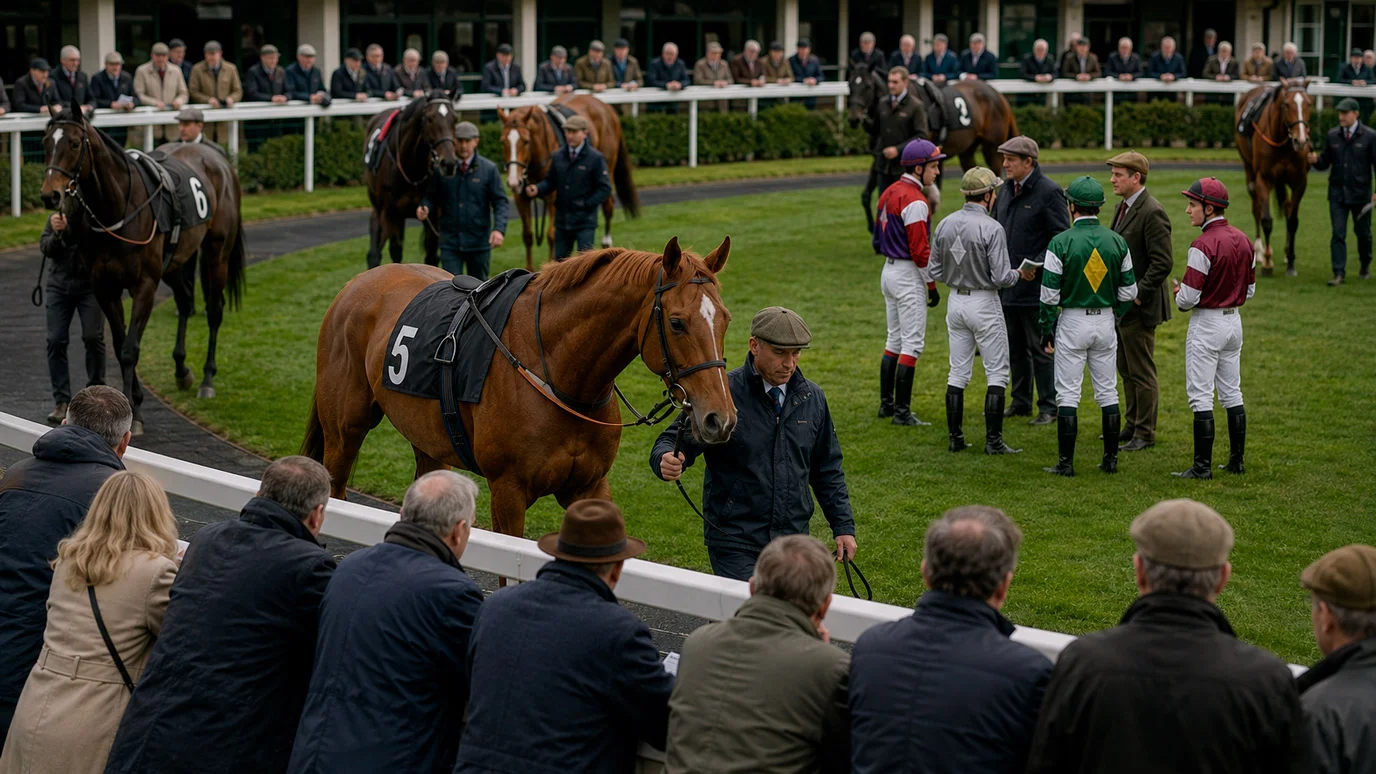
Field size is the easiest input because it is on the racecard. The average field on Flat racing in 2025 fell to 8.90 from 9.14 the year before. Over Jumps it dropped to 7.84 from 8.49. Premier Fixtures bucked the trend, with average fields of 11.02 on the Flat and 9.41 over Jumps. The each-way bet is doing more work for you at Premier Fixtures than at Core Fixtures.
Race type changes the variance profile. A handicap is the natural home of the each-way and most full-cover multiples. A conditions race — Group 1, listed, or graded chase — has shorter prices, smaller fields, and rewards win singles. A maiden is where I personally back away from anything more complex than a small win bet, because the form book is full of holes.
Did you know? The Grand National was first run in 1839. The straight win bet has always been the default. The each-way became standard in the late nineteenth century. The Placepot, by contrast, is a modern invention from the 1990s.
Confidence in the favourite is the most underrated of the three inputs. Strong fancy on the jolly, win single. Favourite vulnerable but a couple of price horses dangerous, each-way. Favourite so vulnerable that several horses can win, a Trixie or Yankee on three or four candidates. No view, the right bet is usually no bet at all.
Grainne Hurst at the BGC once described the Grand National as one of the precious few sporting events with the ability to unite the entire nation around a single spectacle. The same race illustrates the universal punter's instinct: 30% of those who bet on it are first-timers or returning after years away, and 82% of the bets are £5 or less. The framework above is not for them. It is for the people who want to know whether the right bet at the Hurst Park 3.05 is the Yankee or the Lucky 15. Choose the bet for the race. Most punters never do, and the bookmakers price accordingly.
Frequently Asked Questions
What is an each-way bet in horse racing?
An each-way bet is two equal-sized stakes combined into one transaction. Half goes on your horse to win at full odds. The other half goes on your horse to place at a fraction of the win odds — typically 1/4 in handicaps with 16 or more runners and 1/5 in races of 8 to 15 runners — across however many place positions the race offers. A £10 each-way bet costs £20. If the horse wins, both halves pay. If it places, only the place leg pays. If it loses, both halves lose.
How many places does each-way pay in UK horse racing?
The standard schedule is one place on races with up to four runners (each-way unavailable), two places at 1/4 on five to seven runners, three places at 1/5 on non-handicap races with eight or more runners, three places at 1/5 on handicaps of 8 to 11 runners, three places at 1/4 on handicaps of 12 to 15 runners, and four places at 1/4 on handicaps with 16 or more runners. Bookmakers extend this with extra-place promotions on big race days. The Grand National in 2025 saw several operators offering seven places at 1/4 odds.
What is the difference between fixed odds and Tote betting?
Fixed odds bookmakers offer a price that is locked at the moment you place the bet. Tote betting is pool betting — every stake on a given pool is combined, the operator takes its cut, and the remainder is divided among winning tickets. You do not know the Tote dividend until after the race. Fixed odds takes roughly 95% of UK horse racing turnover; the Tote takes the remaining 5%. Tote pools usually pay more than starting price on longshots and less than SP on heavily backed favourites.
Are horse racing winnings taxed for UK punters?
No. The end punter pays no betting duty on winnings from any form of horse racing bet in the United Kingdom. Win, each-way, accumulator, Yankee, Tote dividend — all are paid out in full. The 15% remote betting duty is paid by the licensed bookmaker on its gross gambling yield, not by the customer on collected returns. The Autumn Budget of November 2025 kept the racing duty at 15% while raising other gaming and sports betting duties from April 2026 and April 2027.
What does Best Odds Guaranteed mean?
Best Odds Guaranteed, usually written BOG, settles your winning bet at the bigger of your taken price or the official starting price. Back at 5/1 in the morning, return at SP of 7/1, BOG pays at 7/1. Back at 5/1, return at 4/1 SP, you keep the 5/1. BOG applies on UK and Irish horse racing at most major bookmakers with a cut-off time before the race, often 8am or 9am on the morning of the race. Handicap exclusions apply at some operators.
What is a Placepot and how does it work?
The Placepot is a Tote pool bet requiring you to pick at least one horse to place in each of the first six races at a single UK meeting. Stakes start at 10p per line. If at least one of your selections places in every one of the six races, your ticket survives to the dividend. The Placepot pool is divided among surviving units after the sixth race. If nobody survives all six, the pool rolls over. Place positions follow each-way rules for the race.
Do I need a separate account to bet through the Tote or britbet?
Yes, in practice. From 1 November 2025, britbet operates pools on 14 British racecourses — the Arena Racing Company tracks plus Hexham, Newton Abbot and Ripon — while UK Tote continues on the other 45 racecourses. Most major bookmakers integrate Tote pool betting into their racing platforms so you can place a Placepot from a single account, but the specific operator running the pool depends on the racecourse you are betting into.
Choosing Your Next Read on UK Racing Betting
A guide to the structure of a market is not the same thing as a guide to playing it well. What I have tried to do here is hand you the map. The geography of UK racing bets — the fixed-odds heartland, the Tote pool islands, the full-cover archipelago, the regulatory weather pushing in — is the territory every punter operates in, whether they realise it or not.
If you are most often betting big-field handicaps and your bread-and-butter bet is the each-way, the deep treatment of place terms, dead heat rules and extra-place economics in the each-way bet in UK horse racing guide is the next read. If you are drawn to the Tote pools and want dividend mechanics and the britbet split laid out in detail, the tote pool betting in UK racing piece is the companion. The full-cover family — Yankee, Lucky 15 and the Goliath — gets bet-by-bet payout maths and bonus structures in the multiple bets in UK horse racing walkthrough. Forecast and tricast exotic singles are explored with CSF formula mechanics in forecast and tricast in UK racing. Settlement features — BOG cut-offs, NRNB triggers, Rule 4 scales, Cash Out fair value — sit in UK bookmaker features for horse racing.
Pick the one that matches the bet you are most likely to place this weekend. Read it before you place the bet. That is the habit that separates the punters who collect from the ones who keep wondering why they do not.
