
 Available in US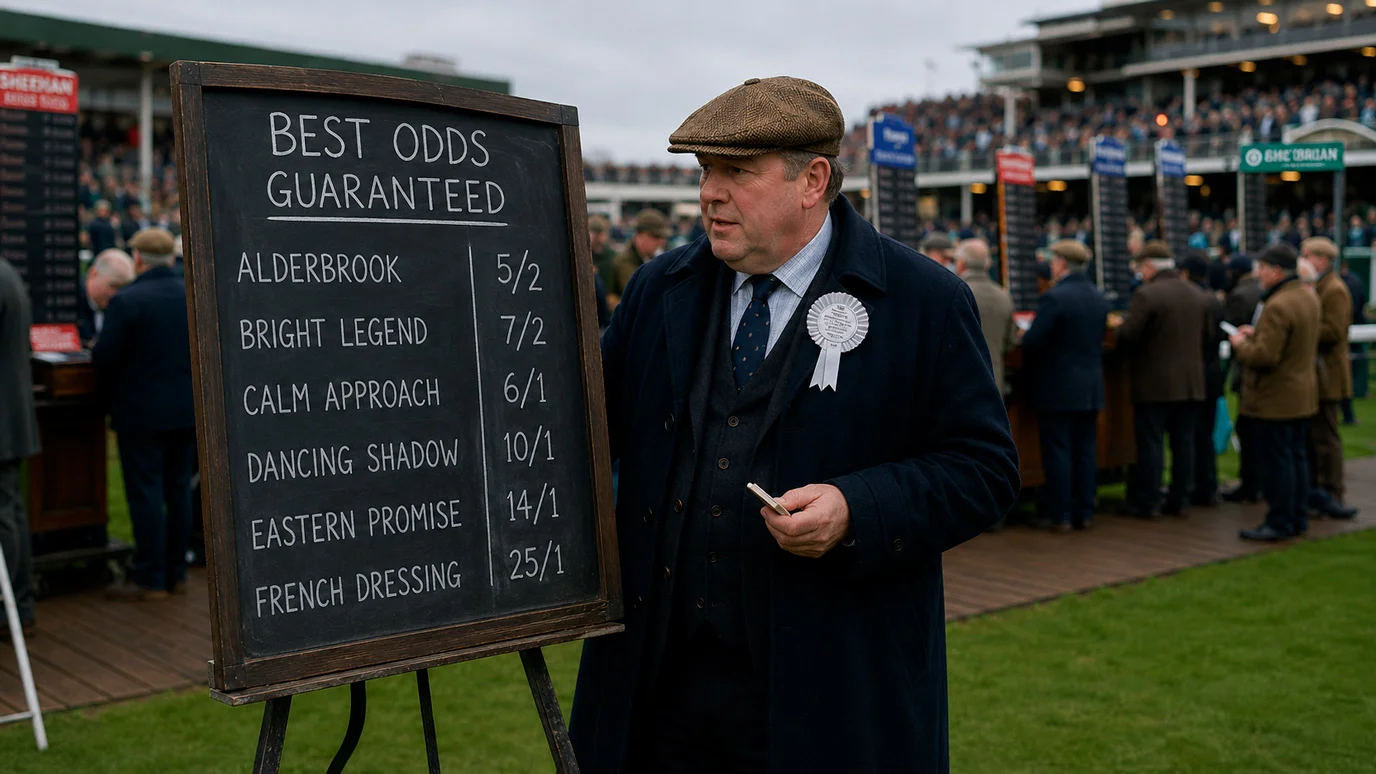
- Bet Settlement Rules: Stake and Payout Mechanics
- Starting Price vs Early Price
- Best Odds Guaranteed: How Layers Pay the Higher Price
- Non-Runner No Bet on Ante-Post Markets
- Rule 4 Deductions: The Tattersalls Scale
- Cash Out: Manual, Auto and Partial
- How Board Prices Get Set Before SP
- Why BOG Sometimes Excludes Handicaps
- Affordability Checks and Bet Settlement
- Bookmaker Feature Questions
Bet Settlement Rules: Stake and Payout Mechanics
Place a bet on a UK racecard and the bookmaker is not just offering you a price on a horse — they are layering several settlement modifiers on top of that price, any of which can change what you actually get paid when the race is over. Best Odds Guaranteed. Non-Runner No Bet. Rule 4 deductions. Cash Out. Starting Price returns. Each one is a separate mechanism with its own trigger, its own maths and its own carve-outs by operator. None of them is a bet type. All of them shape the settlement of bet types you already understand.
That distinction matters. The bet types in this guide — win, each-way, multiples, exotics — are choices you make at slip time. The features in this article are mechanisms the bookmaker applies after the slip is in. The punter who treats them as background detail leaves money on the table. The punter who understands them changes which slip they place, and at which operator, and at what time of day.
The headline product is Best Odds Guaranteed — known industry-wide as BOG — and it is the feature that has done most to shape the UK retail betting market over the past fifteen years. The supporting cast is Non-Runner No Bet on ante-post markets, Rule 4 on day-of-race withdrawals, Cash Out on in-running settlement, and the Starting Price mechanism that underpins all of them. Layered underneath the operational mechanics is the regulatory backdrop: affordability checks, financial vulnerability triggers, and the Autumn Budget tax changes confirmed in November 2025.
This chapter is the one to read if you have ever stared at a settled bet and thought “that is not the figure I expected”. Almost always, one of the modifiers below is the reason.
Starting Price vs Early Price
The Starting Price is the official price returned for every horse in every UK race at the moment the gates open or the tape rises. It is calculated by the Starting Price Regulatory Commission from a sample of the prices being quoted by representative on-course bookmakers in the betting ring at the off — a quiet piece of UK racing infrastructure that almost nobody outside the industry thinks about, even though it underpins the settlement of millions of bets a week.
An early price, by contrast, is any price a bookmaker advertises before the race goes off. Some operators put up morning prices the day before. Others wait until the racecards are confirmed in the morning. The early price is a bookmaker’s commercial decision based on their view of the runner; the SP is a market-wide consensus number captured at the very last moment.
The choice between taking an early price and taking the SP is the most common settlement question UK punters face. The maths depends on which direction the market is moving. If the punter takes an early price of 8/1 in the morning and the horse drifts to 12/1 SP, the early-price slip has lost two pounds of value per pound staked. If the same horse shortens to 6/1 SP, the early price has gained two pounds of value. The punter is betting on which direction the market will move between slip and off, on top of betting on the horse itself.
Best Odds Guaranteed changes that calculus, and we will get to it in the next section. Before BOG existed, the take-or-leave decision on early price was a genuine commercial gamble. BOG essentially turns the decision into “take the early price unless you think the SP will be much shorter” — the early price is now the floor, and the SP is the potential ceiling. The free option in favour of the punter.
The SP returners themselves operate within tight time constraints. UK racing has been getting noticeably better at hitting scheduled off times — 82.2 per cent of races in 2025 started within two minutes of their scheduled time, up from 79.2 per cent in 2024 and 72.7 per cent in 2023. That tightening matters for SP integrity. The SP is captured at the off; the longer the delay between scheduled and actual off, the more late market drift can distort the price. The recent improvement in punctuality has tightened SP volatility for punters who take SP rather than early prices.
The other reason SP matters is that it is the input to almost every other bookmaker feature. CSF dividends are calculated from SP. Rule 4 deductions are calculated from the SP of the withdrawn horse. BOG payouts are determined by comparing the early price taken to the SP returned. The SP is the engine that drives the settlement of a substantial slice of every UK racing bet, even when the punter never explicitly asks for it.
Best Odds Guaranteed: How Layers Pay the Higher Price
The first time I took a horse on Best Odds Guaranteed and watched it drift from 5/1 in the morning to 12/1 SP before winning, I learnt more about how the UK retail market actually works than I had picked up in the previous two years of betting. BOG is the single largest commercial concession layers make to retail punters.
BOG is simple to state. You take a price on a horse in the morning or during the day. If the horse wins and the official SP is higher than the price you took, the bookmaker pays you at SP. If the SP is lower, you keep the price you took. You always collect the better of the two. There is no premium for the promotion — it is built into the win bet on the meetings and operators where BOG applies.
The mechanism works because bookmakers know that early prices are right on average against SP — sometimes shorter, sometimes longer. On a random bet, BOG costs the layer nothing on net. The cost concentrates on specific drifting horses where the SP comes in well above the early price, and the layer eats that as a customer-retention expense.
The cut-off time matters. Most UK operators apply BOG to bets struck after 8 a.m. on the day of the race. Some extend the cut-off to the previous evening. A few apply BOG from market open. The cut-off is published in the slip terms but the slip software rarely flashes a warning.
Exclusions are where BOG gets messy. Multiples — accumulators, Yankees, Lucky 15s — are excluded by most operators, although some apply BOG to the win leg of each-way bets in multiples. Ante-post bets are generally excluded entirely. Handicaps are sometimes excluded by specific operators on specific meetings; we will return to that carve-out later.
The Autumn Budget 2025 confirmed that the remote betting duty on UK horse racing will stay at 15 per cent — significantly lower than the rates being applied to remote gaming (rising from 21 to 40 per cent in April 2026) and general online sports betting (15 to 25 per cent in April 2027). The horse racing exemption preserves the commercial space that funds promotions like BOG. “We have been clear throughout that harmonisation of tax rates of British racing and other betting and gaming products would have been catastrophic for our sport” — Martin Cruddace, the chief executive of Arena Racing Company, said in the run-up to the Budget. The duty differential is what funds the layer’s ability to offer BOG.
For punters, treat BOG as a one-way ratchet. The early price is the floor. The SP is the potential ceiling. Taking the early price on a BOG-eligible bet on a horse you fancy is almost always the correct decision unless you are anticipating the price to come in significantly shorter.
One of the most debated features among modern punters is knowing exactly when to cash out horse racing bets to secure a guaranteed profit.
Non-Runner No Bet on Ante-Post Markets
An ante-post bet is a bet placed on a horse for a specific race well before the final declarations are made — sometimes weeks, sometimes months, occasionally years in advance. The classic case is backing a horse for the Grand National in January, or for the Cheltenham Gold Cup in November. The advertised prices are bigger because the punter is taking on a layer of risk: if the horse does not turn up at the start, the bet usually loses.
Non-Runner No Bet — NRNB — flips it. Under NRNB, the bookmaker commits that if your selected horse does not run, the stake is refunded. The slip is voided rather than settled as a loser. The early price you took is preserved against the risk of withdrawal.
NRNB is not the default. It activates at specific moments in the build-up to a race, and the activation date is the single most important piece of information to track for any punter taking ante-post positions. The most common pattern across UK operators is for NRNB to activate roughly a week before the race, sometimes earlier for marquee festivals.
Take a worked case. A punter backs a horse for the Cheltenham Gold Cup in early February at 25/1 ante-post. NRNB does not yet apply. The horse is then withdrawn from the race in late February when the trainer announces a setback. The stake is lost. Now take the same horse at 14/1 in the week before the festival, after NRNB has been confirmed by the operator. The horse is withdrawn the day before the race. The stake is refunded.
The difference between those two scenarios is timing, not the horse. The earlier price is bigger because it carries the withdrawal risk; the later price is smaller because the bookmaker has removed that risk for the punter.
Cheltenham and Royal Ascot have their own NRNB conventions. The biggest operators typically announce NRNB on Cheltenham Festival markets in late February or early March. Royal Ascot markets follow a similar pattern in early June. Some operators are slower than others to activate, and there is a small commercial edge for punters in tracking which operator activates first for a given festival.
The other ante-post quirk: NRNB usually applies to win-only bets, not each-way. Each-way ante-post bets generally settle the place leg as a regular winner-of-the-place if the horse runs and places, but the win leg follows the win settlement rules. Withdrawal of a horse before NRNB voids both legs at non-NRNB operators and refunds both at NRNB operators. Always check the slip terms.
Rule 4 Deductions: The Tattersalls Scale
Rule 4 is the bit of UK racing settlement that nobody enjoys explaining and every punter eventually meets. It governs what happens when a horse is withdrawn from a race after final declaration but before the off — late enough that the market had already settled around the horse’s presence, but too early for a Non-Runner No Bet refund to apply.
The mechanism is a deduction from winnings on bets placed at fixed early prices, not on bets settled at SP. SP is recalibrated by the SP returners at the off to reflect the withdrawal, so SP bets already absorb the impact. Early-price bets are locked in at a price that reflects the withdrawn horse still being in the race, so a Rule 4 deduction is applied to prevent an unfair advantage from a reduced field.
The deduction is calibrated by the Tattersalls scale, which maps the SP of the withdrawn horse to a fixed pence-in-the-pound deduction. The shorter the price of the withdrawn horse, the larger the deduction. The standard scale: a withdrawn horse at 6/4 or shorter triggers a 45p in the pound deduction. At 9/4 to 7/4, around 40p. At 2/1 to 5/2, around 35p. The numbers step down at each price band, falling to a 5p deduction at 10/1 to 14/1, and to no deduction at all for withdrawn horses priced 16/1 or longer.
Take a worked example. A punter takes 6/1 in the morning on a horse running in a twelve-runner handicap. The second favourite at 3/1 is withdrawn at the start due to a stalls issue. Rule 4 kicks in with a deduction of around 30p in the pound on the winnings. The horse wins. The winnings on a ten-pound stake at 6/1 would normally be sixty pounds. After the 30p deduction, the winnings become forty-two pounds, plus the ten-pound stake back. Total return: fifty-two pounds.
The deduction applies only to winnings, never to the stake itself. The stake comes back in full on winning bets. The deduction is a haircut on the winning amount, not a charge on the slip. Rule 4 does not apply to SP bets because the SP itself is already adjusted at the off.
The Tattersalls scale is industry-standard across UK operators, but a small number of differences exist around edge cases. For the full operational breakdown of how Rule 4 plays through different early-price scenarios, the deeper dive lives in Rule 4 deductions in UK horse racing.
The wider context is that horse racing turnover has been under pressure for several quarters running. Average turnover per race in Q3 2025 was down 5.8 per cent against 2024 and 11.4 per cent against 2023. The squeeze on volumes makes layers more conscious of settlement risk, and Rule 4 is one of the mechanisms that keeps the layer protected when the market shape changes between slip and off.
Cash Out: Manual, Auto and Partial
Cash Out is the feature that turns a settled bet into a live position. Once the race is underway and the market is moving, the bookmaker offers the punter a price to close the bet early — to take a guaranteed return rather than wait for final settlement. The core maths is the current implied probability of the bet winning multiplied by the potential payout, minus a margin for the layer.
Take a worked case. A punter has ten pounds on a horse at 8/1 with a potential return of ninety pounds. The race is run and the horse hits the front going to the last fence with a clear lead. The Cash Out price might offer the punter seventy pounds to settle the bet immediately. If the horse jumps the last cleanly and wins, they would have collected ninety pounds — twenty more than the Cash Out offer. If the horse falls, they would have collected nothing — seventy more lost than by taking the Cash Out.
The decision is the same one a stock trader makes when deciding whether to take a profit early. Take the certain return, give up the upside. Hold for the upside, accept the risk. The bookmaker’s offer is calibrated to be slightly worse than fair-value, so the layer captures a margin on each early settlement.
Manual Cash Out is the standard implementation: the punter sees an offer in the app and clicks to accept. Auto Cash Out lets the punter set a target return in advance, and the bet is automatically settled when the Cash Out price reaches that target. Partial Cash Out takes a fraction of the position off the table while letting the rest run. The mechanics are operator-specific but the structural logic is universal.
The fair-value calculation is straightforward in principle. If a horse is implied to have a 70 per cent chance of winning at the current moment, the fair Cash Out price on a bet that pays ninety pounds is 0.7 × 90 = sixty-three pounds. The bookmaker offers something slightly below — perhaps sixty — to capture the spread. The punter who knows the rough fair-value calculation can spot when the Cash Out offer is significantly worse than fair, which usually happens at moments of high market uncertainty.
Cash Out is rarely available on Tote bets, multiples involving non-racing legs, or in-play markets in their final seconds. It is most commonly offered on win and each-way singles, and on accumulators where partial settlement is mathematically meaningful.
The strategic point: Cash Out is a tool, not a strategy. The punter who Cash Outs every bet that goes their way is converting a positive-expected-value position into a negative one, because the Cash Out spread eats the underlying value. The discipline is selective use — taking Cash Out when the bet’s expected value has materially declined since slip time, and letting other bets run.
Maximize your long-term returns by applying these bookmaker features alongside the expert strategies found on our UK racing bet types portal.
How Board Prices Get Set Before SP
Watch the morning prices on a Saturday card and you will see numbers move every few minutes as the bookmakers update their assessments. Those numbers are the board prices — the prices being quoted by individual operators in advance of the SP being captured at the off. Understanding how board prices get set explains how early prices end up where they do and why BOG creates the value it does.
The starting point is the layer’s own assessment. Each bookmaker has an internal odds-compiling team that builds a market based on form study, sectional times, going analysis, jockey bookings and trainer patterns. The first set of prices a bookmaker puts up represents that internal assessment, plus an overround margin baked into the prices.
Once the prices are live, the market starts to move with the weight of money. If a particular horse attracts more money than expected, the layer shortens the price to reduce their exposure. If a horse is being ignored despite being well-fancied internally, the layer might let the price drift to attract money to the other side of the book. The morning is a constant negotiation between the layer’s internal assessment and the market’s revealed preferences.
“Steamers” — horses being heavily backed — move shorter through the day. “Drifters” — horses losing market support — move longer. The traders watching the market across operators react quickly to genuine moves and slowly to suspected manipulation. A horse moving from 8/1 to 4/1 across all operators in an hour is a steamer; the same move at one operator alone is suspect and the price will be pulled.
The SP is calculated at the off by a sample of representative on-course bookmakers. The board prices feed into the SP indirectly — the on-course prices in the betting ring track the off-course market closely on big races. But the SP is not just an average of board prices; it is a captured snapshot of where the on-course market is at the moment of the off. That distinction matters because BOG settles against SP, not against the morning board price.
For the punter, the practical takeaway is to understand which way the market is moving when deciding whether to take a price. A horse drifting in the morning is one BOG candidate — take the early price, expect SP to be longer, get paid SP under BOG. A horse shortening rapidly is the opposite — take the early price quickly before it shortens further, knowing BOG offers limited upside because the SP is likely to be shorter than the price taken.
Why BOG Sometimes Excludes Handicaps
The carve-out that catches more BOG-claiming punters than any other is the handicap exclusion. A handful of UK operators routinely exclude handicap races from BOG, either entirely or only on specific market types. Others exclude only the biggest handicaps — Grand National, Cheltenham handicaps, Ebor. A few exclude no handicaps at all. The promotion is advertised in broad terms; the exclusion is buried in the slip terms.
The reason layers exclude handicaps is the same reason handicaps pay better each-way fractions: handicap markets are inherently more volatile and the liability per slip is harder to predict. A 12/1 handicap horse opening on a Saturday morning can drift to 20/1 SP or shorten to 6/1 SP depending on jockey announcements, trainer comments and weight of money in the final hours. BOG forces the layer to pay the higher price across that volatility. On non-handicaps, where the favourite usually goes off close to its morning price, BOG costs the layer less.
The handicap exclusion is therefore commercial rather than principled. The layer charges a slightly different effective margin on handicap BOG bets by simply not offering BOG on those bets. The punter who reads the small print and avoids non-BOG handicap markets at certain operators is recovering a margin chunk the layer was banking on capturing.
The wider context is that the black market in UK betting has been gaining ground at the regulated layer’s expense. Traffic on unlicensed betting sites grew by an estimated 500 per cent over three years, coinciding with the rollout of affordability checks. About £9.4 million of Grand National 2025 turnover — roughly 3.8 per cent of the total handle on the race — was placed through unlicensed operators. Punters who feel squeezed by regulated-market restrictions, whether on stake sizes or on the patchwork of BOG carve-outs, are migrating to operators outside the UK regulatory perimeter. The handicap exclusion is one of many small frictions that adds up.
For the BOG-claiming punter, the practical step is to check the operator’s specific BOG terms before placing handicap bets. The exclusions are listed in the promotion terms and are usually one click from the bet slip. The reading takes thirty seconds and can save a five-figure-priced punter several hundred pounds across a festival.
Affordability Checks and Bet Settlement
The settlement landscape changed materially in August 2024 when the UK Gambling Commission introduced light-touch financial vulnerability checks on punter accounts. The threshold was initially set at £500 monthly deposits and was reduced to £150 in February 2025. Cross the threshold and the operator is required to apply a check — automated for some punters, more detailed evidence requests for others.
The mechanism is upstream of bet settlement rather than part of it, but it shapes the settlement experience for higher-stake punters. A punter who has placed a winning bet but is sitting near the affordability threshold may find their withdrawal delayed pending verification. The bet itself is settled normally — the winnings are credited to the account — but access to the funds is gated by the operator’s compliance process.
The numbers reveal the strain. The Racing Post Big Punting Survey for 2025, taking in ten thousand respondents, found that one in three respondents who staked one thousand pounds or more per transaction had used an unregulated betting site in the previous twelve months. The threshold has functionally pushed a slice of high-stake play offshore.
“These parasite operators don’t pay tax, don’t care about safer gambling, and do not contribute a penny to the levy” — Grainne Hurst, the chief executive of the Betting and Gaming Council, said of the offshore market shift. The unlicensed operators absorbing the displaced volume are outside the UK regulatory perimeter, which means they are also outside the HBLB levy contribution. The 2024-25 Levy income reached £108.9 million, the highest since 2017, but the underlying turnover trend has been declining for three consecutive years.
For the regulated retail punter, affordability checks have changed what bet sizes are practical without friction. A series of two-hundred-pound singles can clear the £150 monthly deposit threshold quickly. The check itself is light-touch in most cases — confirmation of identity, occasionally a soft-credit check — but the friction is real for punters who used to bet at higher volumes without paperwork.
The Autumn Budget November 2025 added another layer. The Treasury confirmed that remote betting duty on UK horse racing remains at 15 per cent, deliberately preserving the differential against rising rates on remote gaming and general online sports betting. The differential is the financial cushion that allows UK racing layers to fund promotions like BOG and NRNB. Without it, the cost of the promotions would have to come out of an already-thin margin.
The practical implication for punters is that the regulated UK market remains the cleanest place to bet on horse racing — settlement is predictable, disputes go to ombudsman, the promotional infrastructure is robust — but the friction at higher stake levels has increased materially since 2024.
Bookmaker Feature Questions
Three questions about the settlement modifiers come up routinely, and they all share a pattern: punters meet the rule for the first time when a slip comes back differently from what they expected. The answers below are the ones I would give over the rail at Sandown if you held the slip out and asked what had happened.
Articles
Prepared by the typesbethors editorial staff.
