
 Available in US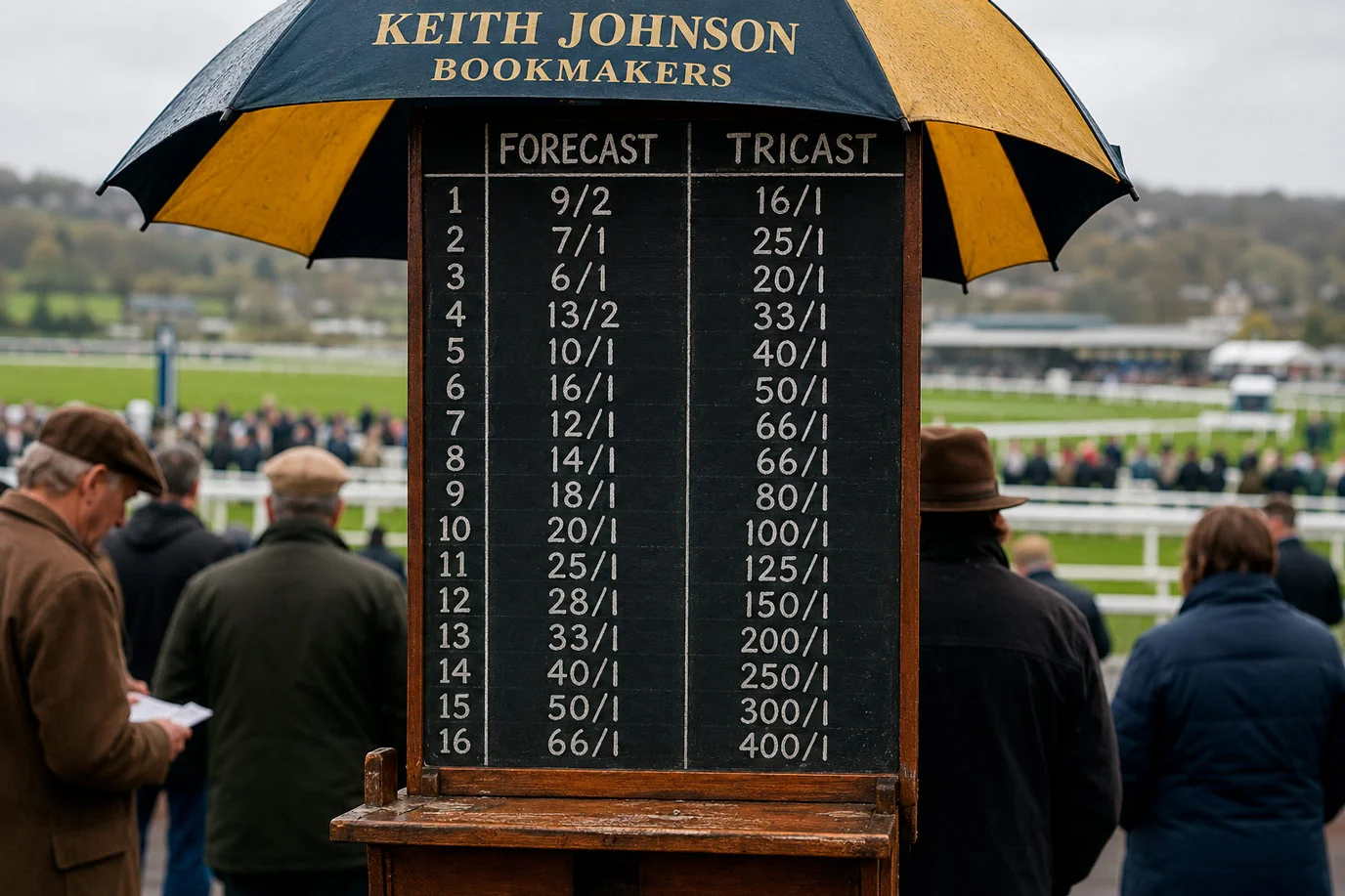
Perm Bets: Multi-Order Coverage and Unit Cost Math
The first time I played a Combination Forecast properly was at the Ebor meeting in 2017. Three horses in the perm at a unit cost of 50p, covering six possible finishing orders. The winning combination landed at a CSF dividend that made the £3 outlay look obscenely good value. That was the moment I understood that combination forecasts aren’t really one bet – they’re a stake-efficient way of buying multiple specific finishing orders without manually placing each as a separate forecast.
A standard forecast is a bet on which two horses will finish first and second in a specified order. A Combination Forecast covers both possible orders for each pair you’ve selected – so if you pick three horses, the combination covers all six possible 1-2 finishing orders among them (A-B, B-A, A-C, C-A, B-C, C-B). Each of those six orders is a separate unit bet at your chosen unit stake. The total cost is unit stake multiplied by the number of orders covered.
Perm bets – same logic, different naming – extend the principle. A perm any 2 from 4 horses covers all 12 possible forecast orders among any 2 of your 4 selections. A perm any 3 from 6 in a tricast covers all 120 possible 1-2-3 orders among any 3 of your 6 selections. The cost grows fast; so does the coverage of possible outcomes.
How a Combination Forecast Stake Adds Up
The maths is mechanical. With three horses in a Combination Forecast at £1 unit stake, you cover six finishing orders. Total stake: £6. With four horses, you cover 12 orders, total stake £12. Five horses cover 20 orders for £20. The pattern is n×(n-1) where n is the number of horses in the perm – a quadratic increase in coverage as you add selections.
Tricast combinations grow faster. Three horses cover 6 finishing orders (1-2-3, 1-3-2, 2-1-3, etc.) at unit stake – £6 for £1 unit. Four horses cover 24 orders at £24. Five horses cover 60 orders at £60. Six horses cover 120 orders at £120. The combinatorics explode quickly enough that practical tricast perms stop at four or five selections for most punters.
The strategic question is always whether the dividend justifies the stake coverage. A correctly-ordered forecast on a 16-runner handicap might produce a CSF dividend equivalent to 25/1 or higher. If your unit stake is £1 and you’ve staked £6 on a three-horse combination, the payout on a £6 winning unit at 25/1 dividend is £150 – a return of approximately 24/1 on the total stake despite betting six separate combinations. The combinatorial coverage doesn’t substantially erode the headline price because forecast dividends on 16-runner handicaps tend to be larger than the marginal cost of the additional combinations.
The maths on smaller fields works less well. A 7-runner conditions race forecast might produce a CSF dividend of only 8/1. Your three-horse combination at £6 stake returns £48 on the winning combination – equivalent to 7/1 on the total stake. The additional combinations cost you a full point of effective price.
Computer Straight Forecast vs Tote Forecast
UK racing runs two parallel forecast products with different payout mechanics. CSF – Computer Straight Forecast – is a computed dividend from a formula based on the starting prices of the two finishing horses, run by the bookmakers. Tote Forecast is a pari-mutuel pool product where punters’ stakes combine and the dividend is calculated from the pool.
CSF dividends are predictable once you know the SP of the first two finishers. The formula incorporates the starting prices in a way that produces a fair dividend reflecting both horses’ contribution to the bet’s difficulty. The CSF dividend is the same across every UK bookmaker – they all use the published CSF computation, settled centrally.
Tote Forecast dividends depend on the pool. If pool money was heavily concentrated on the 1-2 combination that actually finished, the dividend is small. If pool money was spread thinly and the actual 1-2 was a less-favoured combination, the dividend can be substantially larger than the CSF equivalent. The 5 per cent UK pari-mutuel market share against fixed odds’ 95 per cent makes Tote Forecast a thinner-pooled product, which means dividends can be more volatile in both directions.
Strategic implication: for combinations where you’ve correctly identified the likely 1-2 finishers in roughly the order the market expects, CSF and Tote Forecast usually pay similarly. For combinations where you’ve spotted an underpriced longshot to fill one of the positions, Tote Forecast can pay substantially more because pool money didn’t follow your read. The trade-off is dividend uncertainty – Tote dividends are unknown until the pool is calculated post-race.
Reverse and Computer Straight Forecast Together
Bookmakers offer Reverse Forecast as a two-bet structure on the same two horses – one bet on order A-B, one bet on order B-A. The total stake is twice your unit, the payout calculates from the CSF dividend on whichever order actually finishes. Reverse Forecast is essentially Combination Forecast on just two horses, named as a separate product for marketing clarity.
The relationship between Reverse Forecast and Combination Forecast is: Reverse Forecast on two horses is the simplest case of Combination Forecast (2 selections, 2 orders). Combination Forecast on three or more horses extends the logic to cover all pairwise orderings among the selected runners.
Reading the operator’s forecast menu, you’ll typically see straight forecast (one specific order), reverse forecast (both orders for one pair), and combination forecast (all orders for multiple horses) as separate products. They share the same underlying CSF dividend mechanic – the difference is in how many orders your stake covers.
For 80 per cent of punters who use forecasts at all, reverse forecast is the practical product. You’ve spotted two horses you fancy to fill the first two places but you’re uncertain which will win. Reverse forecast at £5 unit costs £10 total, covers both orders, and wins on whichever of the two configurations actually happens. Combination forecasts of three or more horses are advanced perm-playing that suits punters with specific multi-runner reads.
Where Perms Make Sense in UK Racing
The races where combination forecasts and perms genuinely earn their stake are big-field handicaps with multiple plausible top-finishers. Stewards’ Cup at Goodwood, Cesarewitch at Newmarket, the Ebor at York, the Wokingham at Royal Ascot – all 20-plus runner Flat handicaps where the 1-2-3 finish is genuinely hard to predict but several runners are within a credible window.
A Combination Forecast covering four runners in a 22-runner Cesarewitch costs £12 at £1 unit (12 finishing orders covered). The CSF dividend on a 22-runner handicap with longshot fillers can routinely exceed 50/1 – meaning a winning unit returns £50+ for a total stake of £12, an effective price north of 4 times stake. The combinatorial coverage justifies the additional cost because the forecast dividend is fat enough to absorb it.
The same maths breaks down on smaller-field races. A 9-runner conditions race forecast might produce a CSF dividend of 6/1. A three-horse Combination Forecast at £6 stake returns £36 – barely more than 5/1 on the total stake. Better to bet one specific forecast at £3 stake for the same effective coverage of your highest-conviction order.
Cheltenham Festival 2024 saw 34.9 million bets through Flutter brands alone with each-way betting up 25 per cent year on year – but combination forecasts didn’t see the same volume uplift. The Festival’s specialist forecast markets remain under-played relative to their value, partly because the maths is opaque to casual punters and partly because the bet type doesn’t market well alongside simpler products. Specialists who know the maths can find genuine edge in big-field Festival handicaps using combination forecasts that the broad market is leaving alone. For deeper reading on box bet strategy and when boxing a tricast pays off compared to a straight tricast, the box-bet piece walks through the coverage decisions.
Combination Forecast Questions
Two questions come up frequently about combination forecasts – how non-runners affect the bet, and whether dead-heats are settled cleanly.
Articles
Prepared by the typesbethors editorial staff.
