
 Available in US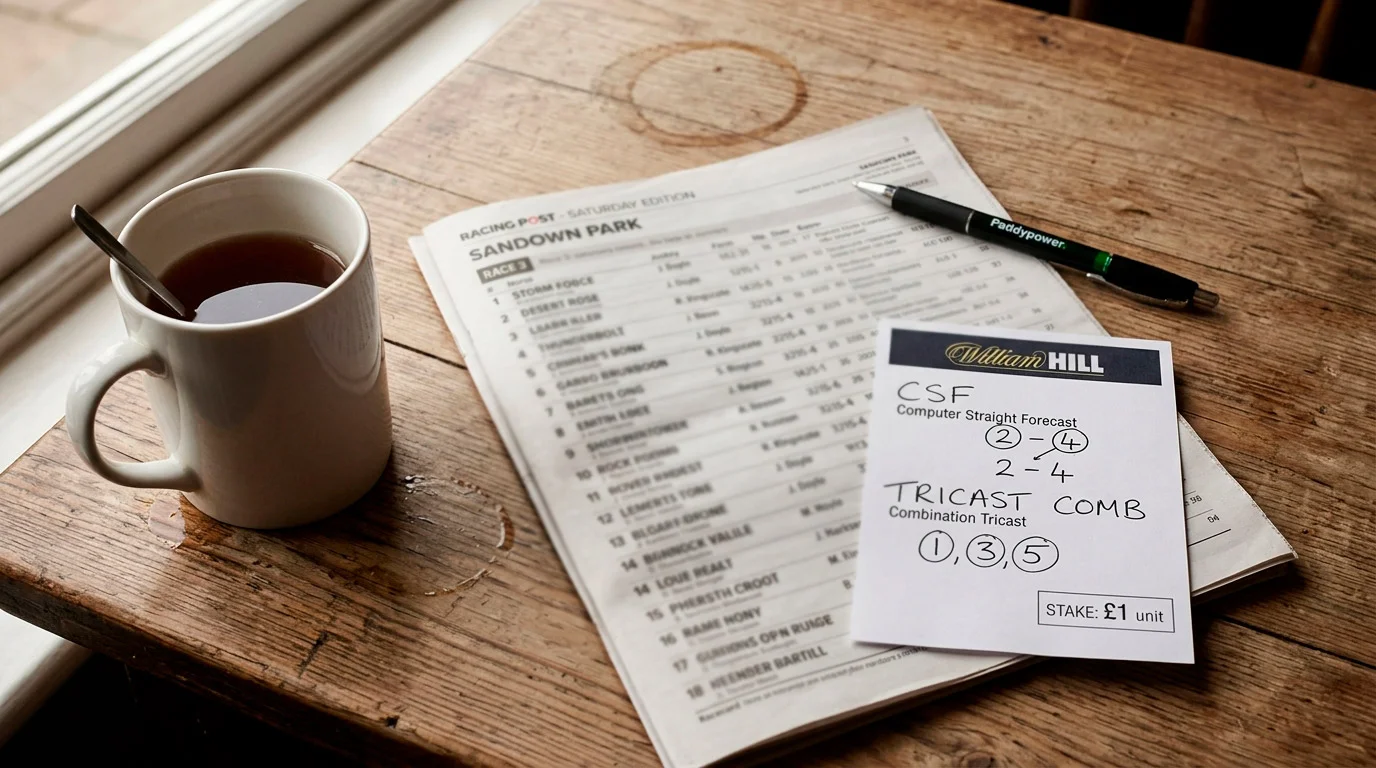
- Single-Race Exotics: Forecast and Tricast Payout Maths
- Computer Straight Forecast in UK Racing
- Reverse Forecast: Two Bets for Two Orders
- Combination Forecasts on 3+ Selections
- Tricast: First Three in Correct Order
- Combination Tricast: Covering Every Order
- Exacta vs Forecast: Same Idea, Different Pool
- Trifecta vs Tricast
- How Withdrawn Runners Settle Exotic Bets
- When Exotic Singles Are Worth the Stake
- Forecast and Tricast Questions
Single-Race Exotics: Forecast and Tricast Payout Maths
An exotic single-race bet is a wager on the specific finishing order of one race — not on whether a horse wins or places, but on which two or three horses cross the line first and in what sequence. Forecast picks the first two in correct order. Tricast picks the first three. Both bets exist in straight and combination forms, and both have pool-betting counterparts under the Tote (Exacta and Trifecta) that work on different settlement maths. Get the order right and the dividend is several times what a straight win bet on the same horse would pay.
What separates this family from the rest of the racecard is the precision required. A win bet asks for a winner. A forecast asks for a winner and a second-placed horse, in that order. The probability of getting both right is the product of the two individual probabilities, modified by the form correlation between the two horses. The mathematical compression of “you have to be right twice on one race” is what makes the bet hard, and it is also what makes the dividend interesting on the days when the form works out.
The single-race nature is also what separates exotics from multiples and from Tote multi-race pools. A Yankee covers eleven combinations across four races; a forecast covers one combination in one race. A Placepot needs six placed horses across six races; a tricast needs three horses in the right order in one race. The cumulative risk is concentrated rather than distributed. That changes the strategy profile entirely — exotics reward deep analysis of one race over broad coverage of a card.
Two pricing models run in parallel underneath the family. Bookmakers price forecasts and tricasts on a computer formula derived from the starting prices of the runners involved, with no advertised odds before the race. The Tote runs Exacta and Trifecta pools on the same races, with dividends calculated post-race like every other pool product. The two routes — fixed formula and pari-mutuel pool — produce different returns on the same finishing order. Understanding which to use on which race is half the work.
Computer Straight Forecast in UK Racing
The first time I tried to predict what a Computer Straight Forecast was going to pay before the race started, I spent forty minutes with a calculator and ended up about ten per cent off the actual dividend. The CSF formula is not difficult conceptually, but it has more moving parts than punters expect.
A Computer Straight Forecast — universally abbreviated CSF — is a bookmaker bet on the first two horses in correct finishing order. There is no advertised price before the race. Instead, the dividend is calculated after the race using a formula based on the official Starting Prices of the two horses involved, the size of the field, and the relative prices of the other runners. The formula is standardised across UK racing, settled by the SP returners who fix the Starting Prices themselves.
The formula’s core logic is intuitive once you strip away the algebra. The base case is the implied probability of the two horses finishing first and second in that exact order, expressed as a multiplier against a one-pound stake. A favourite winning ahead of a second favourite produces a small dividend because the implied joint probability is high. An outsider beating another outsider produces a much larger dividend.
Take a specific case. A horse wins at 6/1 SP and a second horse runs second at 8/1 SP in a twelve-runner handicap. The CSF dividend in that race would typically pay around thirty-five pounds for every pound staked. The straight win bet on the 6/1 horse would pay seven pounds. The CSF is paying roughly five times the win-only return for getting the order of the first two right.
The formula is not a simple multiplication. A naive 6 × 8 = 48 calculation gets close, but the actual CSF dividend is usually lower than the simple product because the formula adjusts for field size — a smaller field makes any specific 1-2 combination more likely. The formula also has a takeout component built in. CSF dividends are predictable in shape, just not in exact magnitude.
The CSF is offered on every UK race with five or more runners. It is the most-bet single-race exotic in UK racing, and on Premier Fixtures the turnover per race has been pulling away from the average. Average turnover per race on Premier Fixtures rose 2.7 per cent in 2025, while the Core Fixtures equivalent fell 8.6 per cent. A meaningful share of that Premier Fixtures turnover sits in the CSF market on the day’s featured handicap.
What punters miss most often about the CSF is the absence of a price before the race. The dividend is whatever the formula returns after the result is declared. Punters who want certainty before the off should stick to win bets. Punters who want the upside of getting the order right take the CSF and live with the post-race dividend.
Reverse Forecast: Two Bets for Two Orders
If the CSF is the bet for punters who know which horse will finish first and which will finish second, the Reverse Forecast is the bet for punters who know which two horses will finish in the frame but cannot call the order. The Reverse Forecast covers both possible 1-2 orders for two selected horses — A wins and B runs second, or B wins and A runs second. Two separate forecasts on one slip. At a one-pound unit, the bet costs two pounds.
The settlement is straightforward: only one of the two orders will pay (or neither, if some other horse wins or runs second). The winning order is settled at the standard CSF dividend for that order. The losing order is forfeit.
Take a worked example. Two selections, both at 5/1 SP. The race settles with the first selection winning and the second selection running second. The slip cost two pounds. The CSF dividend for that pairing might come out at roughly twenty-three pounds for every pound staked. The Reverse Forecast pays one of its two pounds at twenty-three pounds — twenty-three pounds returned on a two-pound outlay. Net profit: twenty-one pounds.
If the order had been reversed — the second selection winning and the first selection running second — the dividend would be different (the CSF formula treats the two orders separately, and the dividend depends on which horse was the favourite at SP). The asymmetry in the formula means the Reverse Forecast is not just a doubled stake on the same outcome; it is two genuinely distinct bets with two potentially different payouts.
The Reverse Forecast is most useful in races where two horses look clearly ahead of the rest of the field but where the punter cannot confidently call which will outpoint which. Two strong stayers in a long-distance handicap. Two front-runners in a sprint where the draw might be the deciding factor. Two stable companions where the punter has no read on which trainer wants to win.
The bet is less useful when one of the two horses is a clear favourite and the other is the second favourite — the punter is paying double for a marginal hedge on an outcome they already favour one way. In that case a straight CSF on the more likely order is the cleaner bet.
Combination Forecasts on 3+ Selections
The combination forecast is what happens when the punter wants to back three or more horses to finish first and second in any order. Three selections produce six possible 1-2 orderings — AB, BA, AC, CA, BC, CB. Four selections produce twelve orderings (n × (n-1) for n selections). Five selections produce twenty. The stake is the number of orderings multiplied by the unit stake. A three-selection combination forecast at a one-pound unit costs six pounds. Four selections cost twelve pounds. Five selections cost twenty pounds.
Each ordering is settled as a separate CSF. Only one ordering will pay on any given race — the one matching the actual 1-2 finish. The losing orderings are forfeit. The maths is therefore the dividend on the winning order minus the cost of all the losing orders.
Run a worked example. Three selections at 6/1, 8/1 and 10/1 SP in a fourteen-runner handicap. One-pound unit, six-pound stake. The race finishes with the 8/1 horse winning and the 10/1 horse runner-up. The CSF for that pairing — the 8/1 winning ahead of the 10/1 — might come out at around eighty pounds for every pound staked. The combination forecast pays the one winning order at eighty pounds, minus the five pounds spent on the other five losing orders. Net return: eighty pounds on a six-pound outlay. Net profit: seventy-four pounds.
The combination forecast earns its place when the punter has a clear group of three or four horses they expect to dominate the race, but cannot reliably order them. A four-handed competitive sprint where any of four horses look capable on form. A handicap where the trainer’s three runners look closely matched. The bet expresses “one of these three will win and another will run second” without forcing the punter to call the order.
The trap is the cost scaling. Five selections produce twenty orderings at a one-pound unit, and only one will pay. The CSF dividend on the winning order has to be high enough to cover the other nineteen losing pounds plus return a profit. That requires longer-priced horses in the winning pairing.
Tricast: First Three in Correct Order
If the CSF is a precision bet on two horses, the tricast is the precision bet on three. Pick the first, second and third in correct finishing order. One slip, one stake, one combination. At a one-pound unit, the bet costs one pound. Like the CSF, the dividend is calculated by a computer formula based on the SPs of the three horses involved.
The formula adds the third horse’s price into the calculation. The base case is the same — joint implied probability of three specific horses finishing first, second and third in that exact order. A short-priced favourite winning ahead of two second favourites produces a modest tricast dividend, in the low tens of pounds per pound staked. A medium-priced favourite winning ahead of two outsiders can produce a tricast that pays hundreds per pound staked. The dividend stretches further than the CSF because the joint probability of a three-horse order is much lower.
The crucial restriction: tricasts are only offered on handicap races with eight or more declared runners. The reasoning is structural. Non-handicaps with smaller fields produce too few possible 1-2-3 orderings for the formula to settle at a useful dividend.
Take a worked tricast. A twelve-runner handicap finishes with a 4/1 winner, a 10/1 second and a 14/1 third. The tricast dividend in that race might pay around six hundred pounds for every pound staked. The CSF on the same first two horses would have paid roughly fifty pounds. The third leg of the tricast — the 14/1 horse running third — is doing most of the dividend work.
The Tote runs a parallel product called Trifecta on the same races, with the dividend derived from pari-mutuel pool maths instead of the bookmaker formula. The two products co-exist and settle to different numbers. Trifecta dividends on the same finishing order can be higher or lower than the bookmaker tricast depending on how much pool money was bet on the same combination.
The strategic question with a single tricast is whether the punter can credibly call the first three in order — a much harder claim than calling the first two. Most experienced UK punters who play tricasts use combination tricasts rather than straight ones, accepting the higher cost in exchange for the right not to fix the order.
Combination Tricast: Covering Every Order
The combination tricast covers every possible 1-2-3 order across a group of selected horses. Three selections produce six orderings — ABC, ACB, BAC, BCA, CAB, CBA. Four selections produce twenty-four orderings. Five selections produce sixty. The cost scales by the factorial of the selection count, and it scales fast. A three-selection combination tricast at a one-pound unit costs six pounds. Four selections cost twenty-four pounds. Five selections cost sixty pounds.
Each ordering is settled as a separate tricast. Only one will pay on any given race — the one matching the actual 1-2-3 finish. The combinatorial cost-to-cover ratio is much harsher than the equivalent for forecasts because three-horse permutations grow faster than two-horse permutations. The dividend on the winning order must clear the cost of all the losing orders before any profit is realised.
Run an example. Three selections at 5/1, 8/1 and 12/1 SP in a ten-runner handicap. One-pound unit, six-pound combination tricast stake. The race finishes 8/1, 12/1, 5/1 in that order. The tricast dividend for that specific finishing order might pay around three hundred pounds for every pound staked. The combination tricast pays the one winning order at three hundred pounds, minus the five pounds spent on the other five losing orderings. Net return: three hundred pounds on a six-pound outlay.
That works because the winning order involves all three medium-to-long-priced selections. If the actual order had been 5/1 winning ahead of 8/1 and 12/1 in any sequence, the tricast dividend on the winning order would have been smaller — the 5/1 favourite winning compresses the dividend formula — and the combination cost would have been the same. The bet works when the winning order is one of the longer-priced permutations within the selected group.
Four-selection combination tricasts at twenty-four pounds per pound unit are the practical ceiling for most punters. Five selections at sixty pounds is too rich for the average punter to absorb a losing slip on, and even with a winning order on three long-priced horses, the dividend will struggle to clear the stake significantly. The break-even logic gets thinner as the selection count rises.
This is the same combinatorial DNA as system bets — the maths of “cover every combination so one of them pays” — applied within a single race rather than across multiple. The exotic version of the same problem.
Exacta vs Forecast: Same Idea, Different Pool
The Exacta is the Tote’s pari-mutuel version of the forecast. Pick the first two horses in correct finishing order. One slip, one stake — but instead of the bookmaker formula, the dividend is calculated post-race from the Exacta pool on that race, after the operator’s takeout. The Tote settles the Exacta as a pool product on the same races the bookmaker settles a CSF. Two products. Same finishing order. Different maths.
The difference matters more on some races than others. On marquee races with large pari-mutuel pools — Royal Ascot under World Pool, Cheltenham handicaps, Grand National Day — the Exacta dividend is fed by serious liquidity and tends to track close to or slightly above the bookmaker CSF on the same pairing. On thin midweek cards, the Exacta dividend can be hugely volatile — a 14/1 winner ahead of a 25/1 second can produce an Exacta dividend two or three times the bookmaker CSF on the same combination, because the pool money rarely backed the longshot pairing and the dividend per surviving ticket is consequently enormous.
The asymmetry is structural. The bookmaker CSF formula spits out the same dividend regardless of how much money was bet on a particular pairing — it derives the number from SP alone. The Tote Exacta dividend depends on what other punters did with their stakes. Two products price the same finishing order through entirely different mechanisms.
Pari-mutuel betting accounts for around five per cent of UK total betting turnover. The other ninety-five per cent is fixed-odds. That asymmetry means the Tote Exacta pool on any race is typically much smaller than the equivalent CSF book at the bookmaker, which is the main structural reason for dividend volatility on the pool side. Bigger pool, more stable dividend; smaller pool, more volatile dividend.
The practical decision rule is straightforward. On a longshot 1-2, the pool tends to pay better. On a favourite-led 1-2, the formula tends to pay better. On marquee race days with World Pool augmentation, the pool tends to be at least competitive across the price range. For the deeper cross-Atlantic terminology — why an Exacta in the UK is called an Exacta in the US too, and what the equivalents are for Quinella, Trifecta and Superfecta — the breakdown lives in UK and US horse racing bet name glossary.
Trifecta vs Tricast
The Trifecta is the Tote’s pari-mutuel version of the tricast, with the same structural relationship the Exacta has to the CSF. Pick the first three in correct order. Tote pool, post-race dividend, no advertised price. The bookmaker tricast and the Tote Trifecta settle on the same finishing order through different maths, on the same races where both products are offered.
The dividend gap between the two products is wider on tricasts than on forecasts, because the underlying probability is rarer and the pool size on Trifecta is much smaller than on Exacta. World Pool turnover on the seventeen UK and Irish race days in 2022 hit $605 million, with the final race day alone taking nearly $32 million — that international liquidity gets fed into Trifecta pools on those days, and the dividends become substantial. On a routine card without World Pool, the Trifecta pool can be small enough that a single 1-2-3 longshot order produces a Trifecta dividend in the high four figures per pound staked.
The bookmaker tricast formula is more predictable but more constrained. The dividend on a given 1-2-3 order tracks within a roughly known range given the SPs involved. The Tote Trifecta dividend on the same order can pay anywhere from half to several times the tricast equivalent depending on pool composition. Punters who play tricasts and Trifectas as parallel products on the same race report consistently that the Trifecta wins on long-shot orders and the tricast wins on favourite-led orders.
The other difference is field size restrictions. Bookmaker tricasts require eight-runner handicaps as a minimum. Tote Trifectas are typically offered on a wider set of races, including some non-handicaps and some smaller fields, depending on the meeting. The Trifecta market on a six-runner conditions race is offered where the tricast is not, and the dividend on a 1-2-3 favourite-led finish in that race can be more attractive than any other available product.
The strategic profile of the two bets is divergent. Tricasts on big-field handicaps where the favourite is likely to win and the order of the next two is the question. Trifectas on the longshot pairings the bookmaker formula would compress, especially on World Pool days when the pool is large enough to settle a sensible dividend.
How Withdrawn Runners Settle Exotic Bets
The first time I had a horse withdrawn from a CSF five minutes before the off, I thought the bet was dead. It is not. Withdrawn-runner settlement on exotic bets follows a different rulebook to ordinary win bets, and the rules are worth knowing before the stewards announce a non-runner over the racecourse tannoy.
If one of the horses in a CSF is withdrawn before the off but after the punter placed the bet, the standard practice across UK bookmakers is to void the relevant forecast and refund the stake on it. The bet does not run. The slip is settled as a refund. The same logic applies to a tricast — if any of the three named horses is withdrawn, the bet voids and the stake is returned.
Rule 4 deductions, which apply to win bets when a horse is withdrawn after final declaration, do not normally apply to forecasts and tricasts. The CSF and tricast formulas are based on the SPs of the runners that actually go to post, and the SPs are themselves adjusted for the withdrawal. A withdrawal compresses the prices of the remaining runners — the favourite gets shorter, the second favourite gets shorter, and so on — so the CSF formula on a 1-2 pairing involving two of those compressed prices produces a slightly smaller dividend than it would have done with the withdrawn horse still in the market. The dividend reflects the post-withdrawal market without applying a separate stake deduction.
On combination forecasts and combination tricasts, the same withdrawal logic applies but only to the combinations involving the withdrawn horse. A four-selection combination forecast with one horse withdrawn becomes a three-selection combination forecast, and the punter is refunded the stake on the orderings that included the withdrawn horse. The remaining orderings stand and settle normally.
The Tote Exacta and Trifecta apply slightly different rules. Pool products generally void any ticket involving a withdrawn horse and refund the stake from the pool before the dividend calculation. The withdrawn ticket holders do not share in the pool, and the remaining pool is divided among the surviving winning tickets. The mechanism is operator-specific, so checking the rules on the relevant Tote or britbet app before placing the bet matters more on exotic pool products than on a straight Win pool.
When Exotic Singles Are Worth the Stake
Exotic singles earn their place when the punter has a genuine analytical edge on the shape of a race that the straight win bet cannot exploit. That is the only condition that matters. Without the edge, the cumulative formula margin on a CSF or tricast pays the bookmaker and nobody else.
The clearest case is a large-field handicap where the form picks out two or three horses ahead of the rest and the punter has a view on the order. Sixteen-runner handicaps with one strong stayer, one fast finisher and one front-runner all priced in the same single-figure band are classic exotic territory. The CSF dividend on a 1-2 involving two of those three horses pays multiples of the win-only return, and the analytical work — identifying which has the right race profile for the specific course and going — is rewarded directly.
The harder case is the favourite-led race. A 5/4 favourite winning ahead of a 7/2 second produces a small CSF dividend, in the low single figures per pound staked. The win bet on the favourite returns 2.25 pounds per pound. The CSF on the favourite-second-favourite pairing might return 6 pounds. Favourite-led exotics rarely justify the stake unless the punter can see something the market has missed about the second-placed horse.
The Tote Exacta and Trifecta open additional avenues. Trifecta dividends on longshot 1-2-3 orders can pay hundreds or thousands per pound staked. World Pool augmented Trifectas on Royal Ascot or Champions Day are several times larger than domestic equivalents. The strategic profile of pool exotics is closer to the lottery model than the bookmaker formula products — small, infrequent, occasionally enormous.
“There is undoubtedly an ever-growing desire for data among those consuming and betting on racing. As other sports continue to develop ways in which their fans can gain greater insights through use of real-time data, this is clearly an area in which racing can continue to evolve” — Brant Dunshea, the chief executive of the British Horseracing Authority, said that in late 2025, and it captures the direction the exotic market is moving. Real-time form data, sectional times, live pool information — these are the inputs that make exotic singles a more analytically rigorous bet than the gut-feel slips that dominated a decade ago.
Average field size on UK Flat racing fell to 8.90 in 2025 from 9.14 in 2024, and over Jumps to 7.84 from 8.49. Smaller fields mean fewer credible runners in the 1-2 and 1-2-3 betting markets, which tightens the dividend on every exotic and erodes the bet’s value on routine cards. The exotic punter increasingly has to wait for the right race to come along — Premier Fixtures, big handicaps, marquee festivals — rather than spreading exotic stakes across midweek cards that no longer support them.
Forecast and Tricast Questions
Three questions on exotic single-race bets come up repeatedly, and they all share the same root: the lack of an advertised price before the race trips up the assumptions punters carry over from win betting. The maths underneath is reasonable; it just looks unfamiliar.
Articles
Published by the typesbethors team.
