
 Available in US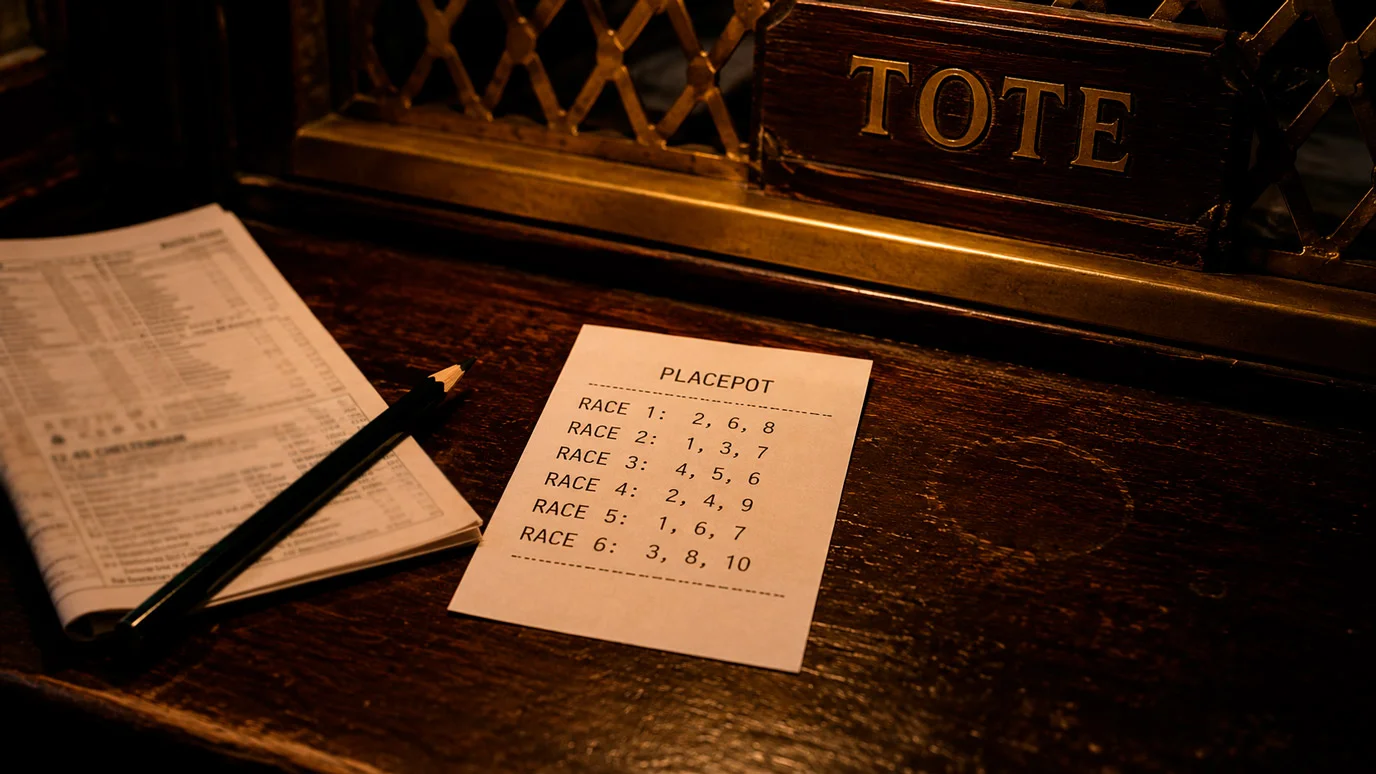
- Tote Pool System: Mechanics and Dividend Calculation
- How a Pari-Mutuel Pool Calculates Your Return
- The Placepot: Six Races, One Stake
- The Quadpot: Placepot's Smaller Cousin
- The Tote Jackpot: Win-Only Across Six Races
- Scoop6: Saturday-Only Pool Drama
- The Tote Guarantee on Win Bets
- Britbet Takes Over ARC Pools in November 2025
- World Pool: International Money Hits UK Racing
- When the Pool Beats the Bookmaker
- Tote Pool Questions
Tote Pool System: Mechanics and Dividend Calculation
Place a Tote bet and you are not betting against the bookmaker — you are betting against everyone else at the racecourse. The final payout has nothing to do with a chalk price written half an hour before the off. It is calculated after the race, by dividing the money left in the pool after the operator’s takeout among the holders of winning tickets. No fixed odds. The dividend is whatever the maths leaves you when the runners cross the line.
That is the cardinal difference between Tote bets and everything else on a UK racecard. With a bookmaker you know your potential return the moment you take the slip. With the Tote you find out when the race is over. The trade-off is that the longer the price your horse was running at — and the more punters wrote it off pre-race — the higher the dividend tends to be, because the pool is shared among fewer winning tickets.
The Tote sits in a small corner of UK racing. Pari-mutuel pools account for around five per cent of total betting turnover; the other ninety-five per cent is fixed odds. It is a minority sport in a minority sport, and yet it has survived since 1929 because for certain bet types — Placepot, Scoop6, Jackpot, Quadpot — there is no fixed-odds equivalent. The bookmaker cannot offer a six-race place accumulator at a dividend driven by everyone else’s losing tickets. Only a pool can do that.
Pool betting also has a structural quirk most punters never think about until it changes on them. As of November 2025, UK pari-mutuel is split between two licensed operators — UK Tote on most racecourses, britbet on Arena Racing Company’s tracks plus Hexham, Newton Abbot and Ripon. Same bet types. Different pools. Different dividends. That split is the most significant change to UK pool betting in a generation.
How a Pari-Mutuel Pool Calculates Your Return
Years ago I tried to explain the Tote dividend to a friend in a pub by drawing diagrams on a beer mat. He kept asking the same question: “But what are the odds?” There are no odds. That is the thing he could not get past, and it is the thing that trips up everyone the first time they place a pool bet.
You place a one-pound bet on a horse in the Tote Win pool. Your pound joins every other pound bet on that race into a single fund — the gross pool. The operator takes out a fixed percentage as their gross profit and the contribution to the prize money and levy. That deduction is the takeout. What is left is the net pool. The net pool is what gets divided.
When the race finishes, the operator counts the winning tickets and divides the net pool by the number of winning units. The result is the dividend, quoted as a return per pound staked. If the net pool is one thousand pounds and there are one hundred winning one-pound units, the dividend is ten pounds — a return of nine pounds plus the original pound back. In bookmaker terms, that is 9/1. The fixed-odds market on the same horse might have been 7/1 or 11/1. The Tote dividend is whatever the maths of that specific pool produces.
Takeout rates vary by pool type and operator. The big multi-race pools — Pick 4 and Pick 6 style products under the new britbet structure — carry a takeout rate of twenty-five per cent. Tote Win pools typically run lower, around sixteen to eighteen per cent. The difference reflects liquidity (the bigger multi-race pools attract less money, so the operator needs a wider margin) and complexity. Either way, the takeout is fixed and visible. The fixed-odds equivalent — bookmaker overround — is variable and disguised inside the prices.
A practical consequence is that pool dividends are unpredictable until the off — sometimes until the photo. Punters who back a horse in the Tote Win at twenty minutes to the off do not know whether the dividend will end up shorter or longer than the fixed-odds SP, because that depends on what every other punter does next. The dividend converges as the pool grows. The “Tote indicator” on the screens at the racecourse is just a running estimate of where the dividend currently sits, recalculated every few seconds.
Your decision to back the horse is locked in, but the return is fluid until the gates open. For a horse who attracts late money the dividend shrinks. For a horse the public ignores it grows. The bookmaker has been replaced by everyone else holding a slip in the queue.
Understanding the recent industry shifts is crucial, especially when comparing the Britbet and UK Tote pool operators for your daily wagers.
The Placepot: Six Races, One Stake
The Placepot is the bet that introduced most British racegoers to pool betting, and it is the reason the betting hall at a UK racecourse still has a queue at the Tote window. Pick a horse to be placed in each of the first six races on a single meeting’s card. One stake. Six selections. Get all six placed and you collect a share of the pool. Miss one and the bet dies.
“Placed” follows the standard each-way grid for each individual race, so the Placepot inherits a friendlier safety net than a six-fold win accumulator. In a typical eight-runner non-handicap, “placed” means top three. In a sixteen-runner handicap, top four. The Placepot punter is not picking winners — they are picking horses to finish in the frame across six consecutive races.
What makes the Placepot live or die is how many other punters have selected the same horses. The dividend can be transformatively asymmetric: in a quiet midweek meeting at Wolverhampton, a Placepot might pay twenty pounds for a winning one-pound ticket. On a Saturday at Sandown with the favourite running through all six races, the dividend can be under five pounds. Few enough winners and the dividend goes to four or five figures.
The savvy Placepot punter is not trying to find the favourite; they are trying to find a placed horse the rest of the betting hall has missed. A 14/1 outsider that runs an honest fourth in a sixteen-runner handicap is a Placepot dream selection. The favourite in the same race might place too, but everyone else also picked it, so the dividend share is smaller for everyone.
The bet is perm-friendly. A 3 × 2 × 1 × 2 × 1 × 3 perm at a one-pound unit costs thirty-six pounds and gives you thirty-six lines through the six races. The maths of perm-staking is also the maths of overspending: it is easy to talk yourself from a five-pound Placepot into a fifty-pound one by adding a “safety” horse to two legs.
The rollover rule applies. If no ticket gets six placed horses on a given day, the dividend rolls into the next meeting’s Placepot pool. That accumulation is the reason midweek Placepots sometimes carry hundred-thousand-pound figures into Saturday cards.
Racecourse attendance reached 5.031 million in 2025 — the first time the figure has exceeded five million since 2019, up 4.8 per cent year-on-year. A meaningful share of that on-course traffic walks through the Tote window before the first race. The Placepot is the bet that keeps people in their seat from the first race to the sixth, watching a horse finish fourth and discovering they are still alive in the bet.
The Quadpot: Placepot’s Smaller Cousin
Stand near the Tote window forty minutes before the third race of the day at any UK course and you will see a small but consistent stream of punters buying Quadpot tickets. Most of them have just had their Placepot killed by an unlucky second race. The Quadpot is their hedge — a smaller, faster, four-race version of the same idea.
The Quadpot covers races three through six on the meeting. Four selections, each to be placed, one stake. The placed grid follows the same rules as the Placepot — each-way places by field size for the individual race. Lose any leg and the bet dies. Win all four and you collect a share of the smaller Quadpot pool.
Two things follow from the shorter run. The dividend is lower — typically a few pounds to a few tens of pounds for a one-pound winning ticket on a routine card — because the pool is smaller and the chances of getting four placed horses are higher than getting six. And the timing makes it useful as a back-up. A punter whose Placepot dies in race one or two can buy into the Quadpot before race three and salvage some pool exposure for the rest of the afternoon.
The Quadpot also rewards a different kind of selection thinking. Six placed horses is a stretch; four is a target. The perm cost is lower — a 2 × 2 × 1 × 2 perm at a one-pound unit costs eight pounds, half the price of an equivalent six-leg Placepot perm. That makes the Quadpot the favoured pool bet for punters who want exposure to a card but do not want to risk a big stake on six unbroken placed finishes.
It is also the pool that benefits most from late switches. Because you are choosing four selections after the first two races have already been run, the punter has a forty-minute window to watch how the going is riding, whether favourites are placing, whether the inside or outside draw is winning. The Placepot punter committed before the first race had been run. The Quadpot punter knows what the card looks like before they pick.
The Tote Jackpot: Win-Only Across Six Races
The Tote Jackpot is the Placepot’s cruel older sibling. Same six races. Same one stake. But every selection has to win — no placed finishes count. Six winners across six consecutive races on the same card. It is the hardest of the major UK pool bets, and it is precisely that difficulty that builds rollover jackpots into eye-catching territory.
The maths is brutal. Even on a soft card where the average winning price is 5/1, the implied probability of six winners on six selections is roughly one in forty-six thousand on a per-line basis. The reality is worse because some of those races will be big-field handicaps where the winner came from a 16/1 cluster that nobody backed. Most days of the year the Jackpot pool does not pay out. Nobody hits the six. The pool rolls.
The rollover is where the Jackpot earns its place on the betting board. A pool that has rolled over for ten or fifteen days running can reach a hundred thousand pounds, occasionally several hundred thousand. That accumulation is what attracts the perm-stakers who would not normally bet into a six-race win pool — the cost of a sensible perm against a quarter-million-pound rollover pool tilts the maths in a way that does not exist on a routine Tuesday.
The Jackpot, like the Placepot, is perm-friendly. A 3 × 2 × 2 × 1 × 2 × 3 perm at a one-pound unit covers seventy-two lines for seventy-two pounds. On a normal day that is dead money. On a hundred-thousand-pound rollover day, it is a credible attempt at a five-figure return, with a real but low probability of hitting. Disciplined Jackpot punters wait for the rollover to build before they engage. The discipline of skipping days when the pool is small is the bet’s defining habit.
The Jackpot punter has to accept that there are no operator-published selections. The pool is what it is — six races, six winners — and the punter is alone with the form book. That isolation is part of the appeal. It is the most analytical pool bet on the menu.
Scoop6: Saturday-Only Pool Drama
The Scoop6 is the bet that turned racing Saturdays into national television events in the late 1990s and never quite let go. It runs on six ITV-televised Saturday races across two or three different meetings — usually the most competitive handicaps of the afternoon. Six winners required. No placed finishes. Two-pound minimum stake per line.
The headline feature is the split. The Scoop6 dividend is divided into the Win Fund and the Place Fund, and they pay separately. Punters who back six winners share the Win Fund. Punters who back six horses that placed (but did not all win) share the Place Fund. The Place Fund is the safety net that means a near-miss does not always end empty-handed.
The second oddity is the Scoop6 Bonus Round. Any punter who collects on the Win Fund qualifies to enter a follow-on bet the next Saturday — pick one horse in one specified race, and if it wins, take a share of a separate Bonus Fund that may have been rolling for weeks. Bonus Funds have hit seven figures in the past, and the bonus round is the single biggest source of “biggest-ever-payout” stories in UK pool betting history.
The Saturday-only structure concentrates the bet into the busiest racing day of the week. Total betting turnover on British racing was down nine per cent in the first quarter of 2025 against the same period in 2024, but the Saturday afternoon pool products held up better than the weekday equivalents because they ride on broadcast traffic. People watching ITV racing on a Saturday afternoon are more likely to buy into a Scoop6 than they are to buy into a midweek Tote Jackpot.
Strategically, the Scoop6 rewards a particular kind of selection profile. Six big-field handicaps with two or three credible winners each — that is what a Scoop6 card usually contains. Punters perm two horses across most legs and a single horse in the legs they feel strongest about. A 2 × 2 × 1 × 2 × 2 × 2 perm at the two-pound minimum costs sixty-four pounds for thirty-two lines. Get the perm right and the Win Fund pays. Place one or two legs accidentally and the Place Fund pays.
The Scoop6 also depends on which operator runs the relevant racecourse pools — and that is where the new britbet split matters. ARC tracks now feed their Scoop6 pool through britbet on the Saturdays the bet covers their courses. UK Tote retains the bet at the remaining racecourses. The Scoop6 still runs. The pool structure is the same. The operator is not.
The Tote Guarantee on Win Bets
There is one Tote product that exists specifically to remove the only honest complaint punters have about pool betting: not knowing the dividend until after the race. It is called the Tote Guarantee.
Place a Tote Win bet at a meeting where the Guarantee is in operation, and the operator commits to paying you at least the official starting price if the dividend turns out to be lower. If your horse wins at 8/1 SP and the Tote dividend comes out at the equivalent of 6/1, you get paid at 8/1. If the dividend comes out higher — say 10/1 — you get paid the dividend. You always collect the better of the two. There is no premium for the Guarantee; it is built into the Tote Win product on the meetings where it applies.
The economics work because, on average, the Tote Win dividend on UK racing tracks reasonably close to SP across a full afternoon. The Guarantee costs the operator on the races where the dividend collapses below SP — typically races where late money piled into a specific horse — but they recoup on the races where the dividend pays well above SP, because punters take the higher number willingly. The asymmetry is in the operator’s favour over time even though it appears generous on the headline.
From a punter’s point of view, the Guarantee removes the structural objection to Tote Win. The risk of the dividend coming in shorter than SP is eliminated. The upside of a longer dividend remains intact. That makes Tote Win at Guarantee meetings a strictly weakly-better bet than the equivalent fixed-odds SP, before any consideration of price-shopping or BOG.
The Guarantee is not universal. It runs on selected meetings — the bigger racedays where pools are large enough to make the maths safe for the operator. The schedule shifted in November 2025 when britbet took over the ARC pools — the Guarantee continues to apply at most major meetings, but punters now need to check which operator’s app or window they are betting through. The Guarantee mark on the racecard is the visual signal.
Britbet Takes Over ARC Pools in November 2025
The first of November 2025 was a quiet day on the British racing calendar, and almost nothing about the racing itself made the news. What changed, almost overnight, was who runs the pools at fourteen racecourses across England. From that date, britbet became the licensed operator of all pari-mutuel pools at every Arena Racing Company racecourse, plus Hexham, Newton Abbot and Ripon. The remaining UK racecourses continue to be served by UK Tote.
That is the biggest change to pool betting infrastructure in a generation. ARC operates a substantial chunk of the calendar — Lingfield, Newcastle, Doncaster, Wolverhampton, Royal Windsor, Southwell among others — and every Placepot, Quadpot, Jackpot, Win pool and Exacta at those venues now feeds into britbet’s pool architecture. For punters who bet pools regularly, that means tracking which operator owns the pool on any given day, and recognising that the two pools are entirely separate liquidity.
“We have been clear throughout that harmonisation of tax rates of British racing and other betting and gaming products would have been catastrophic for our sport” — Martin Cruddace, the chief executive of Arena Racing Company, said that in the run-up to the Autumn Budget. ARC’s pool infrastructure is a piece of the same commercial strategy. Owning the pool product on their own racecourses gives ARC a direct revenue line from on-course and online pool punters.
Pool dividends will diverge on the same race types between the two operators because the pools are smaller and separately constructed. A Placepot at a UK Tote meeting and a Placepot at a britbet meeting are sized by different volumes of betting traffic. Bigger national days — Royal Ascot, Grand National Festival, Cheltenham, the Derby — still concentrate the bulk of pool money through the historic UK Tote channels. The britbet pools on midweek ARC meetings are necessarily thinner.
Takeout rates have been confirmed. The big multi-race pools — Pick 4 and Pick 6 style products under britbet — carry a takeout rate of twenty-five per cent. That is the same headline rate the industry has been working with, now formalised inside britbet’s licensed framework. Takeout applies before the dividend is calculated, regardless of operator.
For the operational breakdown of which courses moved to britbet, what stayed with UK Tote, and what each change means for the regular Placepot punter, the deeper dive is in how the britbet and UK Tote operator split works in practice.
World Pool: International Money Hits UK Racing
For seventeen days a year in the UK and Ireland, the pool money on a small set of marquee races stops being national money and becomes global money. World Pool — driven by the Hong Kong Jockey Club — concentrates international pari-mutuel liquidity onto the biggest race days in the British and Irish calendars. In 2022, World Pool turnover across seventeen race days in the UK and Ireland hit $605 million, up forty-four per cent year-on-year from $414 million in 2021. The final race day of that programme alone took almost $32 million.
The race days that qualify are the obvious ones — Royal Ascot, the Derby, Champions Day at Ascot, Glorious Goodwood. On those days, what used to be domestic Tote pools are augmented by Hong Kong-driven liquidity, plus pool money from jurisdictions across Asia and Australasia. The result is dividend pools several orders of magnitude larger than what UK punters see on a normal Saturday card.
“Online betting, particularly, follows the pattern of large marquee events. For example, racing saw an uptick in participation recently, and GGY has tracked along with results. The statistics are showing a return to the previous norm, rather than a decline” — Andrew Rhodes, the chief executive of the UK Gambling Commission, said that of the betting market around marquee race days, and World Pool is the most concentrated example of the dynamic he is describing. The international money turns up for the big events.
For the UK punter, what changes is dividend volatility. A larger pool generally produces dividends that hew more closely to the implied probability of the runner, because the law of large numbers works the operator’s way as the pool grows. The wildly asymmetric dividends that turn up in small midweek pools — where one ticket on a 12/1 winner can collect a six-figure share — become rarer when the pool is fed by hundreds of millions of dollars of international money. The longshot dividend on a Royal Ascot World Pool day is still attractive, but it tends to be closer to the SP equivalent than the same horse would pay in a thin domestic pool.
The other consequence is liquidity for placed-bet products and exotics. Exacta, Trifecta and Quadpot pools on World Pool days are several times larger than the domestic-only equivalents. A covered Exacta or Trifecta that would be loss-making against domestic-only liquidity can be a sensible attempt against a World Pool-augmented pool.
The seventeen-day programme is curated and announced in advance. Punters who want to participate in World Pool dividends need to bet through the World Pool channel on the relevant operator app — they are separate pools running in parallel with separate dividends.
When the Pool Beats the Bookmaker
Here is the question every pool punter eventually asks: if pools account for only five per cent of UK betting turnover, what makes the other ninety-five per cent so confident the fixed-odds bookmaker is the better deal? The honest answer is that the bookmaker is the better deal most of the time, on most horses. The interesting question is the minority of cases where the pool wins.
The pool tends to pay better than fixed odds on longshots. A horse going off at 33/1 SP in a competitive handicap will usually pay a Tote Win dividend somewhere between 30/1 and 50/1 — sometimes considerably higher. The reason is structural: the pool divides the net pool among winning tickets, and on a 33/1 winner there are very few winning tickets. The dividend per surviving ticket is enormous. The fixed-odds bookmaker caps the price at the published SP. There is no equivalent windfall.
The pool tends to pay worse than fixed odds on favourites. A 2/1 favourite in a six-runner handicap will often pay a Tote Win dividend equivalent to 5/4 or 6/4. The pool money has concentrated on the favourite, the proportion of winning tickets is high, the dividend per ticket is correspondingly small. The fixed-odds bookmaker has held a price at 2/1 and is paying that price regardless. On a favourite, the SP is almost always the better number.
That is the rough heuristic — Tote on longshots, fixed odds on favourites — and it survives most empirical tests of dividend versus SP data over the years. Two refinements are worth carrying around. The Tote Guarantee removes the downside of the dividend coming in below SP; on Guarantee meetings, the pool is at least as good as fixed odds on any horse, and strictly better on longshots. And pool products with no fixed-odds equivalent — Placepot, Quadpot, Jackpot, Scoop6 — sit outside the comparison entirely.
Across a single afternoon, most experienced UK punters who use both products allocate stake roughly this way: fixed-odds singles or each-way on the obvious shorter-priced horses, pool products on longshot win bets and on multi-race exotics. Fixed odds wins the cheap stuff. The pool wins the rare stuff. The discipline is not to mix them up — backing a 33/1 winner on fixed odds when the pool would have paid 60/1 is a mistake, just as locking in a 2/1 favourite on the Tote when the SP is the better price is the mirror mistake.
The pool is not a single product — it is a family of products with different maths, different takeout, different rules and now two different operators. Each pool type is a discrete tool with a niche where it works and a wider field where the bookmaker does the job better.
For a complete overview of all wagering options and market mechanics, return to our comprehensive guide to UK horse racing bets.
Tote Pool Questions
Pool betting throws up a different set of administrative questions to fixed odds — the kind that only come up when you actually try to place the bet for the first time. Three I get asked most often:
Articles
Published by the typesbethors team.
