
 Available in US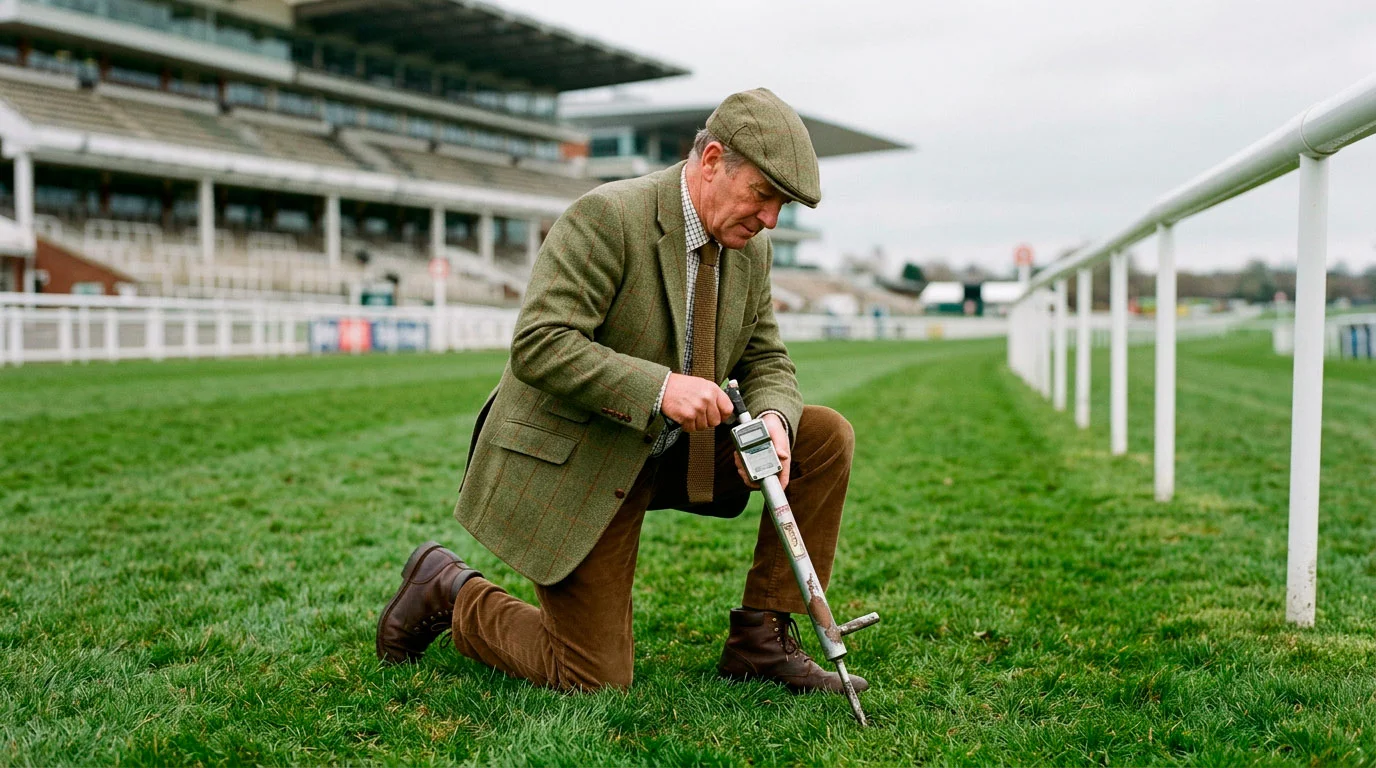
Track Conditions: Soft Good Firm Market Shifts
The single most consequential word on any UK racecard is the going description. Heavy. Soft. Good to Soft. Good. Good to Firm. Firm. Five words on turf, three for all-weather (Standard, Standard to Slow, Slow), and those words decide which horses are well-handicapped and which are running over their heads. The going is the difference between a 14/1 specialist drifting to 25/1 on the wrong ground and the same horse being backed off the boards when the surface is in their favour.
The going report is set by the Clerk of the Course, the on-the-ground official responsible for the racing surface. The clerk uses a going stick to measure ground penetration alongside their own physical inspection – walking the course in the morning, checking for soft patches, drainage variation, watering effects. The published going is their professional judgment, refreshed on race morning and updated through the day if conditions shift.
For betting purposes, the going report is the data point that reorders every other consideration. Form lines have to be filtered through the going lens. A horse that’s won three times on Good is a different animal on Soft. The whole pre-race process – picking selections, deciding bet types, sizing stakes – should start with the going report and work outward from there. Punters who treat going as a footnote miss the largest single edge available in pre-race analysis.
The Official UK Going Scale
The published UK going descriptions follow a consistent scale. From quickest to deepest on turf:
Firm – fast, dry, hard ground. Almost extinct in modern UK racing because tracks water aggressively to avoid it; you might see Firm in genuine summer drought conditions at certain courses, but Good to Firm is more common as the dry-ground description these days.
Good to Firm – the standard dry-summer going. Fast surface, suits speed horses with sound action.
Good – the median description, neither fast nor slow. Most race form is based on Good ground, so the form lines tend to predict best for Good-ground races.
Good to Soft – slightly slower than Good. Stamina starts to count alongside speed.
Soft – genuinely deep ground. Stamina specialists come into their own; speed merchants struggle to act.
Heavy – extreme depth. Some horses simply won’t run on Heavy; others love it. Almost a different sport from Good-ground racing.
All-weather courses use a simpler scale: Standard (the default), Standard to Slow (with extra surface dressing), Slow (deeper, slower surface). The all-weather scale describes the surface preparation rather than weather-driven moisture levels, so the going is more predictable race-to-race than on turf.
One important nuance – the scale isn’t linear. The gap between Heavy and Soft in terms of how the racing surface plays is larger than the gap between Soft and Good. Heavy ground is genuinely punishing, and form lines from Heavy races often don’t translate to softer conditions. Plenty of horses have one career-best run on Heavy and never reproduce it in less extreme conditions.
How Watering and Weather Shift the Market
The morning before any UK race meeting, the Clerk of the Course usually announces watering plans. Watering matters because it shifts the going faster than rain can. A 24-hour watering programme can turn Good to Firm into Good or even Good to Soft, particularly if temperatures are high enough to keep the moisture in the surface.
Markets move on the watering announcements. A horse priced 11/2 in the morning when the going is described as Good to Firm can shift to 9/2 by midday if the watering announcement suggests the ground will be Good or softer by race time. Conversely, if rain that was forecast doesn’t arrive and the clerk holds off on watering, ground-quick horses contract and ground-soft horses drift.
The rainfall forecast is its own pricing input. UK weather is changeable enough that a 3 PM race scheduled for Good ground can be raced on Good to Soft if the morning’s rain comes through faster than predicted. Late-morning form shifts based on weather are common, particularly in spring and autumn.
The strategic move for punters is to commit early-price bets only on going-confirmed runners. If you’re betting on a horse whose form is heavily ground-dependent, don’t lock in a 9 AM price if there’s a chance of a going change by 11. Wait for the going to settle. Better to lose a couple of points of price than to find your specialist horse running on ground they hate. BOG protection helps in the other direction – if the price drifts after you’ve taken it, BOG covers you.
Soft-Ground and Firm-Ground Specialists
Identifying specialists is the highest-value form-study work in UK racing. The going-stick measurements have made the official descriptions more consistent than they were a decade ago, but the form line is still where the real signal lives.
A soft-ground specialist’s form will show repeated wins on Soft, Good to Soft, and Heavy, with poor runs on Good and Good to Firm. The pattern repeats across multiple seasons and multiple courses – it’s not a course-specific quirk but a genuine surface preference. Some breeders’ lines produce soft-ground horses reliably: certain stallions throw stayers and soft-ground performers more often than they throw speed horses.
Firm-ground specialists are rarer in the UK programme because Firm itself is rare. What you find more often are Good-to-Firm specialists who go off short whenever the ground is dry. These horses typically have wins on faster ground and poor form when the going turns soft. They tend to be sprinters and milers, where speed matters more than stamina.
Trainer patterns reinforce the signals. Some yards have a reputation for thriving on soft ground – typically the West Country yards historically – while others target the summer Flat programme with horses bred to handle fast going. Reading the trainer alongside the form gives you cross-confirmation. A West Country jumps yard sending a horse to a Soft-ground Sandown handicap is a positive signal even before you’ve checked the horse’s individual form.
The 21,728 UK horses in training in 2025 – down 2.3 per cent year on year – includes a meaningful sub-population of going-specialists whose connections specifically target races where the ground suits. The contracting population means there are fewer specialists at any given meeting, which means the ones who do turn up at the right going are often clustered in markets and shorter than they should be. A 5/1 soft-ground specialist running on Good to Soft is sometimes a 7/2 fancy because the smart money has found the same form line. Read early, bet early.
Adjusting Bet Type to Conditions
The bet-type implications of going are concrete and worth working through.
Extreme going – Heavy in particular, but also strongly Firm conditions – tends to produce stretched-out fields where outsiders come through past tiring favourites. Each-way bets on long-priced fancies become more attractive in these conditions, because the place positions are more likely to be filled by horses the pre-race market didn’t price for. A 25/1 each-way on a 22-runner Heavy-ground handicap with four places at quarter odds is the kind of bet I’d routinely make in November on a wet Saturday at Bangor or Newbury.
Standard Good going produces the most predictable form patterns. Form-driven straight win bets work best on Good. The longer-priced surprises are rarer, the favourites win more often, and each-way edge is correspondingly smaller. On Good-going midsummer Flat handicaps, win-only is often the cleaner play.
Going changes during a meeting are the situational opportunity worth waiting for. If the going is Good to Soft for the opening two races and trending toward Soft by the fourth, the soft-ground specialists in races four through seven get progressively more interesting. Conversely, if the surface is drying through the afternoon, the going-quick specialists improve as the day goes on.
UK racecourse attendance hit 5.031 million in 2025 – the first time crossing five million since 2019, up 4.8 per cent year on year. That on-course presence matters for going judgement because the published going report is sometimes lagged behind what’s actually happening on the surface. Punters watching jockeys’ returns from earlier races on the day, or paying attention to time analysis from the first three races, often see the going trend before the published description catches up. Cross-reference this with handicap-specific reading on the same conditions in the handicap betting basics piece.
Going Questions
Two questions come up around going that don’t have intuitive answers – the all-weather going scale differences, and whether form should be discounted when going was extreme.
Articles
Created by the "typesbethors" editorial team.
