
 Available in US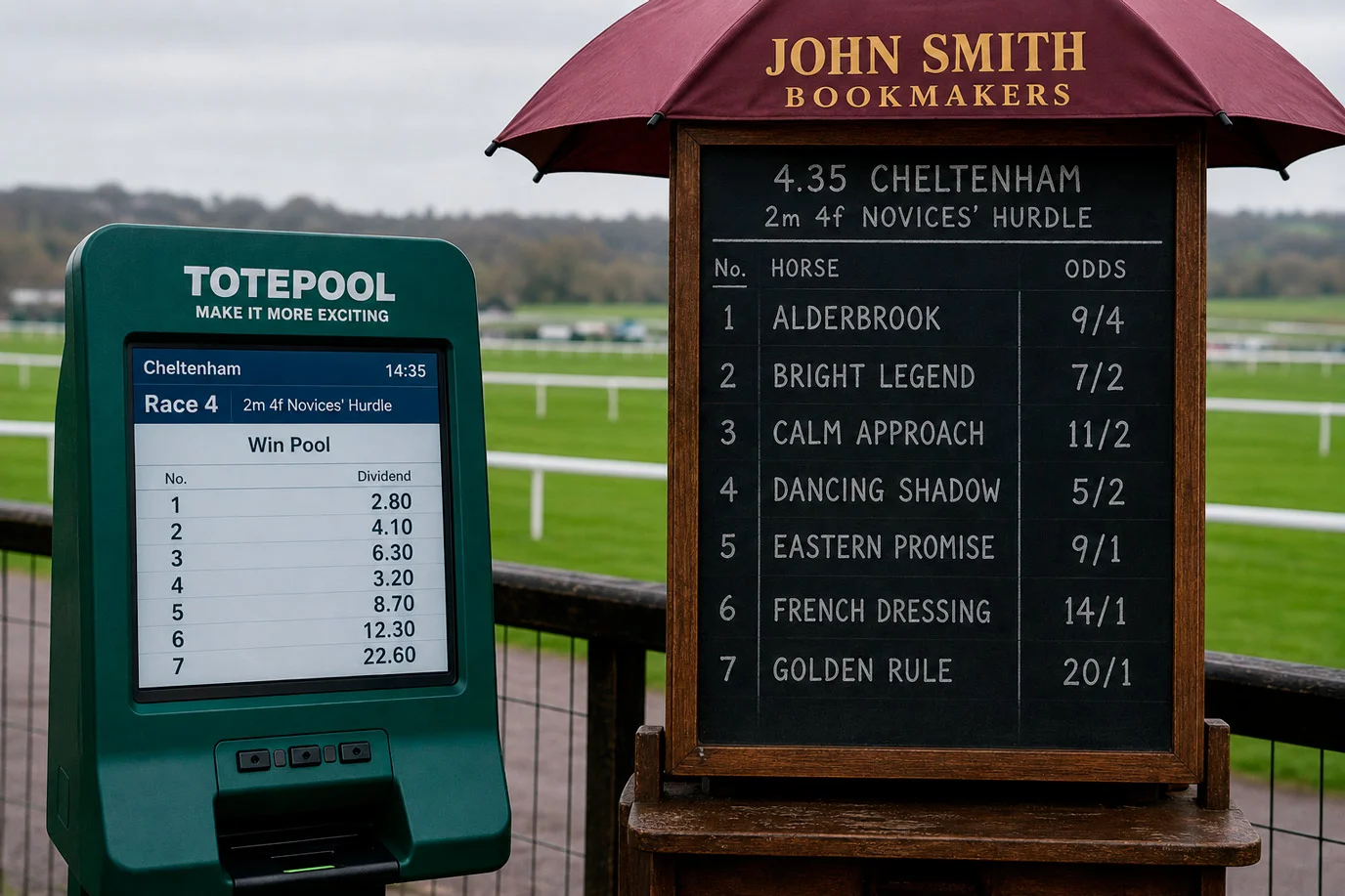
Two Betting Worlds in One Race
Every UK race is priced twice at the same time. The fixed-odds book runs through the bookmakers – Bet365, William Hill, Paddy Power, the rest – quoting individual prices that you can lock in. The pari-mutuel pool runs through the Tote and now britbet, gathering all stakes into a common fund that pays out based on the dividend the pool produces post-race. Same horses, same race, two completely different pricing mechanisms. And about 95 per cent of UK turnover goes through fixed odds, just 5 per cent through the pool.
Wikipedia’s industry data and the figures cited across the racing trade press put the UK pari-mutuel share at around 5 per cent of total betting turnover, with fixed odds taking the remaining 95. That ratio has been stable for years. The pari-mutuel pool isn’t going to displace fixed odds in the UK any time soon – but the 5 per cent that runs through the pool routinely contains better expected-value opportunities than punters realise.
The strategic question for the UK punter isn’t which system to choose universally. It’s which system fits which bet in which race. Some races and some selection types favour the fixed-odds market structurally; others favour the pool. Understanding the difference is one of the genuinely undervalued skills in UK punting.
How the Two Pricing Engines Work
Fixed odds prices are set by individual bookmakers based on their own pricing model and risk position. The layer takes a view on each horse, prices it accordingly, and accepts bets at that price. Each layer’s price reflects their own book – different operators may quote 5/1 against 11/2 against 6/1 for the same horse depending on their own modelling and existing exposure. You shop the prices, take the best one, lock in.
The pari-mutuel pool calculates dividends from the actual stakes that go into the pool. If the total Win pool on a race is £8,000 and £1,500 of that backed the winner, the post-takeout pool of approximately £6,400 (assuming 20 per cent takeout) divides among the winning units. £6,400 divided by £1,500 means each £1 unit returns £4.27 in profit plus the £1 stake. Equivalent to roughly 17/4 fractional.
The structural difference: fixed odds tells you the price before you bet, the pool tells you the dividend after the race. With fixed odds, you commit to a known price; with the pool, you commit to a known stake but unknown dividend. The pool dividend depends on how the other money distributed across the field, which you can’t fully know until the race has run.
Both systems take a margin. The fixed-odds margin is the overround built into the prices – typically 105 to 130 per cent for UK win markets. The pool margin is the takeout, deducted from the pool before dividend calculation – typically 17 to 25 per cent depending on product. Different mechanisms, similar economic effect, both extracting roughly 15 to 25 per cent of stake value across the punter population over time.
When the Pool Pays More on Longshots
The pari-mutuel pool consistently pays better than fixed odds on longshots, particularly in races where the pool money piled onto favourites. The reason is mathematical: if pool money concentrated on the 4/5 favourite, the dividend calculation on the actual winning longshot doesn’t see much of that money diluting the share. The post-takeout pool divided among a small group of winning units produces a high dividend.
Concrete example: an 18-runner big-field handicap with a 5/2 favourite that ends up winning. Fixed-odds prices on the winner: 5/2, paying £35 profit on a £14 stake. Pool money concentration meant 35 per cent of the pool backed this horse. Dividend equivalent: 1.83/1 – substantially less than the 5/2 fixed-odds price. Conversely, a 25/1 longshot winning the same race: fixed-odds price 25/1 paying £350 profit on a £14 stake. Pool money on this horse: 2 per cent of pool. Dividend equivalent: roughly 40/1.
The HKJC World Pool brought additional liquidity to selected UK race days, with $605 million in turnover across 17 UK and Irish race days in 2022 – up 44 per cent year on year. That international liquidity, particularly on Royal Ascot and Derby days, concentrates pool money in ways that can produce dramatic longshot premiums for punters who bet outside the favoured pack. On World Pool race days specifically, the longshot edge in the pool can be substantial relative to fixed odds.
The trade-off is dividend uncertainty. You commit to a £10 Tote Win bet not knowing whether the dividend will land at 8/1 or 16/1 on the same horse. The fixed-odds price gives you certainty; the pool gives you upside on the longshots and downside on the favourites.
When Fixed Odds Beat the Pool
The fixed-odds market dominates on heavily-backed favourites. A 4/9 jolly that wins produces a fixed-odds payout of £4.44 on a £10 stake. The same horse in the pool likely produces a dividend below SP because pool money concentrated on it – the calculated dividend might be 1/3 or 2/5, paying £3.33 to £4 on the same stake. The Tote Guarantee covers this by topping up to SP, but the fixed-odds price was already the better deal upfront.
The fixed-odds market also wins on certainty. Punters who want to know exactly what their payout will be before placing the bet are paying for that certainty through the overround. The pool offers no such certainty until the race is over and the pool calculates.
And fixed odds offer the BOG asymmetry – take the early price, get the higher of early price or SP. The pool has the Tote Guarantee, which functions similarly, but BOG and Guarantee aren’t always available on the same races, and BOG generally has wider coverage across UK fixtures than Tote Guarantee.
For each-way bets specifically, fixed odds usually win because the place fraction (1/4 or 1/5) is fixed and known at the time of betting. Pool each-way splits the bet into a Win pool entry and a Place pool entry, with the Place pool dividend volatile in ways that don’t always favour the punter. The known fixed-odds place fraction is generally a better proposition than the unknown pool place dividend, particularly on shorter-priced selections.
A Strategy Framework for Choosing
A practical framework for choosing between fixed odds and the pool on any UK race takes three questions.
First, is the horse short or long priced? Short-priced favourites (sub-7/2) generally produce better fixed-odds returns. Long-priced runners (12/1 and above) often produce better pool dividends because of the longshot premium effect.
Second, what’s the field size and depth? Big-field handicaps with 16-plus runners produce more pool variance – favourites get heavier pool money concentration, longshots get bigger relative dividends. Small-field conditions races (sub-10 runners) have tighter pool dynamics that more closely track fixed odds.
Third, what’s the bet type? Win singles work cleanly in either market. Each-way generally favours fixed odds because of the known place fraction. Multi-race pool products like Placepot and Scoop6 only exist in the pari-mutuel world – those aren’t a choice question, they’re pool-only.
The 5 per cent UK pool market share suggests most punters are defaulting to fixed odds without ever asking these questions. The HBLB collected £108.9 million in 2024-25, the highest since 2017, and the operator economics behind that levy depend on healthy pari-mutuel volume alongside the fixed-odds book. Pool products are part of the UK racing ecosystem worth understanding, even if you only deploy them strategically on the races where they offer genuine edge. The granular mechanics of how Tote pools calculate against fixed-odds equivalents are covered in the Tote Guarantee piece.
Pool vs Fixed Odds Questions
Two strategic questions come up frequently – whether the pool’s dividend volatility is too risky for routine betting, and whether combining the two systems on the same race makes sense.
Articles
Prepared by the typesbethors editorial staff.
