
 Available in US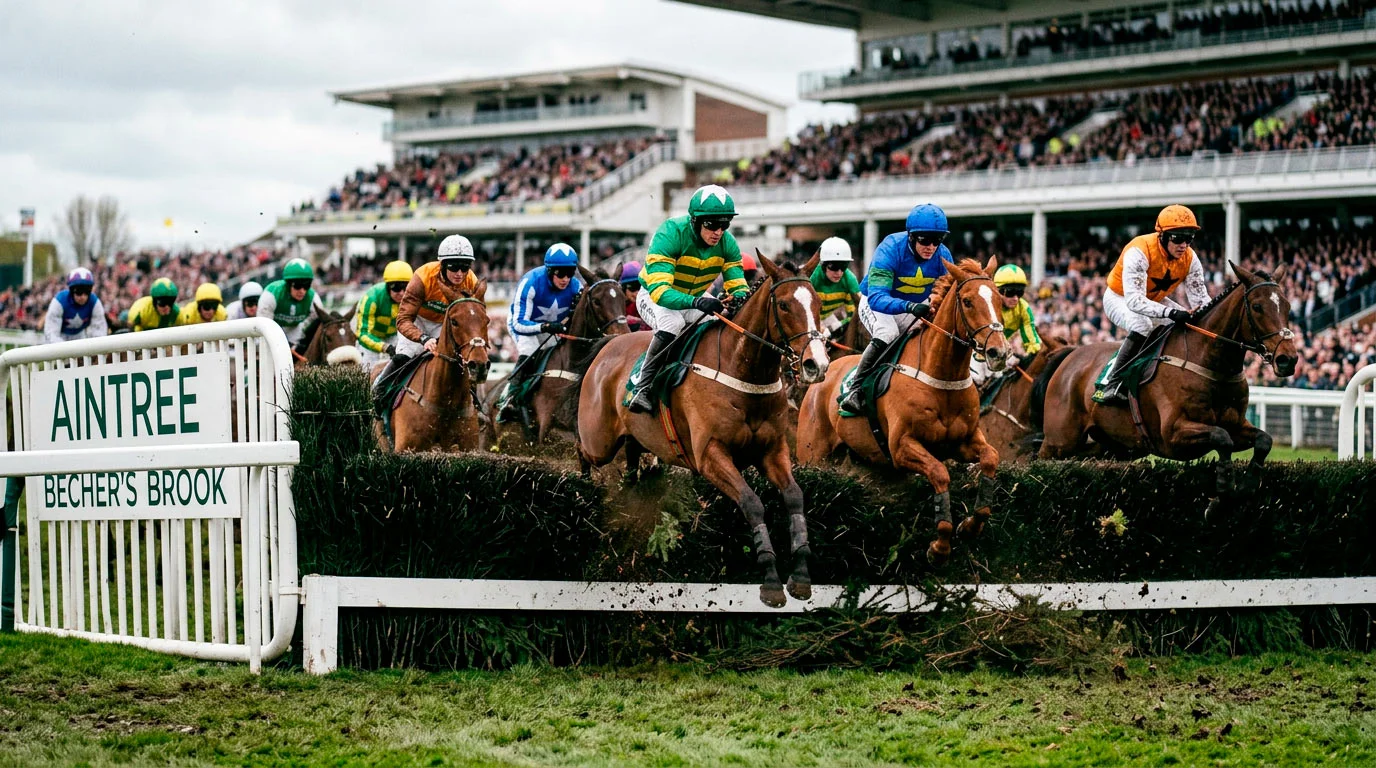
Place Terms Are the Grand National’s Real Battleground
If you can only pay attention to one variable on Grand National morning, make it place terms. Not the horse names, not the going report, not the jockey bookings. Place terms – how many places each layer is paying and at what fraction. I’ve watched extra-place wars between UK bookmakers swing punter ROI on this race by more than the actual selection ever does. Pick the same horse at four places versus seven places and you’re looking at a completely different bet.
Grand National Festival 2025 turnover was forecast at around £250 million across three days, with the National race alone pulling £150-200 million of that. The race generates up to six times more betting turnover than the Cheltenham Gold Cup and roughly seven hundred per cent more bets than its nearest sporting rival. That much money sloshing around one race means the layers are competing harder for it than they compete for anything else on the calendar. Place terms are the weapon they use, and the punter who reads the slip carefully gets paid for noticing.
The base rule is straightforward – sixteen-runner-plus handicap, four places at a quarter the odds. Grand National sails past sixteen runners; the field is capped at thirty-four. So four places at 1/4 is the floor, not the standard. Every operator boosts from there, and the boosts vary by year, by promotional cycle, even by hour on race morning.
Default Four Places vs Enhanced Offers
The default treatment for any handicap with sixteen or more runners under UKGC-licensed terms is four places at a quarter of the odds. On the Grand National that means a 25/1 shot pays 25/4, just over 6/1 fractional, on the place leg of an each-way bet. That’s the baseline you’re working from when you compare offers.
Enhanced terms come in three common shapes. Some operators bump the place count to five – still at quarter odds. Some go further to six places, occasionally at quarter, sometimes shifted to fifth or sixth. The arms race typically peaks at seven places, with the bigger operators using that as their flagship Grand National promotion in the days before the race. I’ve seen layers run seven-place offers, sometimes only for accounts taking the bet on the Friday before, sometimes available right up to the off.
The catch with enhanced offers is in the small print, and the small print changes every year. Common conditions you’ll see: minimum stake floors (often £1, sometimes £5), bet-builder exclusions, in-play exclusions, restrictions on stake size for the boost to apply, sometimes a cap on the additional places paid as a free bet token rather than cash. Read the terms before you place. The five-place at 1/5 offer can quietly pay less in cash than the four-place at 1/4 standard once you do the maths on a 20/1 winner.
One pattern worth flagging – operators rarely cut the place fraction below 1/4 on the National. Where they cut, they cut place count rather than fraction. So a “seven places” offer is genuinely seven places at quarter odds in most cases, even if a five-place offer might quietly be at fifth odds. The fraction is the lever they protect.
Why I Am Maximus Hurt the Books
Run the tape back to Saturday 5 April 2025. Willie Mullins-trained I Am Maximus crossed the line first at Aintree under Paul Townend, having gone off at 7/1 joint-favourite. The win itself wasn’t the bookmakers’ problem. The places were.
“I Am Maximus winning was one of our worst possible scenarios so we weren’t thrilled by the outcome,” said Jack Shelley, Deputy Director of Racing at William Hill. That’s an unusual statement after a favourite wins. Favourites winning generally helps the layer, because favourite money is the largest single category and a winning favourite returns less profit per pound than a longshot. What did the damage in 2025 was the trifecta of placed horses behind the winner, including longer-priced runners who had attracted heavy each-way money on enhanced place terms.
When a layer is paying seven places at 1/4 odds and three of the top-seven finishers are between 25/1 and 50/1, the place liability stacks up faster than the win book can offset it. I Am Maximus’s victory came with placed horses that triggered substantial each-way payouts across the industry. The William Hill quote isn’t bookmaker theatre – it’s a real reflection of how the modern Grand National book gets hurt: not by the winner but by the field finishing in a configuration the layer didn’t price for.
The lesson for punters is direct. The places are where the layers are most exposed on this race. That’s why the enhanced offers exist – they’re designed to look generous while still being profitable on most outcomes. When the result hurts the book, it hurts because the layer’s modelling got the place spread wrong, not because their stars-aligned generosity backfired. Read that for what it is – an invitation to bet each-way at the most generous terms available, on a longshot you genuinely fancy to place.
What an Extra Place Adds to a £10 Stake
Concrete maths makes the point better than theory. Take a £10 each-way bet at 25/1 with four places paid at quarter odds versus the same bet at seven places. The horse finishes sixth – well outside the standard four places but inside the seven-place enhancement.
At four places, sixth is a loser on both halves. You lose your full £20 staked. Net result: minus £20.
At seven places, sixth place wins on the place half. £10 at 25/4 (which is 25/1 multiplied by 1/4) returns £62.50 profit plus your £10 place stake back, so £72.50 from the place side. The win side is still a loser – you lose that £10. Net result: plus £52.50.
So the gap between a four-place layer and a seven-place layer, on this single bet on this single horse finishing sixth, is £72.50. On a £20 total stake. That’s the maths that drives Saturday-morning shopping around between operators. If you’re going to back a 25/1 shot each-way at Aintree, the place terms aren’t a detail – they’re roughly half the value of the entire bet on the place-leg outcome that punters most commonly hit.
I run these numbers for every Grand National bet I place, on every horse I’m considering. Five minutes of comparison-shopping is worth more than five hours of form study on this race. The layers know it, which is why they all run enhanced offers and why they all guard the small print so carefully.
Why Some Punters Drift to Unlicensed Sites
The Grand National also exposes an uncomfortable truth about UK betting. Of the roughly £250 million in race turnover in 2025, around £9.4 million – about 3.8 per cent of the total – flowed through unlicensed operators. That figure has been climbing steadily, with traffic to black-market betting sites up around 500 per cent over three years, coinciding closely with the rollout of affordability checks.
The mechanism is simple. UK licensed operators have to apply financial vulnerability checks at deposit thresholds that step down progressively – the lighter checks now trigger at £150 monthly deposits since February 2025. Punters who object to those checks, or who hit accumulated deposit ceilings on big race days, drift to operators outside the UKGC perimeter. Those operators don’t pay the betting levy, don’t apply UK player protection, and don’t necessarily honour place terms or BOG.
The risks compound. No UKGC dispute resolution, no segregated player funds, no clear withdrawal process if the operator decides not to pay. I’ve seen forum threads from Grand National 2024 of punters chasing payouts from offshore sites that ghosted them after a result didn’t go the layer’s way. The headline place terms might look better at an unlicensed operator. The mortgage on those terms is that you might not see the money back.
If you’ve ever felt the pull of an unlicensed site because their place terms look fatter, run the question through this filter – what happens if I win £2,000 and they refuse to pay? With a UKGC-licensed operator, you have IBAS dispute resolution and the Commission’s enforcement record to lean on. Off the grid, you have a Telegram channel and hope. That’s not a tradeoff worth four extra place positions.
Grand National Each-Way Questions
Two questions come up year after year specifically around Grand National each-way mechanics. Both have surprisingly precise answers under standard UK terms.
If you found the place-terms mechanics useful, the way each-way works across smaller handicaps follows the same logic at lower stakes – I covered this in more depth in the each-way deep dive on the field-size rules that drive when extra places appear at all.
Articles
Created by the "typesbethors" editorial team.
