
 Available in US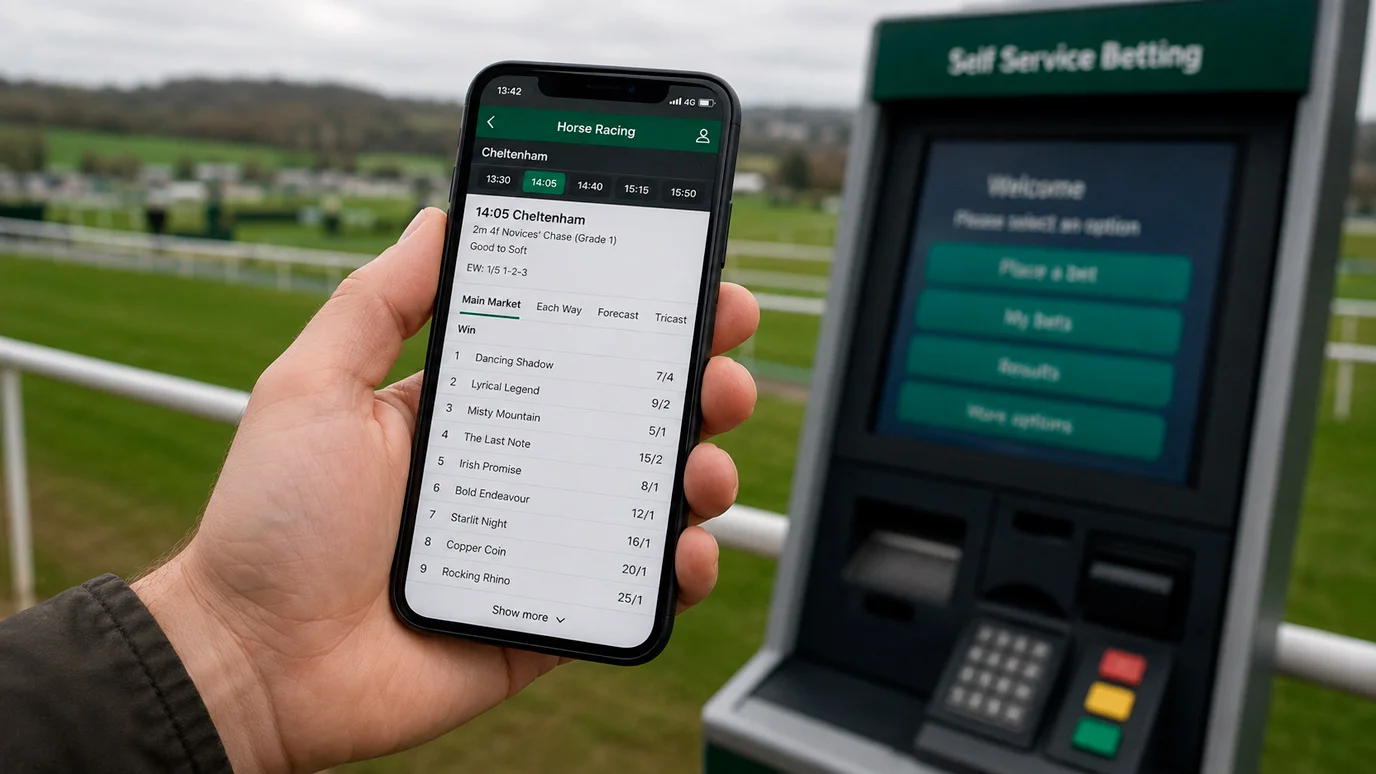
The Device That Changed UK Betting Behaviour
At Cheltenham Festival 2024, more than 80 per cent of all bets placed through Flutter brands came from mobile devices. The remaining 20 per cent – desktop, tablet, on-course paper slips, telephone betting – covers everything else combined. That statistic captures a fundamental shift in how UK punters interact with racing markets, and it has implications for bet selection, timing, and product design that recreational punters rarely consider in framing.
The mobile share isn’t unique to Cheltenham, but the Festival is where the effect is most pronounced. Punters are physically at the racecourse, between races, with their phones in hand. They’re checking prices, placing bets, monitoring in-running positions, and cashing out – all without leaving the seat in the grandstand. The mobile app is the entire betting workflow for a substantial majority of festival attendees.
For the wider UK market, the mobile share is lower but still dominant. Industry estimates put mobile at around 70 per cent of total online betting volume, with the remaining 30 per cent split between desktop, tablet, and rare other formats. The trend has been consistently mobile-positive since around 2018, with a sharp acceleration during 2020-2021 when COVID-era on-course closures forced everyone online and most opted for mobile.
What Mobile Apps Do Better
The strongest mobile features sit in the in-play and live-tracking experience. Mobile apps provide live odds updates with sub-second latency, allowing punters to react to in-running price moves on critical race moments. The phone’s always-on screen and notification system mean you can be alerted to price movements on horses you’re tracking, even when you’re not actively in the app.
Geolocation features are mobile-specific. Some operators show on-course racing schedules adjusted for your physical location, push notifications for races at courses you’ve recently visited, and offer location-specific bonuses for on-course punters. These features have no desktop equivalent in any practical sense – desktop punters need to manually navigate to the relevant race or meeting.
Cash out execution is faster on mobile because the operator’s algorithm has access to recent network signals, gyroscope data for motion detection, and other phone-specific telemetry that lets it confirm the cash-out request is genuine within milliseconds. Desktop cash out goes through additional verification layers that add second-level delays – not catastrophic but noticeable when the in-play market is moving rapidly.
Touch ID and Face ID make repeat betting faster on mobile. Punters who place several bets per race day can authenticate with biometrics on each placement, while desktop punters typically enter passwords or use security tokens that add friction to the bet placement workflow. Across a Saturday card with 30 races, the time saving compounds noticeably.
What Desktop Does Better
Desktop wins decisively on multi-window race watching and complex bet construction. A punter trying to manage four open positions across two racecourses, track in-running prices on three additional horses, and prepare bets for upcoming races does this work much faster on desktop’s larger screen than on mobile. The cognitive load of mobile multitasking – switching between apps, scrolling through cards, drilling into individual races – is substantial.
Form study is significantly better on desktop. The Racing Post’s racecard layouts, the BHA’s ratings data, the trainer and jockey statistics – all work better with the screen real estate and side-by-side window arrangement that desktop provides. Punters doing serious pre-race form study almost universally use desktop or laptop systems even if they ultimately place the bet from mobile.
Spread betting and complex multiples build faster on desktop. The Sporting Index and Spreadex interfaces are designed for desktop primarily; their mobile apps work but with reduced functionality and slower bet construction. Same applies to combination forecasts and Heinz/Yankee multiples where the bet builder benefits from larger screen layout.
Account management – deposit limits, time-out settings, reality checks, self-exclusion – is generally easier on desktop because the navigation layouts are clearer. Mobile apps deliberately make some of these tools harder to access (settings menus several taps deep) which can be problematic for punters trying to apply safer-gambling tools mid-session.
How Betting Behaviour Changes by Device
Mobile betters place more bets, smaller in average size, more spread across more races. The Cheltenham 2024 Flutter data showed 34.9 million bets across the Festival with an average of 14 bets per user – a high average that’s only sustainable through mobile’s frictionless placement workflow. Desktop betters tend toward fewer bets, larger average stakes, more deliberate selection.
In-play volume is dominated by mobile. The split between pre-race and in-play volume varies by race type, but in-play betting on jumps racing in particular skews 90-plus per cent mobile. The reason is operational – in-play windows are short (a typical chase runs 5-6 minutes) and the speed of execution that mobile enables is essential for in-play timing. Desktop in-play exists but tends to be punters at home watching coverage rather than at-course punters.
Cash-out usage skews even more mobile. The Cheltenham 2024 each-way volume increase of 25 per cent year on year reflects mobile-driven engagement with the each-way product, and cash-out usage within that volume similarly concentrates on mobile because the in-running pricing makes the cash-out decision time-sensitive. Desktop cash out is rarer because desktop punters tend to commit to their positions rather than partially settling them.
Multi-race accumulators (Lucky 15, Heinz, Yankee) construct slightly better on desktop but settle equally well on both. Punters who build full-cover multiples often do the bet construction on desktop and then track settlement across mobile during the day. The two devices complement each other in this workflow.
Operator App Quality Variations
Not all UK operator apps are equally well-built. The major players – Bet365, William Hill, Paddy Power, Sky Bet, Coral, Ladbrokes – have invested heavily in mobile experience and offer competitive feature sets. Smaller operators sometimes have weaker mobile apps with limited in-play coverage, slower load times, or restricted bet builder functionality.
The 24.4 million active accounts at remote UK casino, betting and bingo operators at the end of 2024-25 are distributed across many operators, but the mobile-app quality is heavily concentrated at the top of the market. Punters using smaller operators primarily through their mobile apps may find their effective product is meaningfully inferior to the desktop website version of the same operator.
Cross-device account access works reasonably well on all major UK operators – your account holds the same balance and history whether you log in from mobile or desktop, with bet placement, settlement, and account management synchronised in real time. The cross-device experience is one of the genuinely well-implemented features across the UK licensed sector.
Account holding fund data showed customer balances at remote operators sitting at £1.0 billion at the end of the reported quarter – down 6.9 per cent year on year. That balance is held centrally per account rather than per device, so cross-device usage doesn’t fragment your money in ways that affect betting capacity.
Choosing the Right Device for the Right Bet
The practical workflow I use across both devices: form study and bet selection on desktop the night before or morning of major race days. Final bet placement on mobile to capture any morning market price moves. In-running watching and reactive betting on mobile during race time. Cash-out and post-race review on whichever device is most convenient at the moment.
For Saturdays with multiple meetings and complex bet types, the bet builder work happens on desktop because the interface accommodates the multi-leg construction better. For mid-week midweek single-race bets, mobile is the entire workflow – quick price check, single tap to bet, done in 30 seconds.
For Festival weeks – Cheltenham, Aintree, Royal Ascot – the device split depends on whether you’re on-course. On-course punters live almost entirely on mobile for the duration of the Festival. Off-course punters watching on television may use desktop for racecard display alongside the broadcast, with mobile handling actual bet placement.
The 16 per cent of UK males who bet in the last 4 weeks compared to just 4 per cent of UK females (Wave 3 2025 figures) describes the active betting population. Within that population, the mobile-versus-desktop split is increasingly age-driven – younger punters skew heavier mobile, older punters retain more desktop habits. The trend over the next several years will almost certainly be further mobile dominance as the next generation of punters enters the market with mobile-first expectations. For deeper context on how in-play markets specifically interact with device choices, the in-play piece covers the timing dynamics that make mobile dominate that specific bet type.
Mobile vs Desktop Questions
Two questions come up about device choice – whether app-only bonuses are worth chasing, and whether mobile bets settle differently from desktop bets.
Articles
Written by the editors at typesbethors.
