
 Available in US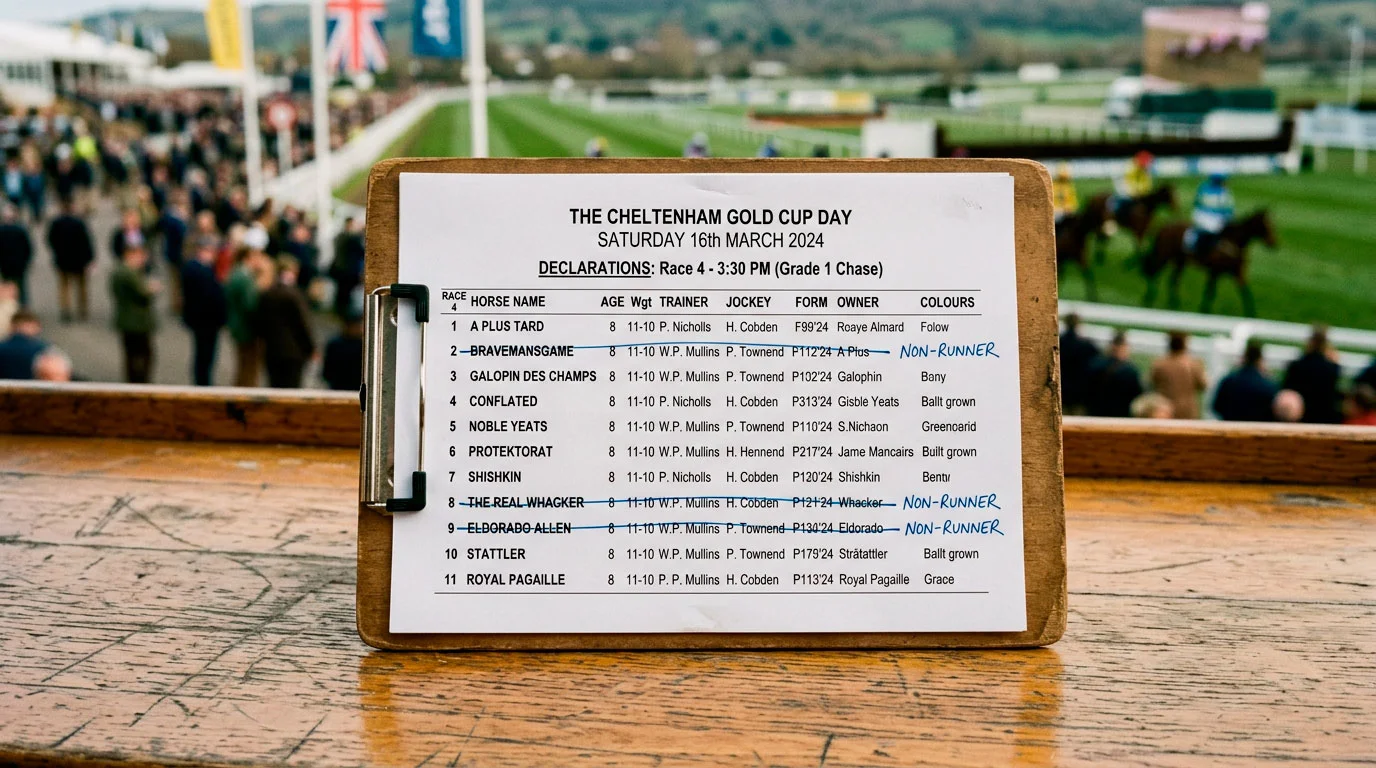
When Stake Survives a Withdrawal
The first ante-post bet I had refunded under NRNB was in 2018, on a Cheltenham Champion Hurdle fancy that didn’t make the start. The stake came back in full the same evening. No questions, no Rule 4 deductions, nothing. That was my introduction to what NRNB actually does – it’s the rule that converts the brutal stake-lost default of ante-post betting into something resembling a normal race-day refund.
Non-runner-no-bet is the bookmaker promise that if your selected horse doesn’t run, you get your full stake back. Plain refund. No partial settlement, no deduction for the market reformation, no fee. The catch is that NRNB doesn’t apply to ante-post markets indefinitely – it activates at a specified date before the race, and any bets placed before that activation are still subject to the stake-lost rule until NRNB kicks in.
That activation moment is the single most important date on the ante-post calendar. Prices typically contract sharply on NRNB activation, because the asymmetric non-running risk gets pulled from the punter back to the layer. If you bet before NRNB activates, you’re effectively paying for the additional price by accepting the stake-lost risk. After NRNB activates, the price is what the price is, and you’re playing a race-day-equivalent bet.
When NRNB Switches On
NRNB activation timing varies by race and by operator, but the patterns are consistent enough to plan around. For most major UK racing fixtures, NRNB activates somewhere between five and seven days before the race. For Cheltenham Festival markets, the standard activation is at the 48-hour declaration stage – which means NRNB goes live on the Sunday afternoon for a Tuesday race, on Monday afternoon for a Wednesday race, and so on through the Festival.
Royal Ascot follows a similar pattern. Most operators flip NRNB at the 48-hour decs stage. Some larger layers – the ones with deeper books and more sophisticated risk modelling – activate earlier, sometimes a full week out, as a customer-acquisition lever. The earlier the activation, the more attractive the offer to punters, but the more risk the layer is carrying.
The Grand National is slightly different. Because final declarations are made earlier in the week (typically the Thursday before the Saturday race) and the ante-post market is unusually liquid, NRNB at Grand National often activates on the Thursday once 48-hour decs are confirmed. Some operators activate slightly earlier in the week – the Wednesday or even the Tuesday – as part of a “Grand National week” promotion.
The Classics – Derby, Oaks, 2000 and 1000 Guineas – see NRNB activate a week or two after final entries close, which is typically a couple of weeks ahead of the race. The flat pattern accommodates the trainer’s ability to confirm runners earlier than in the jumps codes where prep runs and going dependencies create later switches. With UK total turnover in Q1 2025 down 9 per cent year on year, layers have been competing harder on NRNB timing as a way of attracting ante-post stakes.
Operator-specific timings change each year. Always check the specific race’s NRNB clause on the operator’s terms page before you bet, especially if you’re betting in the window where activation might be imminent. A two-day delay in activation can sometimes mean the difference between protected and unprotected stakes.
How Stake Is Actually Refunded
The refund mechanic under NRNB is genuinely clean. Your full stake comes back to your account, usually credited within minutes of the non-runner being declared. The credit appears in your withdrawable balance, not as a free-bet token, not as a partial refund, not with any deduction for the operator’s costs. Stake in, stake out, end of transaction.
What NRNB does not do is apply Rule 4 to the rest of the market. Rule 4 is the proportional deduction applied to winning bets when another horse is withdrawn from the same race – separate mechanic, separate trigger. NRNB sits on the non-running horse’s bet only. If you backed a different horse in the same race ante-post and the runner I’m-talking-about-with-NRNB-protection gets withdrawn, your bet on your horse continues at its original price without a Rule 4 cut. NRNB protects only the bet on the withdrawn horse.
The refund is unconditional in the sense that it doesn’t depend on why the horse didn’t run. Injury, withdrawal at the start, vet-pulled, trainer decision, balloted out of a handicap – all the same outcome under NRNB. The bet voids, the stake comes back. There is one exception worth flagging: if the operator deems the horse to have raced but failed (refused to start, fell at the first), the bet usually settles as a loser rather than as a non-runner. The threshold between “didn’t race” and “raced and failed” is sometimes contested on the borderline cases, but the BHA’s official declaration is the operator’s reference point.
NRNB on Multiples and Accumulators
The mechanics on multiples are where NRNB gets quietly elegant. If one leg of an accumulator becomes a non-runner under NRNB, that leg is removed from the bet and the remaining legs are recalculated as if the non-runner leg never existed. A four-fold becomes a treble. A treble becomes a double. A double becomes a single.
Same principle applies to full-cover bets. A Yankee on four horses with one non-runner under NRNB effectively becomes a Trixie on the remaining three horses – six doubles, four trebles, one accumulator, total 11 bets – recalculated to four doubles plus one treble plus four singles, total 11 individual bets settling on three horses. Wait, I need to recheck that – a Trixie on three horses has three doubles and one treble, four bets total. So a Yankee with one non-runner converts cleanly to a Trixie, with stake reallocated and settled on the remaining three legs. Lucky 15 with one non-runner becomes a Patent. Goliath with one non-runner becomes a Super Heinz.
The strategic point – non-runners under NRNB in a multiple don’t kill the bet, they shrink it. That’s important. The same non-runner without NRNB protection, taken pre-activation, would void the entire multiple in some operators’ rules and would settle as a loser in others. NRNB makes the multiple genuinely resilient to a horse not turning up.
The Q1 2025 turnover decline of 9 per cent year on year squeezed margins across UK operators, and one quiet consequence has been tighter NRNB handling on exotic multiples at some layers. A few operators have specific clauses now where NRNB applies to singles and doubles but not to multi-leg accumulators of four or more, or where multiples are voided rather than shrunk on non-runners. Reading the operator’s NRNB-on-multiples clause is a thirty-second job worth doing if you bet accumulators often.
Festival NRNB Practice
Cheltenham Festival is the largest single use-case for NRNB in the UK calendar. The Festival’s ante-post markets open in autumn for races that don’t run until March, which means there’s a five-to-six-month window in which stakes are exposed to the stake-lost rule before NRNB activates. The 48-hour declarations stage in March converts those exposed stakes into protected bets, which is why the Sunday and Monday of Festival week see substantial NRNB-activation announcements across operators.
Royal Ascot follows a similar pattern but with a tighter window. Ante-post markets open in late autumn or early winter, NRNB typically activates at the 48-hour stage during Royal Ascot week. The 2025 attendance figure of 5.031 million across UK racecourses – the first time crossing five million since 2019, up 4.8 per cent year on year – included strong showings at both Festivals, and that attendance growth is one of the reasons ante-post liquidity has held up despite the wider turnover decline.
Some operators run extended NRNB across both Festivals – activating earlier than 48 hours, sometimes a week out. The trade-off is in pricing: extended NRNB usually comes with slightly tighter prices, because the layer is taking on the non-running risk for a longer window. The punter can still get reasonable prices, but the gap between pre-NRNB ante-post and protected NRNB tightens as the activation window widens.
Strategic move – check NRNB activation dates the moment ante-post markets open in autumn. Operators that publish their NRNB schedule early are easier to plan around than operators that wait until Festival week to confirm timing. The detail matters more than punters tend to realise. A piece on how ante-post markets price these long windows covers the pre-NRNB stake-lost economics in more detail.
NRNB Questions
Two questions surface every year around NRNB edge cases – what happens to balloted-out runners in handicaps, and whether NRNB pays out alongside cash-out activity. Both have clean operator-standard treatments.
Articles
Prepared by the typesbethors editorial staff.
