
 Available in US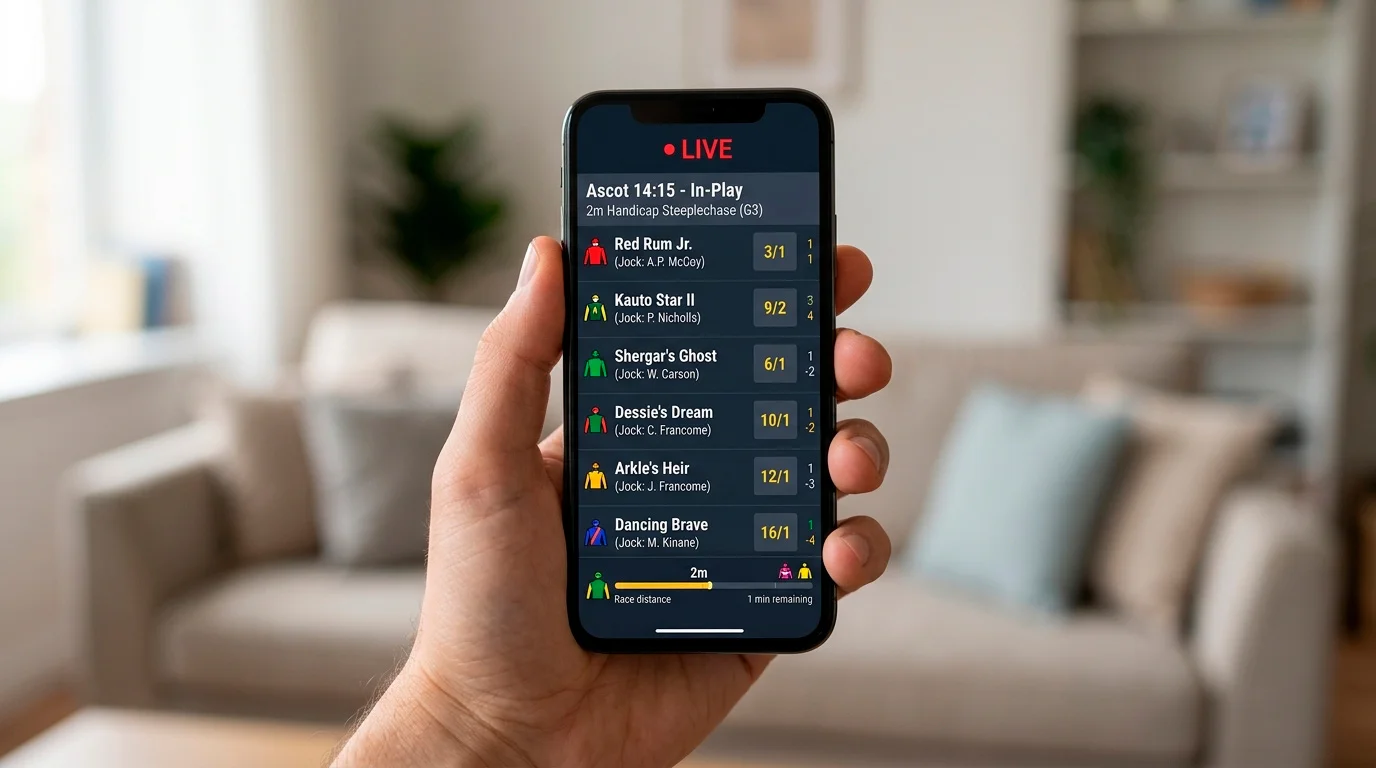
Live Betting: In-Running Exchange Latency and Odds
The window I’m working with on a UK race in-play is typically eight to fifteen minutes. From the off to the line, that’s the entire trading universe. Football in-play has 90 minutes plus extras. Tennis in-play has hours. Horse racing in-play is a sprint – you’ve got the time it takes a chaser to clear two fences to spot a price you like, place the bet, and have the bet accepted before the layer or the exchange engine pulls the market.
In-play horse racing betting is exactly what the name says: bets placed after the off, before the line. Operators run two flavours. Sportsbook in-play, where the layer prices the runners dynamically and the punter takes or refuses those prices. And exchange in-play, where peer-to-peer matching is the mechanism and prices move with whatever orders are in the book. The mechanics, the latency, and the strategic opportunities differ markedly between the two.
What unites them is the speed. UK racing in-play forces a different kind of judgment than pre-race betting – you’re reading a live picture, deciding fast, accepting that the bet might be rejected because the market just moved. The Cheltenham 2024 mobile-betting share of more than 80 per cent makes more sense once you’ve watched a punter try to in-play a chase on a desktop browser. The thumb is faster than the mouse, and in-play racing punishes slow input.
How Bookmakers Keep Racing In-Play Live
The infrastructure behind in-play racing markets is more sophisticated than punters give it credit for. The layer is running real-time pricing algorithms that update implied probabilities based on live position data – usually delivered through the race-track’s sectional timing feeds and the TV camera positions on each runner. As the race develops, the algorithm refreshes individual horse prices, sometimes multiple times per second, to reflect what the model thinks the current win probability is.
The most aggressive operators run continuous pricing through the entire race. The more conservative ones suspend the market at predictable points – final furlong, last fence, potential photo-finish situations – to give the human traders time to consider before re-opening. Suspension is the layer’s protective mechanism against being caught with a stale price while a horse closes fast.
The pricing inputs go beyond raw position data. The model knows the horse’s previous form, the going, the typical sectional speed at each stage of a race over this distance at this course. When a horse is travelling on the bridle two furlongs out at the Old Course at Cheltenham, the layer’s model treats that very differently from the same horse two furlongs out at Newcastle – Cheltenham’s uphill finish punishes horses that aren’t travelling, while Newcastle’s flat finish rewards lasting power. The price reflects the prior probability adjusted by the live position.
For punters used to pre-race betting, the implication is that in-play prices are not just the pre-race price moved up or down – they’re a fresh calculation that incorporates information the pre-race market couldn’t have known. A horse that travelled badly in the early stages will be at a longer in-play price than its pre-race price suggests, even if it eventually wins. A horse that’s looked lively from the off will shorten faster than the pre-race market would have predicted.
Picture Delay and Why It Matters
The technical fact that matters most for in-play racing punters is picture delay. Whatever screen you’re watching the race on, the picture is delayed relative to the actual on-course race. The size of the delay varies by source: TV broadcast over Sky or ITV typically runs 2 to 4 seconds behind live; online stream from a betting operator is usually 3 to 5 seconds; mobile data stream over a domestic broadband can hit 5 to 7 seconds depending on the carrier and the time of day.
The layer’s in-play pricing engine is faster than your stream. The model is receiving track-position data direct from the timing feed with negligible delay, while you’re seeing the race after a multi-second lag. That means the price you see on screen reflects a position that has already happened – by the time you react to a horse making a move, the model has already adjusted, and the market price is no longer the price your eyes thought you were seeing.
The arbitrage that some exchange punters have historically run on UK racing involves being physically closer to the source – court-side at Cheltenham with a direct visual on the runners, or with a Racing UK direct feed minimising the lag against the consumer stream. Even a one-second advantage at certain race moments – leading into the final bend, into the last fence – can be enough to back a horse before the wider exchange book reflects the move.
For the recreational in-play punter on a mobile app at home, picture delay is a constant cost. You’re never going to beat the layer’s model by reading the screen. What you can do is make in-play decisions based on race-shape reading – knowing which horse is likely to drift in-play before the field even hits half-way, based on its position and travel – rather than trying to react to the immediate visual.
Betfair Exchange vs Sportsbook In-Play
The Betfair Exchange runs in-play horse racing as peer-to-peer matched betting. Prices on the exchange are set by punters laying and backing each other, with Betfair taking commission on net wins. Sportsbook in-play at a fixed-odds bookmaker is layer-set – you take or refuse the price the operator offers.
The structural difference matters in two specific ways. First, exchange in-play markets often have wider price spreads than pre-race markets because the order book thins as the race progresses. On a Premier Flat handicap with deep pre-race liquidity, the in-play book can still be reasonably tight. On a midweek 4-runner novice hurdle, the in-play book can be patchy enough that backing or laying a horse mid-race at a sensible price simply isn’t possible – the orders aren’t there.
Second, exchange in-play allows you to lay horses – bet against them winning. Sportsbook in-play doesn’t generally offer a “no horse X” market in racing. The lay option opens strategic positions that fixed-odds doesn’t: laying the leading horse two out in a chase if the form lines suggest it won’t see out the trip; laying the favourite at the home turn in a sprint where it’s not travelling. That’s powerful, but it’s also where serious losses happen – laying horses in chase races can produce open-ended losses if the lay’d horse wins and the price has shortened in-running.
Premier Fixtures saw average turnover per race rise 2.7 per cent in 2025 – meaningful in a year when Core Fixtures saw 8.6 per cent drops. Some of that uplift on Premier Fixtures is in-play volume, especially on the exchange where the markets are deepest. The smaller midweek meetings don’t generate the same exchange liquidity, and in-play opportunities there are thinner.
When In-Play Beats Pre-Race
In-play has specific edges over pre-race betting in specific situations. The strongest case is in long-distance staying chases, where the pre-race market often misprices stamina relative to early speed. A horse that travels lazily through the first half of a three-miler can be 8/1 at the off and 2/1 by the time it hits the second-last fence, having stayed on while the front-runners fall away. Punters who read stamina-versus-speed lines well can buy in mid-race at much better prices than pre-race ever offered.
The flip side – backing front-runners in-play – is generally a worse trade. A front-runner who’s set the pace through the first half of a race will see its in-play price contract sharply, often to a level that doesn’t reflect the genuine probability of it being caught. The market chases the leader and overpays for the visible position.
The other clear case is “opposing” favourites that haven’t shown well. A 6/4 favourite who’s at the back of the field at the two pole, looking unbalanced, isn’t a 6/4 favourite any more – they’re a 4/1 chance at best. The pre-race market hasn’t been updated for that information; the in-play market is updating in real time. If you can read the race and act before the model fully adjusts, there’s a price advantage. The challenge is that the layer’s model is reading the same information faster than you are.
Like any technical edge, this gets harder as the operators get better. Five years ago, in-play horse racing markets were noticeably slow to react to early race developments. Today they’re substantially faster, and the gap between the smart punter and the layer’s algorithm has narrowed. Recreational in-play punting is increasingly a way of accelerating the rate at which you lose money rather than a genuine edge. The strategic in-play position requires either real timing advantage or specific race-shape reading that the model genuinely doesn’t capture well – and both are scarcer than punters tend to assume. Operator feature interactions matter here too, since cash out and partial cash out are common in-play products at most layers – covered in the broader operator features piece.
In-Play Questions
Two questions come up consistently around in-play racing – whether cash out works on in-play bets, and why bets sometimes get rejected during the placement window.
Articles
Written by the editors at typesbethors.
