
 Available in US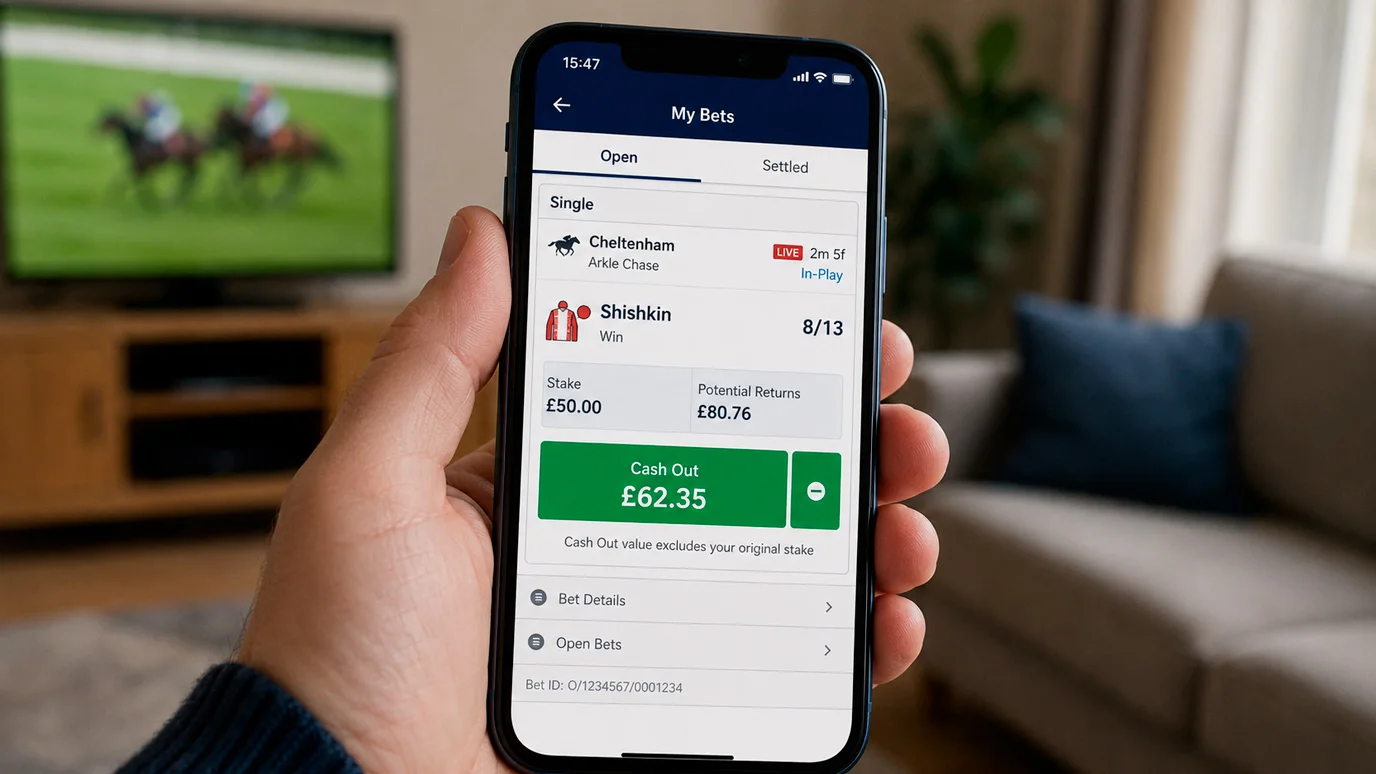
Early Settlement: Mathematical Fair Value and Cash Out
I’ve watched the cash-out button do more damage to punters’ bottom lines than any other operator feature in UK racing. The maths is straightforward: cash out at less than fair value, repeat hundreds of times, lose more money than your selection record actually merits. The button is engineered for psychology – bright colour, prominent placement, a number that’s slightly higher than your stake. The temptation is the entire point.
Cash out is the operator’s offer to settle a live bet before the race finishes, paying you a calculated current value of the bet’s expected payout. The number is derived from the bet’s current implied probability of winning, multiplied by the potential payout, minus the operator’s margin. It looks like fair value. It usually isn’t.
The structural truth about cash out is that it’s a profitable product for the operator, on average, across the punter population. The operator’s cash-out engine has to make money over time – that’s why it exists – and it makes money by pricing the cash-out value below the bet’s fair expected value. The gap between fair value and cash-out value is the operator’s edge, and it compounds over a punter’s lifetime of premature settlements.
How the Cash-Out Engine Prices Your Bet
The cash-out calculation starts from the bet’s current implied probability of winning. If you’ve backed a horse at 4/1 and the horse is now leading two out with the price contracted to 2/1, the cash-out engine reads that 2/1 in-running price (implied probability around 33 per cent) and works backwards.
The fair cash-out value of a £10 stake bet at 4/1 on a horse now 2/1 in-running would be approximately: 33 per cent probability times the £50 potential payout equals £16.50. That’s the bet’s fair value at this moment. Most operators won’t pay you £16.50 – they’ll offer something closer to £15 or £14, with the gap being their margin.
The size of the margin varies by operator and by bet type. Some operators apply a flat percentage discount – say 5 per cent – to the calculated fair value. Some apply a wider discount on less liquid markets where their model has less confidence. Some apply tighter spreads on heavily-traded marquee races where the in-running market is deep and pricing is reliable.
The 24.4 million active accounts at remote UK casino, betting and bingo operators at the end of 2024-25 represent a very large population of punters facing this margin every time they cash out. The aggregate value transfer from punters to operators through cash-out specifically is substantial – and the individual punter rarely feels it because the cash-out number always exceeds the original stake, which feels like a win even when it’s a fair-value loss.
Manual, Auto and Partial Variants
Manual cash out is the default: you click the button when you decide to settle, the operator quotes the current value, you accept or reject. The decision is at your discretion, the value is what the engine offers in that moment.
Auto cash out lets you set a trigger price. If the implied bet value hits your specified target, the bet settles automatically without further input from you. The mechanic protects you from missing favourable moments – say you’re not at the screen at the critical point in the race – but it also commits you to settling at whatever the engine offers when the trigger fires.
Partial cash out splits the difference. You can cash out half of your bet, keeping the other half running. This is the variant that experienced punters most often use, because it lets you bank profit on the contracted-in-running price while keeping exposure to the original full payout if the horse goes on to win. The maths on partial cash out can be elegant – a £10 bet at 4/1 cashed out at £15 for half the stake recovers your original cost (£10 staked, £7.50 immediate, with £2.50 still in the pot), leaving the remaining half as a risk-free position on the outright win.
The trade-off is the engine’s margin on the cashed portion. Partial cash out applies the same margin to the partial amount as full cash out applies to the whole. You’re paying the operator’s edge twice if you partial-out and the bet eventually wins – once on the cashed portion’s margin, once on the foregone full upside from the uncashed portion’s margin equivalent.
When Cash Out Actually Helps Your Bottom Line
Cash out earns its place in specific circumstances. The clearest case is liquidity-event protection. If your horse is leading three out and there’s been a high-profile horse in the field that’s tended to come from off the pace in the final stages, cash out can lock in the protected value before the late-race threat develops. The operator’s engine doesn’t know the specific tactical pattern; you might.
The other genuine use case is risk-managed in-running response. If your horse has been struck into during the race – visible from the camera, not yet reflected in the in-running price – you have information the engine hasn’t yet processed. Cash out before the model updates lets you escape a position that’s about to deteriorate. This requires both attention and timing, and the window is usually narrow.
For routine recreational punting on win singles or each-way bets, cash out is almost always a value loser. The standard pattern – back a horse, watch it lead at the two pole, cash out for slightly more than your original stake – costs you the difference between fair value and the operator’s offer, every single time. Over a year of dozens of such decisions, the cost compounds.
One specific defensive position: never cash out an each-way bet where the place leg is already secure. If your each-way horse is in the paid places with the race won effectively, the cash-out engine still applies its margin to the residual probability of winning the win leg. Letting the bet run gives you full value on the place leg plus the upside if the horse wins; cashing out trades that combined value for a discounted lump sum. It’s almost always the wrong move when the place is already in the bag.
What You Can’t Combine with Cash Out
The cash-out option voids most other operator features that might have applied to your bet. BOG goes away – you take the cash-out value, not the SP-protected payout. NRNB doesn’t trigger after a cash-out; if your selection becomes a non-runner post-cash-out, the cash-out stands and the NRNB refund doesn’t kick in. Rule 4 deductions don’t apply to cash-out values, but that’s a small consolation given the other exclusions.
The combined effect: cash out is best understood as a settlement contract that supersedes the bet’s other characteristics. You’re trading your original bet – with its BOG asymmetry, NRNB protection, Rule 4 exposure and outright payout potential – for an immediate cash settlement at the operator’s discounted price. That’s a complete substitution, not a feature overlay.
The most expensive cash-out scenario I see regularly is a punter cashing out an each-way bet that subsequently has its win leg paying at SP-uplifted prices under BOG. The cash-out engine settled at the early-price probability; the BOG uplift on the eventual SP would have paid substantially more if the bet had been allowed to run. The punter took the small premature win and missed the larger eventual payout – and the operator captured both the cash-out margin and the BOG uplift the punter forfeited.
UK racing’s average turnover per race in Q3 2025 fell 5.8 per cent against 2024 and 11.4 per cent against 2023. Some of that decline reflects punters becoming more cash-out-aware and learning the cost – the aggregate move toward smaller, more frequent cash-outs erodes operator margin in some places and adds to it in others, but the net effect across the industry has been a turnover compression. The wider strategic context, including how BOG and NRNB interact with cash out, is covered in the broader operator features piece.
Cash Out Questions
Two questions come up around cash out that don’t have intuitive answers – whether the offered values are negotiable, and how cash out interacts with multiples and accumulators.
Articles
Created by the "typesbethors" editorial team.
