
 Available in US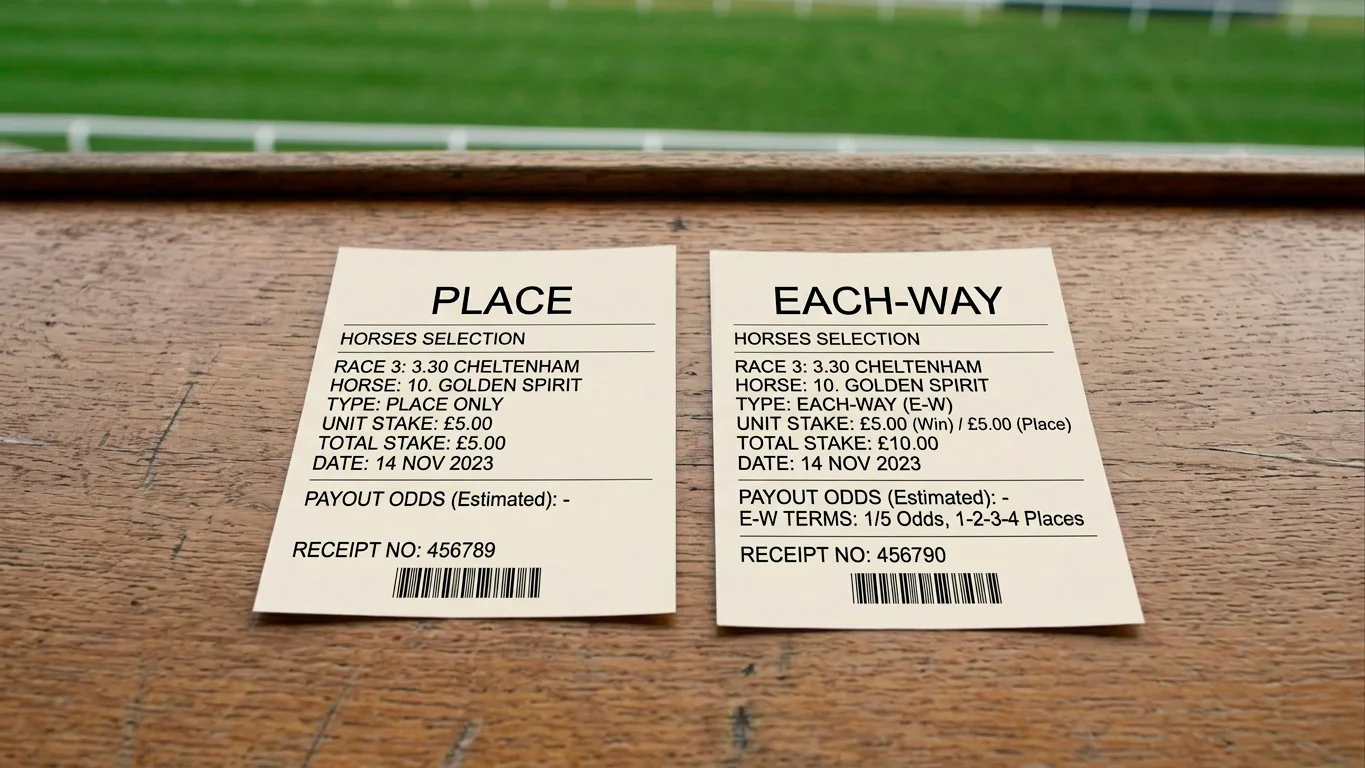
Place Products: Bookmaker Pricing and Returns Math
A reader emailed me last spring after the Lincoln, properly cross. He’d taken what he thought was an each-way at 12/1, watched his horse finish second, and got back what felt like half of what he expected. The reason was simple – he’d backed the place-only market, not each-way, and the two are nothing like the same product. People assume they’re interchangeable. They’re not, and the bookmakers know it.
Place-only is a single bet that pays if your horse finishes inside the paid places. Doesn’t have to win – second, third, fourth all count the same. The odds are quoted separately and they’re shorter than the win price, because there are several ways for the bet to come in. Each-way is structurally different: two equal stakes packaged into one transaction, one half on the win, the other half on the place. You’re paying double the stake and getting two distinct settlement outcomes from one bet.
The two products coexist on the same race but solve different problems. Place-only is for the punter who likes a horse but doesn’t think it’ll win – clean exposure to a top-three finish at a shorter, more honest price. Each-way is for the punter who wants the upside of a win plus a parachute if their horse only places. Mixing them up costs money, and I’ve watched plenty of recreational punters do it.
How a Place-Only Stake Pays
The place-only market sits on a different shelf in the betting app for a reason. Bookmakers quote it as a standalone price, usually somewhere between a quarter and a third of the corresponding win price, depending on field size and how the layer sees the place market filling. If a horse is 10/1 to win, you might see it at 3/1 to place. If it’s 25/1 to win, you might see it at 6/1 to place. The relationship isn’t a fixed fraction – it’s a separate book.
Settlement is clean. Stake the place-only price, the horse finishes in the paid places, you get paid at the full place-only odds. £10 at 3/1 returns £40. There’s no win portion, no extra calculation, no fraction of anything. You don’t get more if the horse wins than if it finishes third – both pay the same amount.
That’s the cleaner part of the trade. The murkier part is which races the market is even available on. Place-only requires a viable place pool – usually eight or more runners on non-handicaps, twelve plus on handicaps – and even then plenty of operators only post place markets on the higher-profile races. You won’t always find a place-only price on a Wednesday afternoon at Brighton. You will reliably find one on Grand National day, where field sizes are massive and the average field across the UK Flat code in 2025 sat at 8.90 runners, with jumps at 7.84. The headline meetings push field sizes well past those averages, which is exactly when place-only markets get worth a look.
Don’t confuse this with the place portion of an each-way. They settle differently, they price differently, and a horse can lose the win leg of an each-way bet but the place-only would still pay at the full standalone price. Same finish, two different products, two different returns.
When You’ll See a Place Market
I’ve been keeping rough mental notes for years on which UK meetings reliably post place markets. The pattern is predictable. Big handicap days. Grand National. Cesarewitch and Cambridgeshire over the Newmarket autumn. November Handicap. Stewards’ Cup. The Ebor. Anything where the field is going to be twenty-plus and the layer needs to attract money into a place book to balance their each-way exposure.
You won’t see it on a six-runner Royal Ascot conditions race like the Prince of Wales’s, even though it’s a marquee meeting. You won’t see it on a maiden hurdle at Sedgefield with seven declared. There simply isn’t enough field width for the place market to make sense – anything paid would compress the price to nothing.
What you will see, increasingly, is place-market promotion around the Festival weeks. Cheltenham, Aintree, Royal Ascot. As Simon Clare put it after Cheltenham 2025, “the tweaking of the racing programme, taking out the old Turners Novices’ Chase and replacing it with a competitive handicap, probably helped” with turnover holding up – and competitive handicaps are precisely where place markets get loaded onto the slip. The handicap programme is where the place book lives.
One operational note worth filing. Place markets often appear later than win markets. The win book might be live the night before; the place book sometimes doesn’t open until the morning. If you’re trying to compare prices between layers, do it on race-day morning at the earliest. The overnight place quote is rarely competitive.
Side-by-Side: Place-Only vs Each-Way on the Same Horse
Consider a 16-runner handicap, a horse priced at 10/1 to win, with each-way running at four places paid at quarter the odds. The same horse is available at 3/1 in the place-only market. You’ve got a tenner to invest. Which bet pays better?
Option one – £10 each-way. That’s £20 staked, ten on the win, ten on the place. If the horse wins: £100 profit on the win half plus £25 profit on the place half (10/1 × 1/4 = 5/2), stakes returned, total £145 back on £20 risked. If it places only: nothing on the win, £25 profit on the place half plus the £10 place stake back, total £35 returned. If it finishes outside the places, you lose the whole £20.
Option two – £20 place-only at 3/1. If the horse wins: £60 profit, £20 stake back, total £80 returned. If it places: same, £80 returned. If it finishes outside the places, you lose £20.
The maths tells you something specific. Place-only pays better than each-way’s place portion alone (£80 vs £35 returned), but each-way’s win-and-place combined wallops it if the horse actually wins (£145 vs £80). You’re trading upside for consistency. The Grand National Festival 2025 turnover hit roughly £250 million across three days, and a big chunk of that flowed through each-way precisely because punters wanted that win upside even though they suspected their horse was a place lay. If you’re certain you’re backing a placer and not a winner, place-only is the better bet. If you think your horse has a genuine win chance, each-way usually wins.
Why Place Markets Have Bigger Margins
Bookmakers price place markets fatter than win markets. Not by a huge amount, but consistently – call it two to four percentage points of overround on top of the win-market margin. The reason isn’t villainy, it’s risk.
A win bookie books one outcome per runner – wins or doesn’t. A place bookie books three or four outcomes per runner, depending on terms. More winning paths, more variance in their book, more capacity for a result to hurt them badly. They charge for that exposure. The compensation comes in the implied probability you’re paying. If a horse is genuinely a 30% chance to place – meaning three places out of, say, ten plausibly involved runners – fair odds would be 7/3, roughly. The market will quote you 2/1 or 9/5. The gap is the margin you’re paying for the place security.
This matters for strategy. If you’re playing place markets routinely, the long-run drag of the extra margin is real. A serious punter wouldn’t sit in place-only markets all season – the overround compounds against you. Place-only earns its place in your toolkit on specific occasions: a horse you genuinely fancy to run third or fourth but don’t trust to win, in a big-field handicap where the field is wide enough to make place value real. Outside that, the each-way market or the win-only market usually offers cleaner expected return.
Place Market Questions
The most common confusions I see from new punters around place markets break into two camps – when you’re even allowed to bet place-only, and how the settlement compares with each-way. Both have short, specific answers under UK rules.
Articles
Published by the typesbethors team.
