
 Available in US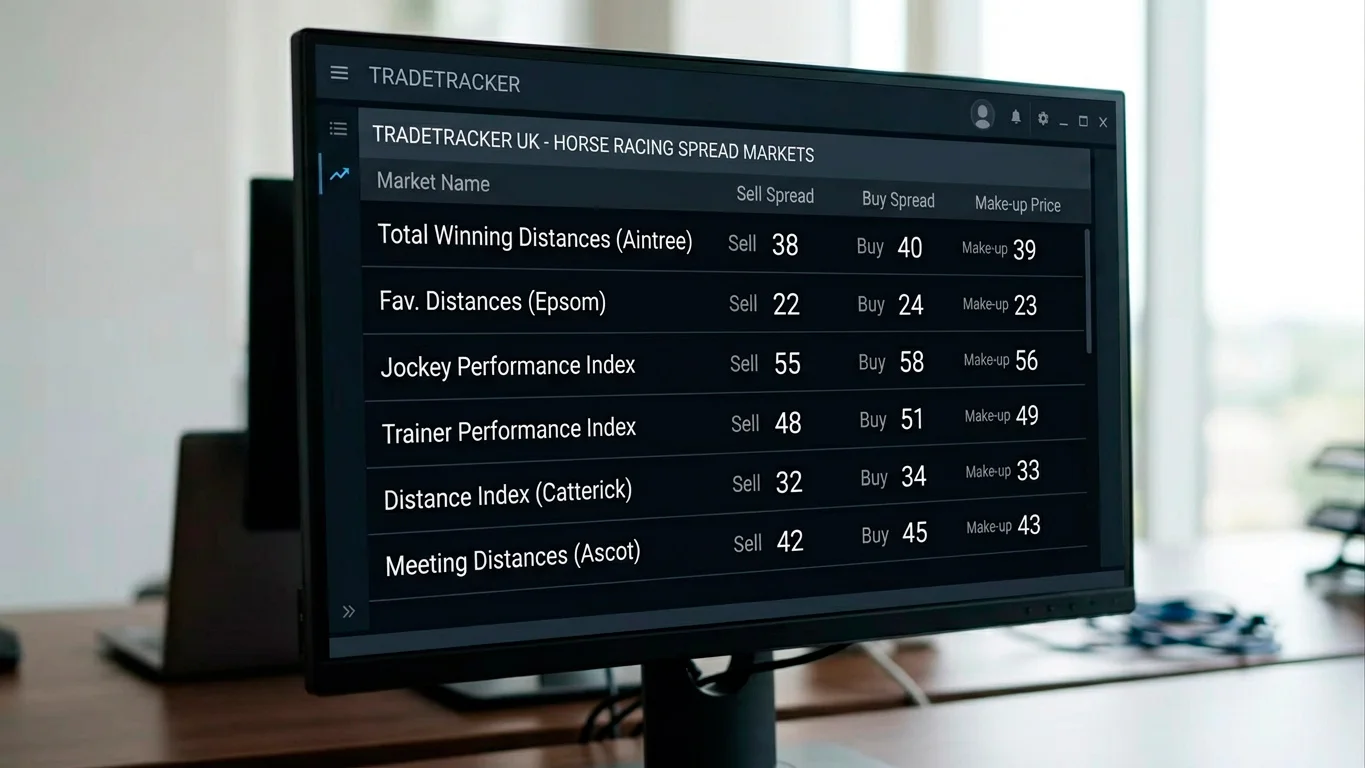
The Bet Type Where Your Loss Can Exceed Your Stake
The first time I placed a horse racing spread bet, the operator’s interface warned me – repeatedly, in heavy capital letters – that my losses could exceed my deposit. The warning isn’t promotional theatre. Spread betting on horse racing is structurally different from fixed-odds or pool betting in a way that introduces unbounded downside, and every UK punter considering the product should understand exactly what that means before clicking through.
Spread betting is a derivative product. You’re betting on whether some race-day index will end above or below a quoted range, not directly on a horse winning. Examples of indices: total race distance, winning distance margins, jockey wins on the day, race time relative to standard. The operator quotes a “spread” – a range – and you buy (above the top of the range) or sell (below the bottom) depending on your view. The payout is the per-point movement of the actual index from your entry price, multiplied by your unit stake.
The structural risk is that the index can move much further than the spread suggested. If you sold an index at 25 and the actual make-up was 60, you’re paying 35 points multiplied by your unit stake. At £10 a point, that’s £350 lost on a single bet – substantially more than the £10 unit stake suggested as your starting position. Spread betting is not for casual punters, and the Sporting Index and Spreadex products are regulated specifically to require client warnings and limits to address this asymmetric risk.
How Race-Day Spread Markets Work
Sporting Index and Spreadex – the two main UK spread betting operators with racing markets – quote indices on a variety of race-related outcomes. The most common include:
Race times: an index reflecting how the actual winning time compares to the standard time for the race. A quoted spread of 0-3 seconds (race time index) would mean the operator thinks the winning time will be 0 to 3 seconds slower than standard. Buy at 3 if you think it’ll be slower than that; sell at 0 if you think it’ll be faster.
Winning distances: an index totalling the cumulative winning margins across multiple races on a card. If the operator quotes a 25-30 length spread, you’re betting on whether the combined winning margins will exceed 30 lengths or fall below 25.
Jockey performance indices: an index reflecting a specific jockey’s combined finishing positions across their rides on a card. Top finishes score higher index points; out-of-the-money finishes score lower. The spread reflects expected aggregate performance.
Race outcomes specific: the lengths between first and second in a specified race, total runners completing the course, total distances ridden by specified jockeys.
Each index has a defined “make-up” – the actual numerical result of the index once the relevant races have concluded. The operator settles each bet based on the difference between the punter’s entry price and the make-up, multiplied by the unit stake.
The Maths That Defines Your Exposure
The fundamental spread bet equation is: profit or loss equals (make-up minus entry price) multiplied by unit stake, with a sign convention that depends on whether you bought or sold.
Buy at 25 with £10 unit stake. Make-up at 35. Profit equals (35 – 25) × £10 = £100.
Buy at 25 with £10 unit stake. Make-up at 15. Loss equals (25 – 15) × £10 = £100.
Sell at 25 with £10 unit stake. Make-up at 35. Loss equals (35 – 25) × £10 = £100.
Sell at 25 with £10 unit stake. Make-up at 15. Profit equals (25 – 15) × £10 = £100.
The maths is symmetric in absolute terms but the practical implications aren’t. The downside exposure is theoretically unbounded – an index can move arbitrarily far against your position. The Grand National 2025 turnover hit roughly £250 million across festival days, with 12 million punters and 82 per cent staking £5 or less. Fixed-odds stake sizes have a hard floor and ceiling. Spread betting stake sizes are similarly bounded by the unit stake, but the loss multiplied through index movements can produce outcomes that overwhelm what a fixed-odds bet of equivalent unit stake could ever produce.
For risk management, most UK spread operators offer stop-loss protections – automatic close-out at a specified loss level – and most accept “guaranteed stop” orders that limit downside to a published maximum at the cost of slightly worse entry spreads. Using these tools is essential for spread betters who haven’t fully internalised the unbounded-loss structure.
Where Spread Betting Earns Its Place
The strategic case for spread betting in UK racing isn’t general – it’s specific to bet types where the punter has a strong view on the magnitude of an outcome rather than the binary outcome itself. Several scenarios fit.
Margin betting on a perceived dominant favourite. If you think the favourite will not just win but win by 8-plus lengths, the spread market on winning distance lets you express that magnitude view. Buying the winning-distance spread at, say, 4-6 lengths captures the upside if the favourite wins by 10 lengths in a way that the fixed-odds market doesn’t reward at all. The fixed-odds bet pays the same on a 1-length win as a 10-length win; the spread bet captures the margin specifically.
Pace-driven race time predictions. If you’re convinced the race will be run at a slow pace producing a slow time, the spread on race time relative to standard can be sold at the operator’s quote. Make-up substantially slower than standard pays the difference multiplied by stake.
Cumulative card indices. The “total winning distances on the card” index appeals to punters with views on whether the day’s racing will produce close finishes (small index value) or runaway wins (large index value). The bet expresses a card-level view rather than a race-level one.
Jockey performance composites. Strong views on a jockey having a particularly good or particularly poor day can be expressed through the jockey performance index in ways fixed odds can’t easily replicate.
How Spread Markets Differ from Fixed Odds
The fundamental differences shape every strategic decision. Fixed odds give you a known maximum loss (your stake) and a known payout (price multiplied by stake). Spread bets give you unknown maximum loss and unknown payout, both proportional to index movement multiplied by unit stake.
Stake sizing on fixed odds bets is straightforward – you decide how much you’re willing to lose and that’s your stake. Stake sizing on spread bets is more complex – your unit stake combined with the index range determines your maximum reasonable loss, which can require explicit risk modelling rather than just budget-based decisions.
Settlement timing differs too. Fixed odds settles immediately after the race ends – you know your win or loss within seconds. Spread bets on multi-race indices settle only after the relevant races have all concluded, which means your position is live longer and the cumulative effect of multiple races plays out across the settlement period.
Tax treatment is the same – UK gambling winnings are not taxed regardless of whether they came from spread bets or fixed odds. The 15 per cent Remote Betting Duty applies to spread operator profits as it does to fixed-odds operator profits. The punter-side tax position doesn’t change.
Operator regulation differs slightly. Spread betting on financial markets is regulated by the Financial Conduct Authority; spread betting on sports including horse racing falls under both FCA and Gambling Commission frameworks. The operator-side compliance requirements are stricter for spread betting than for traditional fixed-odds betting because of the unbounded-loss potential, which is why account opening processes at Sporting Index and Spreadex include more thorough financial vulnerability assessments than typical UK bookmaker accounts.
Practical Cautions for First-Time Spread Bettors
Start at the minimum unit stake. Sporting Index and Spreadex both accept unit stakes as low as 25 pence per point on most markets. A £1 per point bet sounds small but can produce four-figure losses if an index moves substantially. Start at the smallest accepted unit and only increase once you’ve experienced multiple settlements and understand the magnitude of typical index movements on the markets you’re betting.
Use stop-loss orders. The operator interface offers automatic close-out at user-specified loss levels. Use them. They protect against the catastrophic scenario where you forget about an open position and an index moves dramatically – a horse running 30 lengths clear on a winning-distance index, for example, can produce a loss far exceeding any reasonable position sizing.
Understand the make-up mechanism for each market. Different operators settle indices through different specific calculations, and edge cases (non-runners, void races, photo finishes, stewards’ enquiries) can produce surprising make-up values. Read the market rules before you bet, not after.
Don’t combine spread bets with leveraged fixed-odds multiples. The cumulative risk profile of holding spread positions while also betting full-cover multiples on the same races compounds in ways that aren’t intuitive. Most spread bettors who’ve taken serious losses have done so because they had multiple correlated positions running simultaneously and didn’t grasp the aggregate exposure.
The 24.4 million active accounts at remote UK casino, betting and bingo operators at the end of 2024-25 includes a small but specialist spread betting population – Sporting Index and Spreadex are not mass-market UK operators. The specialist nature reflects the higher complexity and risk; the user base is generally more experienced than the typical Saturday-afternoon punter. If you’re new to UK betting and considering spread bets, the answer is generally to learn fixed-odds and pool products thoroughly first. For deeper context on the broader operator features that interact with spread bets, the bookmaker features piece covers the licensed-operator landscape.
Spread Betting Questions
Two questions come up often about racing spread betting – whether stops eliminate downside, and how spread betting compares to exchange laying in risk terms.
Articles
Prepared by the typesbethors editorial staff.
