
 Available in US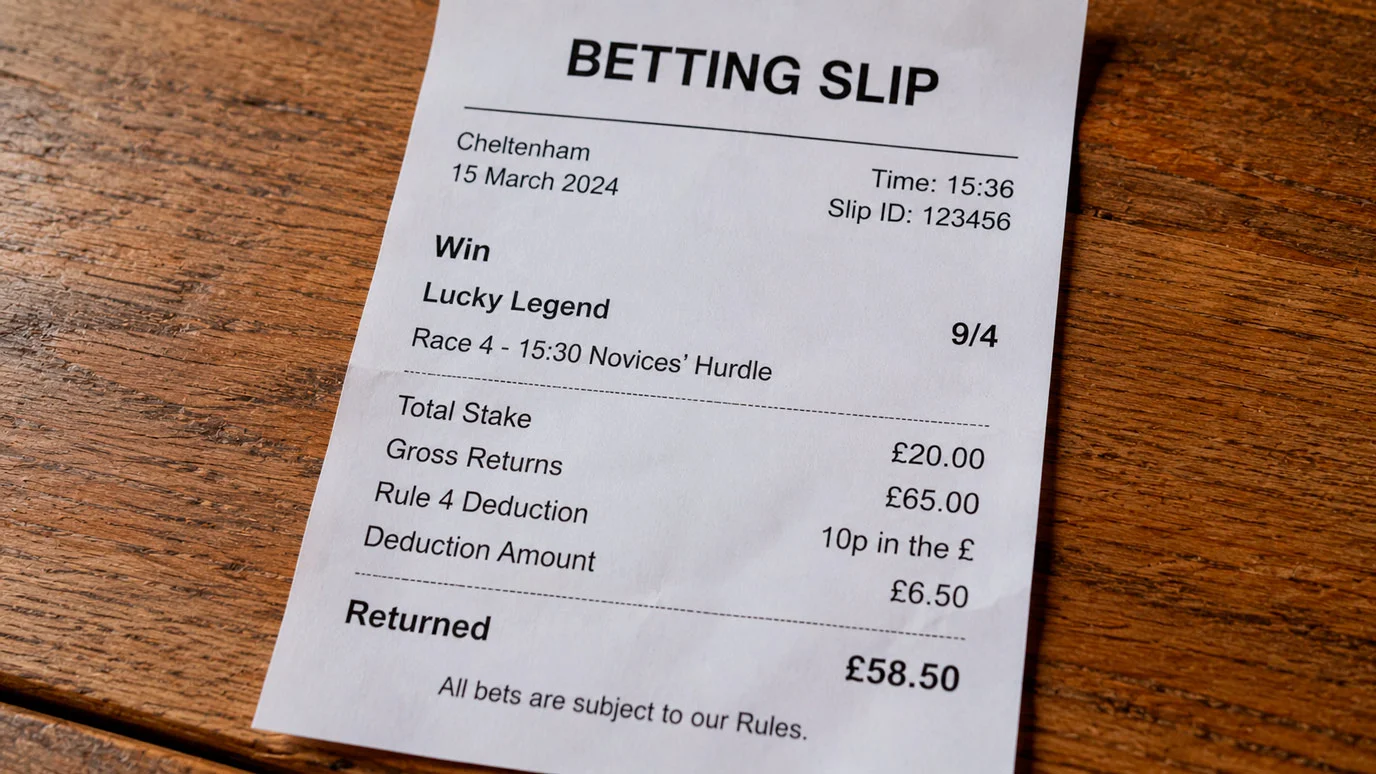
The Deduction That Catches Punters Out
A friend rang me a few years back, properly aggrieved. He’d backed a 7/1 winner at Ayr at his board price, settled his bet expecting £80 back from a tenner, and got £64 instead. He thought he’d been swindled. He hadn’t – he’d been Rule-4’d. A horse priced 11/4 had been withdrawn ten minutes before the off, and his winning bet at the board price had been pro-rata reduced under the Tattersalls scale. As Richard Wayman pointed out: “total betting turnover has fallen by nine per cent compared with the same period in 2024,” and one of the quiet reasons punters drift is settlement surprises like this one. Rule 4 is the most common cause of “where did my winnings go?” complaints in UK racing.
Rule 4 is the rule that pro-rata reduces winnings on horses bet at board prices when another runner is withdrawn between the market being formed and the race starting. The deduction applies to winnings, not to stake. The size of the deduction depends on the price of the withdrawn horse – shorter-priced withdrawals trigger larger deductions because their removal moves the market more.
The mechanic is intuitive once you see it. If a 5/4 favourite is withdrawn from a race where you’ve backed a different horse at 6/1, the entire market’s implied probability shifts. Your 6/1 horse is now effectively shorter, because one of its main rivals has gone. Rule 4 captures that probability shift by trimming your eventual return. The maths is published in the Tattersalls scale, which every UK operator applies in essentially the same form.
When Rule 4 Is Triggered
Rule 4 applies in a specific window: after the bet has been placed at a board price, after the market is formed, before the race starts. It doesn’t apply to ante-post bets placed before the relevant declaration stage. It doesn’t apply to bets taken at the official starting price. It doesn’t apply if the withdrawal happens before the early-price market opens in the morning.
Most Rule 4 events happen in the final hour before a race. Vet-pulled withdrawals, late stable issues, refusals to load – these are the typical triggers. A horse already in the racecard but pulled at the start of the race itself isn’t a withdrawal in the Rule 4 sense – that’s a non-runner from the off, settled differently. The clean test: was the market still reading the horse as a runner when you placed your bet? If yes, and it’s subsequently withdrawn, Rule 4 applies.
SP bets are exempt. The reason is logical – SP itself is calculated from the on-course market at the moment of the off, by which point any withdrawn runners have already been removed from the layers’ boards. The SP is already a “post-withdrawal” number, so applying a further Rule 4 deduction would double-count. Punters who take SP on every bet never see a Rule 4 deduction in their settlement history.
Average turnover per race in Q3 2025 fell 5.8 per cent against 2024 and 11.4 per cent against 2023. Part of the conversation about why this is happening points at settlement frustrations – Rule 4 included – driving punters toward exchanges and offshore products where the deduction model works differently. The UK fixed-odds layer applies Tattersalls uniformly, and “uniformly” doesn’t mean “transparently” to recreational punters.
The Tattersalls Scale Table
The Tattersalls scale is the published rate card. Every UK licensed bookmaker uses it, so the deduction you face will be identical whichever operator you bet with. Here’s the scale, reading withdrawn-horse-price first and deduction-per-pound-of-winnings second.
1/9 or shorter: 90p in the pound deducted from winnings.
2/11 to 2/17: 85p deducted.
1/4 to 1/5: 80p deducted.
3/10 to 2/7: 75p deducted.
2/5 to 1/3: 70p deducted.
8/15 to 4/9: 65p deducted.
8/13 to 4/7: 60p deducted.
4/5 to 4/6: 55p deducted.
20/21 to 5/6: 50p deducted.
Evens to 6/5: 45p deducted.
5/4 to 6/4: 40p deducted.
13/8 to 7/4: 35p deducted.
15/8 to 9/4: 30p deducted.
5/2 to 3/1: 25p deducted.
10/3 to 4/1: 20p deducted.
9/2 to 11/2: 15p deducted.
6/1 to 9/1: 10p deducted.
10/1 to 14/1: 5p deducted.
Above 14/1: no deduction.
The scale is logarithmic – small shifts in withdrawn-horse price near the bottom of the table produce big shifts in deduction, while at the longer-priced end the deductions taper to almost nothing. A 7/1 withdrawal costs you 10p in the pound; a 16/1 withdrawal costs you nothing. That’s why on a small-field race you can see the entire payout of a winning bet vanish under Rule 4 if the favourite is pulled, while on a big-field handicap with a 25/1 longshot withdrawal you’ll barely feel the deduction.
Worked Example: £20 Win Bet With a 4/1 Withdrawal
Concrete numbers make the scale make sense. Take a £20 win single backed at 5/1. Before the race starts, a different horse priced at 4/1 is withdrawn. Rule 4 kicks in at the 10/3-to-4/1 row of the Tattersalls scale: 20p deducted in the pound from winnings.
Your horse wins. The pre-deduction maths is straightforward: £20 staked at 5/1 yields £100 in profit, plus £20 stake back, total £120 returned.
Rule 4 applies the 20p deduction to the winnings portion only. £100 profit reduced by 20 per cent equals £80. The stake is untouched – your £20 comes back regardless. So the actual return on your account is £80 profit plus £20 stake, total £100.
The bet that would have paid £120 pays £100 instead. £20 evaporates into the deduction, captured by the operator to cover the probability shift the market underwent when the 4/1 horse went out.
The same principle scales up and down. A £100 bet at 5/1 with a 4/1 withdrawal yields £500 profit before Rule 4, £400 after – same 20 per cent trim. A £10 bet at 5/1 with the same withdrawal pays £40 profit instead of £50.
One nuance – if you took the bet at SP rather than the board price, Rule 4 doesn’t apply at all. The SP itself is calculated post-withdrawal, so the price you receive already reflects the market’s adjusted view. SP bets on the same race in the same operator would pay full winnings without any deduction.
Two Withdrawals – Rule 4 Doubles Up
The maths gets slightly nastier when two or more horses are withdrawn from the same race. The deductions stack – added together, capped at a maximum of 90p in the pound. So if a 4/1 horse and a 7/1 horse both get withdrawn, the deductions of 20p and 10p combine to 30p in the pound off winnings.
That 90p ceiling matters in extreme cases. A small-field race with two short-priced favourites both pulled can theoretically generate deductions adding to over 90p, but the cap holds at 90p. So a 5/1 winner with two 2/5 withdrawals (each deducting 70p) wouldn’t see a 140p deduction – the operator caps at 90p, meaning the winnings reduce by 90 per cent.
In practice, multi-withdrawal Rule 4 events are rare. Most races see at most one late withdrawal, and many race days produce no Rule 4 deductions across the entire card. But when they do happen, they can be brutal – a £100 winning bet with combined deductions hitting 90p in the pound returns just £10 of profit plus the £100 stake. The HBLB Annual Report noted turnover per race down 8 per cent year on year and around 19 per cent over four years – and Rule 4 frustrations on big-event races, where multiple withdrawals happen more frequently, contribute to that softening of betting volume on the bigger meetings.
The defensive move against Rule 4 is the same defensive move against most settlement quirks – bet SP when you’re worried about late withdrawals. The Tattersalls scale only applies to board prices. The trade-off is that SP might land at a worse number than your morning board price, and BOG-protected board prices usually outperform unprotected SP over a season. Plenty of operator features overlap on this terrain – I covered the broader strategic picture in the operator features piece.
Rule 4 Questions
Two questions get asked enough about Rule 4 that they’re worth direct answers – whether SP bets are genuinely exempt, and whether the deduction reduces stake or only winnings.
Articles
Written by the editors at typesbethors.
