
 Available in US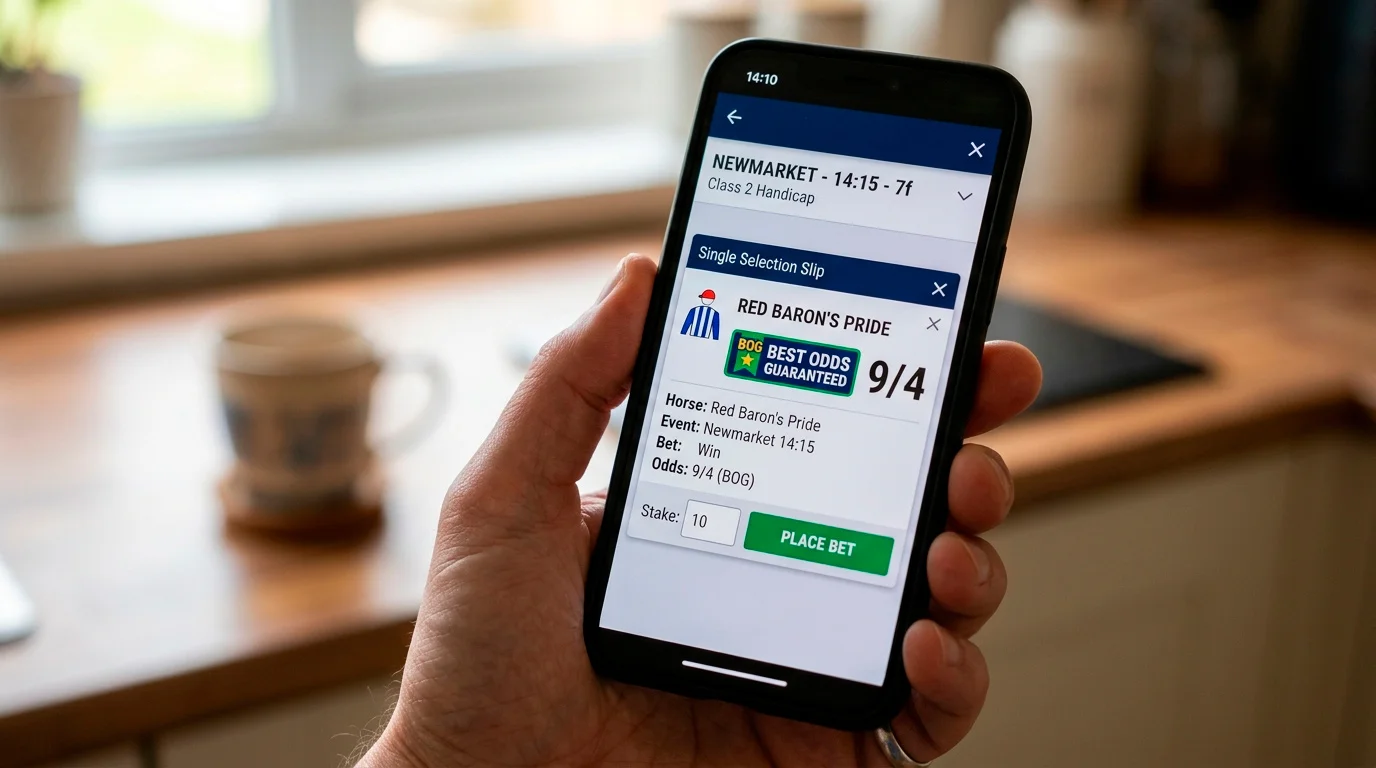
A One-Way Promise to the Punter
I tell every new punter who asks about UK racing promotions the same thing – BOG is the only operator promotion that’s worth understanding properly. Cashback offers wash out over time. Free-bet matched deposits have rollover strings attached. Acca insurance pays a token. Best Odds Guaranteed actually does what it says and it actually changes the expected value of every bet you place. As Grainne Hurst put it about the wider regulatory environment, “once the rises take effect, the UK will have the highest online gaming taxes in Europe” – and inside that pricing pressure, BOG remains the one piece of value the layers genuinely hand back to the punter.
The structure is asymmetric. You take an early price – say 8/1 – at any point from when BOG goes live in the morning until the race begins. If the starting price comes in shorter, say 5/1, you keep your 8/1. If the starting price drifts longer, say 12/1, BOG pays you the SP. You can’t lose on the price direction. The layer is essentially writing you a free option to take the higher of two prices.
The whole game becomes: take early prices that look good to you, then let BOG handle whatever happens. No more agonising over whether to lock in now or wait for SP. The asymmetry exists because the layers compete on it, and because they’ve calculated the cost into their margin. They lose money on individual BOG payouts – they make it back across the millions of bets where the early price holds or shortens.
When BOG Becomes Live
BOG isn’t live around the clock on every race. The standard window across most UK operators starts at 8 AM on the morning of the race and ends at the off. Some layers run BOG from earlier – overnight, from 9 PM the evening before – and a few run shorter windows from 10 AM. The window varies by operator and sometimes by race meeting.
The morning start time matters because the first prices of the day are often the longest you’ll see. A horse you fancy at 14/1 in the 7 AM market might be 10/1 by 9 AM and 8/1 by midday. If your operator’s BOG window starts at 10 AM, the 14/1 morning price isn’t BOG-eligible – you’ve taken it as a regular fixed-price bet. If their window starts at 8 AM, the 8 AM market is BOG-active, but the pre-8 AM prices aren’t. Always check the operator’s window before assuming a price is BOG-protected.
Race-day cutoff is universally the off itself. BOG doesn’t apply once the tape goes up. Bets placed during in-play settle at the price you took without any BOG uplift if SP turns out longer.
One pattern worth noting – the 15 per cent betting duty on UK horse racing remained intact after the Autumn Budget 2025, meaning operator margins on racing weren’t squeezed in the way they were on online slots. That’s one reason BOG keeps existing on UK racing while many other promotions are getting trimmed elsewhere. Racing punters benefit from the carve-out even if they never read the Budget headlines.
How BOG Applies to Each-Way Bets
The way BOG settles on each-way is where most punters get confused, and where operators are most varied in their handling. The general principle: BOG applies to the win portion of an each-way bet but not to the place portion. The place leg settles at the original price you took, at the original fraction (1/4 or 1/5 depending on the race), regardless of where SP lands.
Walk through a worked example. £10 each-way at 16/1 on a Festival handicap, place terms four places at quarter odds. SP drifts to 25/1. If the horse wins, the win half settles at the BOG-uplifted 25/1 – £250 profit plus £10 stake back. The place half settles at the original 16/1, paying 4/1 in place fraction – £40 profit plus £10 stake back. Total return: £310. If your operator applied BOG to both halves, you’d get more, but most don’t.
If the horse only places, only the place half pays – and it pays at the original 16/1 fractional rate, not the BOG-uplifted 25/1. So you’d get £40 plus £10 stake back, £50 total, on £20 risked.
The variation between operators on this point is meaningful. A handful do apply BOG to the place leg as well as the win leg, particularly on promotional weeks like Festival or Grand National. Most don’t. Reading the each-way BOG clause specifically is the only way to know – the general BOG terms page usually has a separate paragraph on multiples and on each-way settlement.
Common BOG Exclusions
The exclusions are where the small print earns its keep. A few patterns recur across UK operators.
Cash-out bets are nearly universally excluded. The moment you cash out, the bet is settled at the cash-out value and BOG doesn’t apply retroactively, even if SP would have paid more. The cash-out value already incorporates the layer’s view of likely outcome, including expected SP movements.
Multiples – accumulators, full-cover bets, Lucky 15s – have variable treatment. Some operators apply BOG leg-by-leg, with each winning leg uplifted to the higher of early price or SP. Some apply BOG only to single-bet legs and not to multiples. A few apply it only to the win-part of each-way singles and explicitly exclude any multiple bet. This is the area where the operator-by-operator differences are largest.
Ante-post bets are excluded almost universally. The early-price BOG promise applies to day-of-race board prices, not to ante-post prices struck weeks earlier. Some operators run special ante-post BOG promotions tied to specific Cheltenham or Grand National markets, but those are explicit promotions with separate terms.
Specific handicaps occasionally get excluded by particular operators, especially on big race days where the layer’s exposure is unusually heavy. The exclusion is rare on UK racing – handicaps are usually BOG-active – but it does happen. Worth a quick check on the operator’s BOG-excluded races page before betting big on a handicap. The interaction between BOG and other operator features is where things get fiddly – the broader piece on UK bookmaker features covers how BOG plays alongside NRNB, Rule 4 and cash-out at settlement.
And online betting accounts for 65.6 per cent of UK horse racing turnover and around half of gross gambling yield. The asymmetry of BOG is part of why online has grown so consistently – the value transfer to the punter on every BOG payout is what online operators offer that on-course bookmakers structurally can’t.
How Much Edge BOG Actually Gives
The expected-value contribution of BOG over a season of betting is larger than most punters realise. The maths is reasonably clean if you stake to consistent units and bet at consistent times.
Take a punter who bets £20 win singles on UK racing, taking the morning price at 10 AM consistently, who places 200 bets through the year. Over those 200 bets, the morning price will move in roughly three patterns by SP: shorter by an average of 8 to 12 per cent on about half the bets (steamers and weight-of-money plays), longer by an average of 10 to 15 per cent on about a third of the bets (drifters), and approximately level on the remainder.
Without BOG, the punter locks in the morning price and gets nothing extra when their horses drift. With BOG, every drifter contributes the additional uplift to the eventual payout if the horse places or wins. Modelling this across a 200-bet sample produces an annual ROI uplift of somewhere between 2 and 4 percentage points for a typical recreational punter, depending on stake-weighting and which races they tend to play.
For a punter staking £4,000 across those 200 bets, that’s £80 to £160 of additional expected return per year, captured purely from taking early prices instead of SP at operators with BOG live. That’s not a fortune, but for a hobby that doesn’t expect to be net-positive over time anyway, it’s a meaningful drag-reducer.
Professional punters get more out of BOG than recreational punters, because they tend to bet earlier in the morning when prices are widest. The differential between early-price-with-BOG and late SP for someone betting at 6 AM on a steamer is often 15 to 20 per cent in their favour over the season.
BOG Questions
The two questions I see most often around BOG are both about edge cases – whether BOG survives a cash-out, and why some bookmakers cap the upside. Both have direct answers that line up with how operators have structured the promotion.
Articles
Published by the typesbethors team.
