 Available in US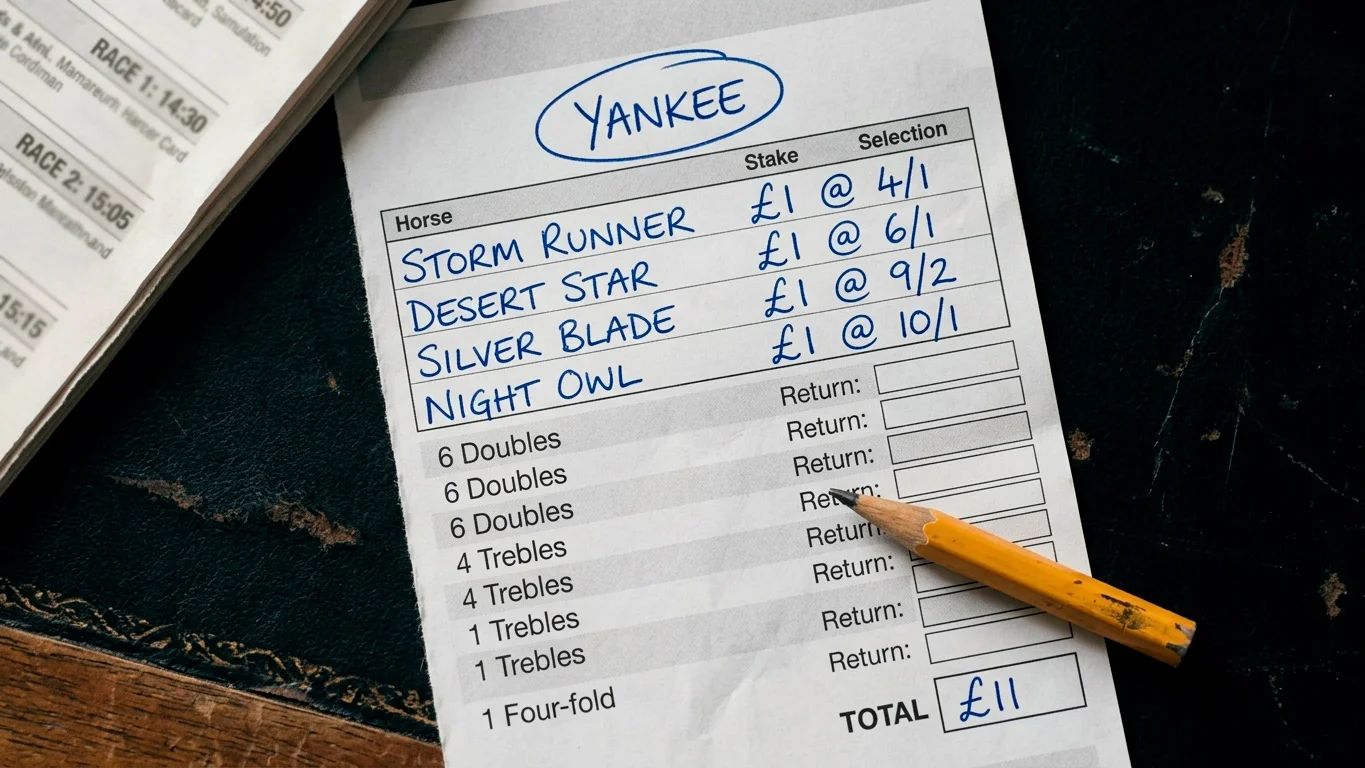
- Full-Cover Bets: Combination Multiples and ROI Strategy
- Trixie: 4 Bets on 3 Selections
- Yankee: 11 Bets on 4 Selections
- Patent: Yankee's Plus-Singles Sibling
- Lucky 15: 4 Selections, 15 Bets
- Lucky 31 and Lucky 63: Bigger Selections, Bigger Stakes
- Heinz and Super Heinz: 57 and 120 Bets
- The Goliath: 247 Bets on 8 Selections
- Union Jack Trebles: 9 Selections in a 3×3 Grid
- When System Bets Make Sense — and When They Don't
- System Bet Questions Punters Get Wrong
Full-Cover Bets: Combination Multiples and ROI Strategy
A full-cover multiple is not a single bet — it is a packaged set of every possible combination of doubles, trebles and accumulators that you can build out of a given number of selections, all settled from one slip. Three selections produce four combinations. Four selections produce eleven. Eight selections produce two hundred and forty-seven. The names — Trixie, Yankee, Lucky 15, Heinz, Goliath — are just industry shorthand for a specific combination count and a specific selection count. Strip the marketing language away and what remains is plain combinatorial maths.
What separates a full-cover bet from a straight accumulator is the partial-winner rule. An accumulator needs every selection to win or the whole bet dies. A Yankee needs only two of the four selections to win — the bet still returns money on the doubles, even if half the slip lost. That tolerance for partial losses is what punters are paying for, and it is also what bookmakers charge a substantial cumulative margin to provide. Every combination in the bet is settled at the bookmaker’s margin. Eleven combinations in a Yankee mean eleven applications of that margin, stacked.
The other thing worth setting up front: the unit stake matters more than the headline name. A “one-pound Lucky 15” is a fifteen-pound bet. A “one-pound Goliath” is a two-hundred-and-forty-seven-pound bet. The slip software almost always defaults to a low unit stake to keep the total visible, but the total can escalate fast if you bump the unit even modestly. Knowing the multiplier on each bet name is the floor of competence on this part of the form.
The chapters below work through each of the standard UK full-cover bets in increasing order of complexity, with the unit-stake multiplier, the minimum number of winners required for a return, and the practical case where each bet starts to earn its place on the slip.
Trixie: 4 Bets on 3 Selections
A Trixie is the smallest of the full-cover bets and the natural starting point for understanding how the maths grows from there. Three selections, three doubles, one treble combining all three. Four combinations total. At a one-pound unit stake, the slip costs four pounds.
The minimum requirement is two winners. Lose two or three selections and the whole slip is dead. Win two of three and you collect on the one double those two horses formed; the other two doubles and the treble settle as losers. Win all three and the slip pays the maximum.
The maths is worth walking through. Three selections at evens — 1/1 — at a one-pound unit. A double at evens-and-evens returns a unit stake of one pound × 2 × 2 = four pounds; three pounds of which is profit. Three doubles at four pounds each is twelve pounds in returns. The treble returns one pound × 2 × 2 × 2 = eight pounds. Twelve plus eight is twenty pounds of returns on a four-pound outlay. Net profit: sixteen pounds.
The Trixie sits on a knife edge: it requires two winners to return anything, and the loss rate at two-of-three is significant. The case where it earns its place is when the punter has three medium-priced selections — say 3/1, 4/1, 5/1 — where the win-and-place maths of each-way is unattractive, but the prospect of getting two-of-three is realistic. The Trixie is then a cleaner expression of “two of these three should come in” than three singles or a three-fold accumulator.
It is the bet that taught a generation of UK punters that one slip can pay something even when not everything won.
Yankee: 11 Bets on 4 Selections
The Yankee is where full-cover betting starts to get interesting. Four selections produce six doubles, four trebles and one four-fold accumulator — eleven combinations on one slip. At a one-pound unit, the bet costs eleven pounds. Like the Trixie, it requires a minimum of two winners to return anything.
The combinatorics scale fast. The six doubles are every pair you can pull out of four — AB, AC, AD, BC, BD, CD. The four trebles cover every set of three. The single four-fold is the full accumulator ABCD. Two-of-four winners hits one double. Three-of-four hits three doubles and one treble. Four-of-four hits everything.
Let me run a specific case. Four selections at 4/1 on a Saturday ITV afternoon. One-pound unit, eleven-pound stake. If all four win, each double returns one pound × 5 × 5 = twenty-five pounds. Six doubles at twenty-five each is one hundred and fifty pounds. Each treble returns one pound × 5 × 5 × 5 = one hundred and twenty-five pounds. Four trebles at one twenty-five is five hundred pounds. The four-fold returns one pound × 5⁴ = six hundred and twenty-five pounds. Total: one thousand two hundred and seventy-five pounds in returns on an eleven-pound stake.
That is the slip every punter remembers. The reality is that most Yankees settle on two or three winners. Two-of-four at 4/1 returns the one winning double — twenty-five pounds on eleven staked. Twelve pounds net. Modest. Three-of-four at 4/1 returns three doubles plus one treble — seventy-five plus one hundred and twenty-five — two hundred pounds on eleven staked. The slip earns its place even without the full house.
The Yankee is the most popular full-cover bet in UK racing because the maths sits in a sweet spot: cheap enough to take on speculatively at a one-pound unit, but with enough combinations to produce a meaningful return if even half the selections come in.
Average field size on UK Flat racing fell to 8.90 in 2025 from 9.14 in 2024, and over Jumps to 7.84 from 8.49. Smaller fields mean shorter prices on the obvious horses. The Yankee punter has to look harder for the four medium-to-long-priced selections that justify the bet. The slip works best across a card of competitive handicaps, not a card of short-priced conditions races.
Punters looking for massive payouts from a single event often utilize combination forecasts and perm bets to cover multiple finishing orders.
Patent: Yankee’s Plus-Singles Sibling
The Patent is the bet for the punter who has been burned one too many times by a single winner on a Yankee. Three selections, same as a Trixie — but with three singles added to the three doubles and one treble. Seven combinations total. At a one-pound unit, the bet costs seven pounds.
The crucial difference is the minimum-winners threshold. A Patent returns money on a single winner. One-of-three winners means one single pays out. The rest of the slip dies. But that one single is enough to keep the bet alive — and that is the entire commercial proposition of the Patent. The slip cannot return zero unless every single selection loses. The premium price — seven pounds versus the Trixie’s four — pays for the floor under the bet.
Let me put numbers on it. Three selections, all at 5/1, one-pound unit. If one wins and two lose: the single on the winner returns six pounds. Six pounds returned on a seven-pound outlay is a one-pound loss — barely a loss, almost a salvage. If two win: one single returns six pounds, the other single returns six pounds, the one connecting double returns one pound × 6 × 6 = thirty-six pounds. Forty-eight pounds returned on seven pounds outlay. Forty-one pounds profit. If all three win: three singles at six pounds, three doubles at thirty-six pounds, one treble at one pound × 6 × 6 × 6 = two hundred and sixteen pounds. Eighteen plus one hundred and eight plus two hundred and sixteen — three hundred and forty-two pounds in returns on a seven-pound stake.
The Patent is the right slip when the punter has three opinions of roughly equal conviction at medium-to-long prices and wants to avoid the empty-handed walk back from a slip with one winner. The trade-off is the three-pound premium over the Trixie, and the fact that single bets on medium-priced horses are individually paying the bookmaker’s overround on each leg. The Patent’s price is not just the seven pounds of stake; it is the cumulative margin baked into each of the seven combinations.
Lucky 15: 4 Selections, 15 Bets
If the Yankee is the most popular full-cover bet, the Lucky 15 is its punter-friendlier sibling and the slip that has produced more accidental six-figure paydays than any other format in UK retail betting. Four selections produce four singles, six doubles, four trebles and one four-fold — fifteen combinations on one slip. At a one-pound unit, the bet costs fifteen pounds. Like the Patent, the singles mean a single winner returns money, so the slip cannot die on a one-of-four result.
What pushes the Lucky 15 ahead of the Yankee in punter loyalty is the bonus structure. Most UK bookmakers offer two enhancements on top of standard settlement. If only one of the four selections wins, the single is paid at double odds — a 5/1 single returns at 10/1 for the purpose of the slip. If all four selections win, the entire bet is settled with a ten or twenty per cent bonus on the total return, depending on the operator. The bonuses do not change the underlying combinations, only their payout multipliers.
Run four-at-4/1 selections through the Lucky 15 maths. One-pound unit, fifteen-pound stake. One-of-four with the double-odds bonus: nine pounds back — a six-pound loss, but better than the Yankee equivalent of zero. Two-of-four: two singles plus one double — ten plus twenty-five — thirty-five pounds. Three-of-four: three singles plus three doubles plus one treble — fifteen plus seventy-five plus one twenty-five — two hundred and fifteen pounds. Four-of-four with the all-winners bonus: the unboosted return of one thousand two hundred and ninety-five pounds becomes one thousand four hundred and twenty-four pounds with a ten per cent uplift.
The Lucky 15 versus Yankee question is the most commonly debated comparison on UK punter forums. The Yankee is cheaper — eleven pounds versus fifteen — and pays more per combination because no money goes on the singles. The Lucky 15 has the singles floor and the bonus structure. If the punter expects to land a single winner from a four-selection slip more often than not, the Lucky 15’s premium pays for itself. If rarely, the Yankee’s cheaper stake is the more efficient choice.
The volume tells the story. Flutter Entertainment alone took 34.9 million bets across Paddy Power, Betfair and Sky Bet during the four days of Cheltenham 2024, with more than 2.5 million active users averaging fourteen bets each. A meaningful slice of that volume is Lucky 15s — the slip is the festival staple for punters who want exposure to a card of competitive handicaps without committing to the all-or-nothing structure of an accumulator.
Lucky 31 and Lucky 63: Bigger Selections, Bigger Stakes
The Lucky 31 and Lucky 63 are the natural extensions of the Lucky 15 to five and six selections. Five selections produce five singles, ten doubles, ten trebles, five four-folds and one five-fold — thirty-one combinations. Six selections produce six singles, fifteen doubles, twenty trebles, fifteen four-folds, six five-folds and one six-fold — sixty-three combinations. At a one-pound unit, the slips cost thirty-one and sixty-three pounds.
The bonus structures continue. UK operators typically offer the same enhancements as the Lucky 15: double odds on a single winner if it is the only winner from the slip, and a percentage uplift if all selections win. The exact uplift varies by operator and promotional period, but the structural feature is consistent.
The maths on the Lucky 31 has the same shape as the Lucky 15, just scaled. Five selections at 4/1, one-pound unit, thirty-one pounds total stake. Three-of-five winners: three singles plus three doubles plus one treble — fifteen plus seventy-five plus one twenty-five — two hundred and fifteen pounds. Identical to a Lucky 15 three-of-four, because the two losing selections kill every combination that includes them, and what remains is a Lucky 15 sub-slip. The Lucky 31’s value over the Lucky 15 only materialises when four or five selections win.
The Lucky 63 amplifies the same pattern. Six selections is the largest slip where the bet remains commercially recognisable — beyond that, the named bet structures shift to Heinz and Super Heinz, which drop the singles. The Lucky 63 keeps the singles, which is what makes it punter-friendly: a one-of-six result still returns the boosted single. Sixty-three pounds is a serious stake at a one-pound unit, but the slip survives on as little as one winner.
The strategic question with both is whether the additional selections genuinely improve the punter’s expected return. Each extra selection adds combinations to the slip, but it also adds combinations that include that new selection — and if that new selection is the punter’s fifth-best opinion of the day, it is statistically likely to lose. The discipline is to keep selection quality consistent across all the legs, which is harder than it sounds.
HBLB Levy income for 2024-25 reached £108.9 million — the highest since 2017 — even though total betting turnover on British racing has been falling year-on-year for three years running. The mismatch is partly explained by punter behaviour shifting toward higher-margin multiples like Lucky 31s and Lucky 63s, where the bookmaker’s cumulative margin per slip is larger than on a clean win single.
Heinz and Super Heinz: 57 and 120 Bets
The Heinz is the bet named after the famous canned-food slogan — fifty-seven varieties. Six selections produce fifty-seven combinations: fifteen doubles, twenty trebles, fifteen four-folds, six five-folds and one six-fold. Notice what is missing — the singles. The Heinz drops them. That is the first structural difference between the Lucky 63 and the Heinz on the same six selections. The Heinz is fifty-seven pounds at a one-pound unit (versus the Lucky 63’s sixty-three), and requires a minimum of two winners to return anything. One-of-six dies.
The Super Heinz is the seven-selection version: twenty-one doubles, thirty-five trebles, thirty-five four-folds, twenty-one five-folds, seven six-folds and one seven-fold — one hundred and twenty combinations. At a one-pound unit, the slip costs one hundred and twenty pounds. Again, no singles, minimum two winners.
The Heinz on six selections at 5/1, with three winners, returns three connecting doubles (one pound × 6 × 6 × 3 = one hundred and eight) plus one connecting treble (one pound × 6 × 6 × 6 = two hundred and sixteen). Three hundred and twenty-four pounds of returns on a fifty-seven-pound stake. With four winners, six doubles, four trebles and one four-fold connect — the slip starts producing returns in the multiple hundreds even before five or six winners come in.
The challenge is the minimum threshold. A Heinz on six 10/1 selections has roughly a thirty-five per cent probability of returning two-or-more winners on independent probabilities — meaning two-thirds of such slips return zero. That is the maths the slip is paying for, and the maths the bookmaker is profiting from.
The Super Heinz at seven selections is where the average punter starts to feel the pressure of the unit-stake multiplier. A five-pound Super Heinz is six hundred pounds. Most disciplined punters do not run Super Heinzes at unit stakes higher than one pound, and even then only on cards where the selections are genuinely strong opinions rather than speculative additions.
The Goliath: 247 Bets on 8 Selections
The Goliath is the bet that proves the combinatorial maths eventually does outrun common sense. Eight selections produce two hundred and forty-seven combinations: twenty-eight doubles, fifty-six trebles, seventy four-folds, fifty-six five-folds, twenty-eight six-folds, eight seven-folds and one eight-fold. At a one-pound unit, the slip costs two hundred and forty-seven pounds. A five-pound Goliath is one thousand two hundred and thirty-five pounds.
It is the most expensive named full-cover bet on the standard UK slip, and it remains the bet most asked about on forums. The reason punters keep returning to it is that on the rare days when six, seven or eight of eight selections come in across a Saturday card, the slip pays at a level that no other recreational bet can match. The combinatorial fanout means the returns scale geometrically with the win count.
The maths is brutal in both directions. Eight selections at 4/1 with five winners returns ten connecting doubles (one pound × 5 × 5 × 10 = two hundred and fifty), ten connecting trebles (one pound × 5 × 5 × 5 × 10 = one thousand two hundred and fifty), five connecting four-folds (one pound × 5⁴ × 5 = three thousand one hundred and twenty-five), and one connecting five-fold (also three thousand one hundred and twenty-five). Roughly seven thousand seven hundred and fifty pounds in returns on a two hundred and forty-seven-pound stake. With all eight winners at 4/1, the total return runs to over one hundred and forty thousand pounds.
The downside is the loss rate. Two or three winners out of eight at 4/1 produces a modest return that does not cover the stake. Most Goliaths placed on competitive UK handicap cards return less than the stake. The bet survives commercially because the upside is so asymmetric — one good slip per season covers a year of small losses — and because the bookmaker’s cumulative margin across two hundred and forty-seven combinations is one of the largest baked-in edges in retail betting.
Flutter Entertainment’s 34.9 million bets across Cheltenham 2024 included a substantial slice of Goliath slips placed on the Friday card, when punters have been watching the festival for three days and are looking for a Hail Mary slip on the Gold Cup card.
The Goliath earns its place when the eight selections genuinely belong on the same slip — eight horses the punter has independent reasons to like, across a card of big-field handicaps where the win counts can hit five, six or seven. As a “let’s see what happens” slip with three or four real opinions and four selections added to make the slip work, the Goliath is just a slow way to give the bookmaker two hundred and forty-seven pounds.
Union Jack Trebles: 9 Selections in a 3×3 Grid
The Union Jack Trebles is a bet with a structure most punters have never used and most slips never offer by default. Nine selections are arranged in a three-by-three grid. The bet covers eight trebles — three along the rows of the grid, three along the columns, and two along the diagonals. The grid pattern resembles the Union Jack flag, hence the name. At a one-pound unit, the slip costs eight pounds.
Each treble is settled independently. To return anything on a given treble, all three horses in that row, column or diagonal must win. The bet does not run on partial winners within a treble — a row with two winners and one loser pays nothing on that row. The minimum requirement to land any treble at all is three winners that happen to align on a row, column or diagonal of the grid.
That is the strategic part. The placement of horses on the grid matters as much as the selections themselves. A punter who puts their three strongest selections along the top row is betting that those three will win and collecting one paid treble; the eight-pound stake is mostly carrying combinations they did not really back. A punter who scatters their strongest selections so each appears in two or three trebles — a corner horse appears in a row, a column and a diagonal — spreads the upside across more combinations.
The maths is cleaner than the Heinz family because every paid combination is the same size: a treble. Eight trebles at three selections of evens each is one pound × 2 × 2 × 2 = eight pounds returned per winning treble. If two trebles connect — say a row and a diagonal sharing one corner horse — the slip returns sixteen pounds on an eight-pound stake. Modest. Three winners landing on an exact row, column or diagonal pays one treble.
The Union Jack Trebles works best as a structured way to bet a card with nine horses the punter genuinely fancies — say a Saturday ITV card with nine featured handicaps — and a deliberate grid placement strategy. It does not work well as a slip thrown together with three strong opinions and six fillers. The grid forces every selection to share equal weight, and weak selections drag the slip down.
Always ensure you understand the basic mechanics by consulting the FurlongStake betting platform before staking large amounts on accumulators.
When System Bets Make Sense — and When They Don’t
I have watched hundreds of full-cover slips settle over the years and the pattern is consistent. The slips that work are the ones where the selections were going to be bet anyway as singles or doubles, and the multiple structure is the punter’s way of compounding the upside. The slips that lose are the ones where selections were added to make the bet name fit — a sixth horse on a Lucky 63 because the punter wanted a Lucky 63, an eighth horse on a Goliath because the slip software defaulted to eight.
The first discipline is selection quality. Every leg of a full-cover bet must clear the same threshold the punter would apply to a straight single. If the punter would not back leg six on its own at the price, leg six does not belong on the slip. Each combination in the slip is settled at the bookmaker’s overround. Eleven combinations in a Yankee mean eleven applications of that overround stacked together. A Lucky 63 stacks the margin sixty-three times. A weak selection drags the implied return on every combination it touches.
The second discipline is matching the bet to the card. Full-cover slips work best on competitive handicap cards where the win prices on the selections are 4/1 or longer. Short-priced favourites compound badly through the combinations — a 6/4 winner in a Lucky 15 contributes 2.5 to the multiplier on every double, treble and four-fold it appears in. The Lucky 15 punter on a card of even-money favourites is paying the slip premium without getting the combinatorial upside.
The third discipline is unit-stake control. The slip software offers two-pound and five-pound units because they sell. A five-pound Goliath is a one-thousand-two-hundred-and-thirty-five-pound bet. Disciplined punters keep the unit at one pound or below for the bigger named bets, and accept that headline four-figure returns are the exception, not the planning case.
The Racing Post Big Punting Survey for 2025, taking in ten thousand respondents, surfaced an uncomfortable trend: one in three respondents who staked one thousand pounds or more per transaction had used an unregulated betting site in the previous twelve months. That number reflects the pressure that affordability checks and account restrictions have placed on punters who routinely run high-stake Goliaths and Heinzes. The Gambling Commission’s £150 monthly deposit threshold for light-touch financial vulnerability checks, applied since February 2025, sits underneath that shift.
“The Gambling Commission seems to want to reduce gambling to just small-stakes gamblers and that can’t be right” — Nevin Truesdale, the former chief executive of The Jockey Club, said that of the regulatory direction, and the comment captures the structural tension the full-cover punter sits inside. The honest middle path is to play the slips within stake limits the punter can absorb without flagging affordability checks — roughly the small-stakes Lucky 15 and Yankee bracket, where most regulated UK retail volume now lives.
For the deeper treatment of how combinatorial logic works within a single race — boxing finishing orders rather than spreading across multiple races — the breakdown lives in box bet strategy on UK exotics.
System Bet Questions Punters Get Wrong
Three questions on full-cover bets land in my inbox more often than the rest, and they tend to come from punters who have already placed the slip and are working out what to expect at settlement. The maths underneath is straightforward but the slip software hides it badly.
Articles
Prepared by the typesbethors editorial staff.
