
 Available in US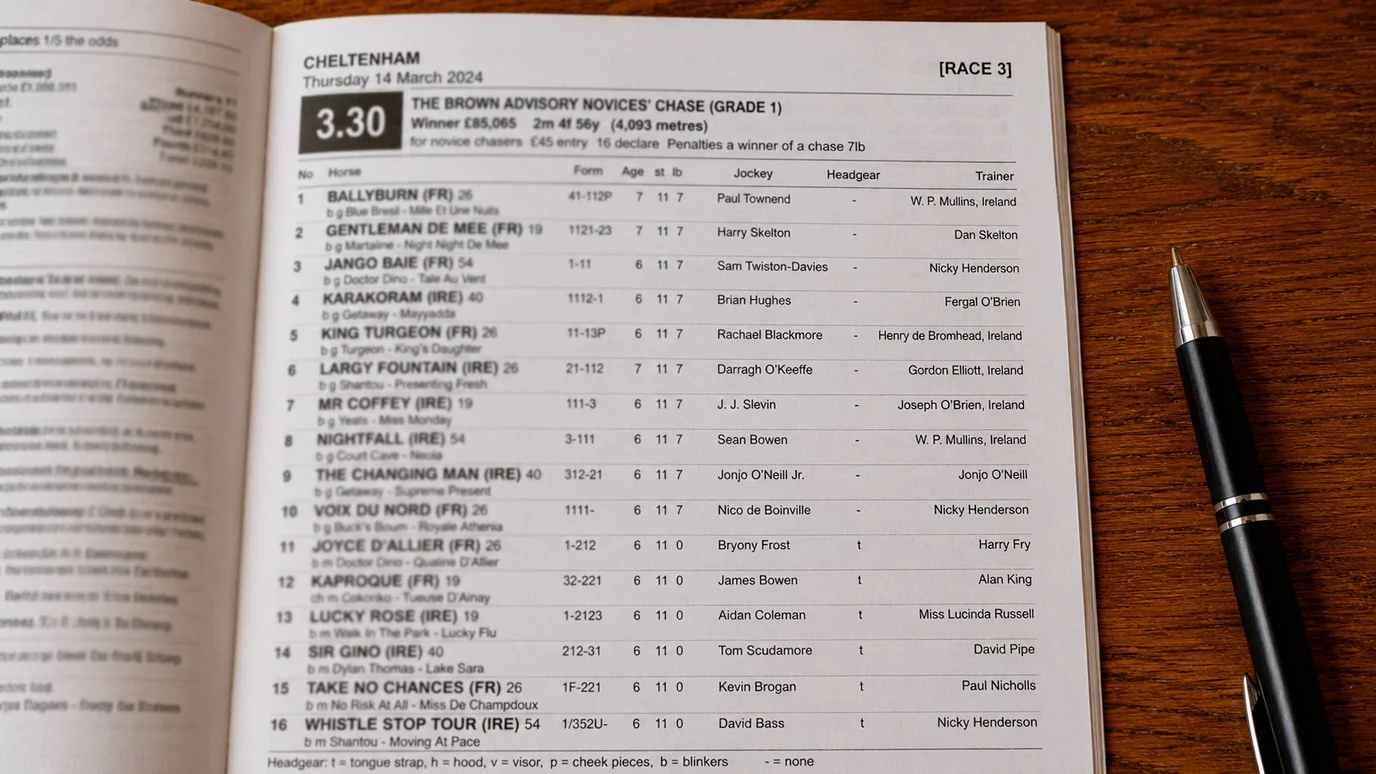
UK Racecard Data: Form Figures and Weight Markers
Brant Dunshea, CEO of the British Horseracing Authority, put the point well in late 2025: “There is undoubtedly an ever-growing desire for data among those consuming and betting on racing. As other sports continue to develop ways in which their fans can gain greater insights through use of real-time data, this is clearly an area in which racing can continue to evolve.” That data appetite is already met on a UK racecard – eight distinct informational layers stacked into a single line per runner, each layer carrying a specific weight for bet decisions. Punters who skim past the racecard miss most of what they’re paying for.
A UK racecard line condenses: form figures, weight carried, age, sex, jockey claim, headgear codes, going preference indicators, days since last run, and the official rating. Nine pieces of structured information, often laid out in less than a single visual line in the Racing Post or the operator’s racecard module. Reading those nine pieces properly is what separates a deliberate bet from a name-pick.
The good news is that the layout follows a strict convention. Once you know the order and the abbreviations, every UK racecard you’ll ever read becomes navigable. The bad news is that recreational punters rarely take the half-hour required to learn the convention, and instead make decisions based on the horse’s name and the layer’s morning price. That gap is the entire reason why morning markets are exploitable by punters who do the reading.
Decoding Form Figures
Form figures are the small numbers and letters next to each horse’s name showing recent finishing positions. They read right-to-left, most recent on the right. So a horse showing “4-321P” finished 4th two runs back, won the run before that, finished 2nd, then 3rd, then 1st, then pulled up in their most recent race.
The numeric codes are straightforward – 1 through 9 are finishing positions, 0 means tenth or worse. Once a horse finishes outside the top nine in any race, the form figure for that race is a zero regardless of whether they finished 10th or 22nd. That zero is doing more work than it looks like.
The letter codes are race incidents rather than positions:
F means fell. The horse hit a fence or hurdle and went down. Jumps-only code.
P means pulled up. The jockey withdrew the horse during the race, usually because something was wrong – tiring badly, lame, slipping, simply unwilling to continue. P is a serious negative form indicator; horses pulled up regularly are usually carrying issues.
U means unseated. The horse stayed up but the jockey came off – a different problem from a fall. Sometimes the result of a jumping error, sometimes a horse veering or bucking. Less negative than F because the horse itself stayed sound.
R means refused. The horse stopped at an obstacle and wouldn’t jump. Almost always a serious behavioural issue.
B means brought down. The horse was knocked down by a faller in front. Not the horse’s fault, doesn’t reflect on its ability, but counts as a non-completion in the form line.
The hyphen in form figures separates seasons. A horse showing “32-15” had 3rd then 2nd in one season, then a season change (often a code change between Flat and jumps), then 1st and 5th in the new season. The break is informational – it tells you the horse has had time off, possibly an operation, possibly a code switch.
Weight, Age and Sex Codes
The weight column shows the burden the horse is carrying, listed in stones-and-pounds format. A horse showing 9-7 carries nine stone seven pounds – 133 pounds total. Top weight in a handicap is typically 9-12 or 10-0 for Flat, 11-12 or higher for jumps where the heavier National Hunt weights apply.
The age is listed alongside the weight, typically as a small number. A 5 means five-year-old, 3 means three-year-old. Age is more important than recreational punters appreciate – different age groups peak at different distances, and the experience differential between a four-year-old and a seven-year-old chaser is significant.
The sex letter follows the age:
c = colt (entire male, under five years old).
h = horse (entire male, five and over).
g = gelding (castrated male of any age).
f = filly (female under five).
m = mare (female five and over).
Sex matters because the racing programme has sex-restricted races, weight allowances for fillies and mares against males, and breeding implications for older entires that influence their racing schedules. A gelding running a race where filly allowances apply doesn’t get the allowance. A mare running in a mares-only race has a structural advantage over fillies of the same rating in mixed-sex company.
Headgear Markers
Headgear codes appear after the horse’s name as letter abbreviations indicating equipment fitted for the race. The codes signal that the trainer has identified a specific behavioural issue and is trying to address it.
b = blinkers. Restrict the horse’s peripheral vision, forcing focus forward. Used on horses that look around too much or get distracted in races.
v = visor. Similar to blinkers but with a slit at the back allowing some side vision. Less restrictive than blinkers; sometimes a stepping stone before going to full blinkers.
h = hood. Covers the ears; muffles sound. Used on horses that get over-aroused in the parade ring or that race too keenly.
t = tongue tie. Holds the tongue down to prevent it being swallowed or getting under the bit. Often used on horses that have shown a wind issue or that have been pulling too hard.
e/s = eye shields. Less common than blinkers; partial vision restriction without complete side blocking.
The marker “1” after a headgear code (b1, v1, h1) indicates first-time application. First-time headgear is a major form signal – it tells you the trainer has identified a problem and is intervening. First-time blinkers, particularly, can produce dramatic form turnarounds either way. The market often shortens or lengthens prices noticeably on first-time-headgear runners depending on the trainer’s track record with the device.
Going and Distance Preference
Most modern racecards mark each runner’s going preference and distance fit with a small annotation. The form figures alongside often show only races at the relevant distance or on the relevant going, with the broader form available as a separate line. Reading these annotations alongside the headline form is one of the highest-value uses of racecard time.
A horse showing strong form on Good going and poor on Soft is a strong “drop on soft” signal – back away when the going changes. The reverse – strong on Soft and poor on Good – is the soft-ground specialist worth flagging. These specialist preferences create the most reliable form-based edges in handicap betting, because the going changes from race to race and the field’s composition of going-specialists varies.
Distance preference works similarly. A horse with winning form over a mile and poor form over seven furlongs is unlikely to win a seven-furlong race even at a tempting price. The data is there on the card; the reading is the punter’s responsibility.
The 2025 BHA racing report showed 82.2 per cent of UK races started within two minutes of their scheduled time, up from 79.2 per cent in 2024 and 72.7 per cent in 2023. Better timekeeping means more predictable going reports – Clerks of the Course have more reliable conditions data to work from when describing the surface, and that filters through to more accurate going preferences on the form lines.
Reading the Whole Card in 90 Seconds
The workflow I use for quick bet decisions in a UK race takes about ninety seconds per race. Six steps, none of them optional.
Step one – class and distance. What class is the race (1 to 7), what’s the distance, what’s the going? These set the context for everything else. A Class 4 handicap over a mile on Good is a fundamentally different race from a Class 2 conditions race over seven furlongs on Soft.
Step two – top of the weights. Who’s carrying top weight, what’s their rating, what’s their recent form? Top weight in a handicap is usually the rating-driven favourite and gives you the market’s anchor.
Step three – form figures across the board. Skim each runner’s last three runs. Identify horses with strong recent form, horses dropping after poor form, and horses on long absences.
Step four – headgear and equipment changes. First-time headgear is highlighted in racecard layouts. Note which horses have new equipment.
Step five – going and distance fit. Cross-reference each runner’s preferred going and distance against today’s conditions. Anything mismatched is a strike against.
Step six – official rating. The 16 per cent of UK males who bet in the last four weeks compared to 4 per cent of females (Wave 3 2025 figures) shows how much betting decision-making sits with one demographic, and that demographic tends to skip the rating column entirely. Don’t. The rating tells you what the handicapper thinks of the horse independent of recent results. Big gaps between rating and price are sometimes value, sometimes warning signs.
For the deeper read on how going specifically reshapes which horses are well-placed, the going piece walks through the ground-specialist patterns in more detail.
Racecard Questions
Two specific racecard codes generate consistent questions from new punters – the course-and-distance marker, and why some ratings appear in brackets.
Articles
Written by the editors at typesbethors.
